
Automotive
A stress crack is a non-impact crack that usually starts at the windshield edge and grows without any chip or point of contact. Long, straight cracks that begin at the frame typically mean replacement, not repair. Photograph the damage now, keep the glass away from sudden heat or cold, and get a professional inspection before it spreads further.
TL;DR:
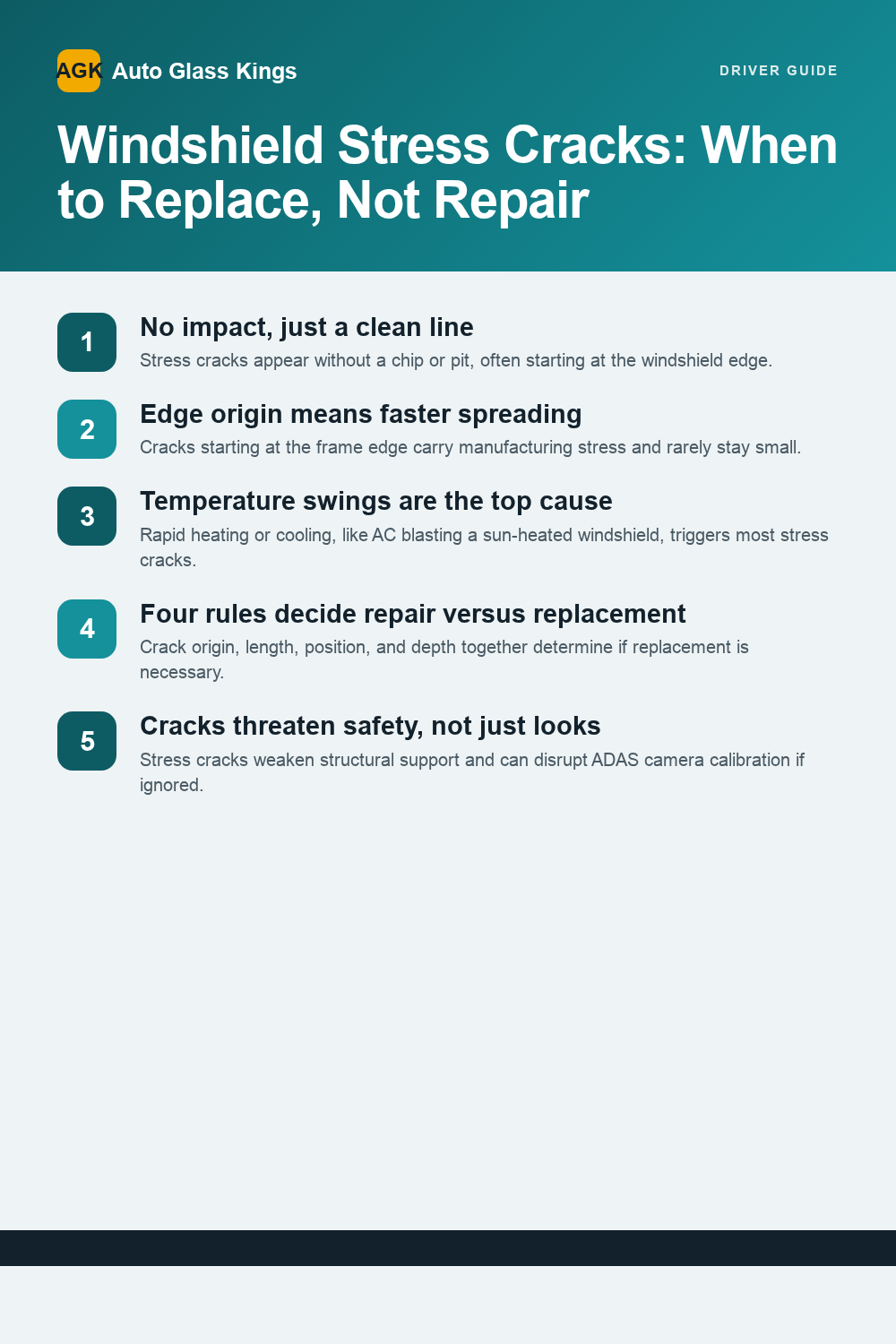
- Cracks originating at the windshield edge are more likely to spread quickly and generally require full replacement instead of repair.
- Rapid temperature swings, improper installation, or frame stress significantly increase the risk of stress cracks forming and worsening.
- Stress cracks compromise vehicle safety by weakening the windshield’s structural support and can impair ADAS functions if not properly recalibrated.
- Repair is usually feasible for small, short cracks away from the edge and outside the driver’s direct line of sight, but long or edge-starting cracks often need replacement.
- Getting a professional inspection and prompt replacement, including in-house ADAS calibration, helps prevent crack escalation and preserves resale value.
Table of Contents
- What Is a Windshield Stress Crack? How to Spot One
- Common Causes of Stress Cracks
- Why a Stress Crack Is More Than a Cosmetic Problem
- Repair vs. Replacement: The Rules That Actually Matter
- What a Professional Inspection and Replacement Actually Involves
- Immediate Steps and Prevention
- Stress Cracks vs. Other Cracks: Why the Repair Approach Differs
- Does a Stress Crack Hurt Your Car’s Resale Value?
- A Technician’s Honest Take on Owner Mistakes
- Get Your Windshield Fixed Right the First Time
- Sources
What Is a Windshield Stress Crack? How to Spot One
A stress crack looks nothing like the damage most drivers expect. There’s no chip, no pit, no shattered starburst where something hit the glass. Instead, you get a clean line, straight or gently curving, that seems to appear out of nowhere overnight or during a temperature swing.
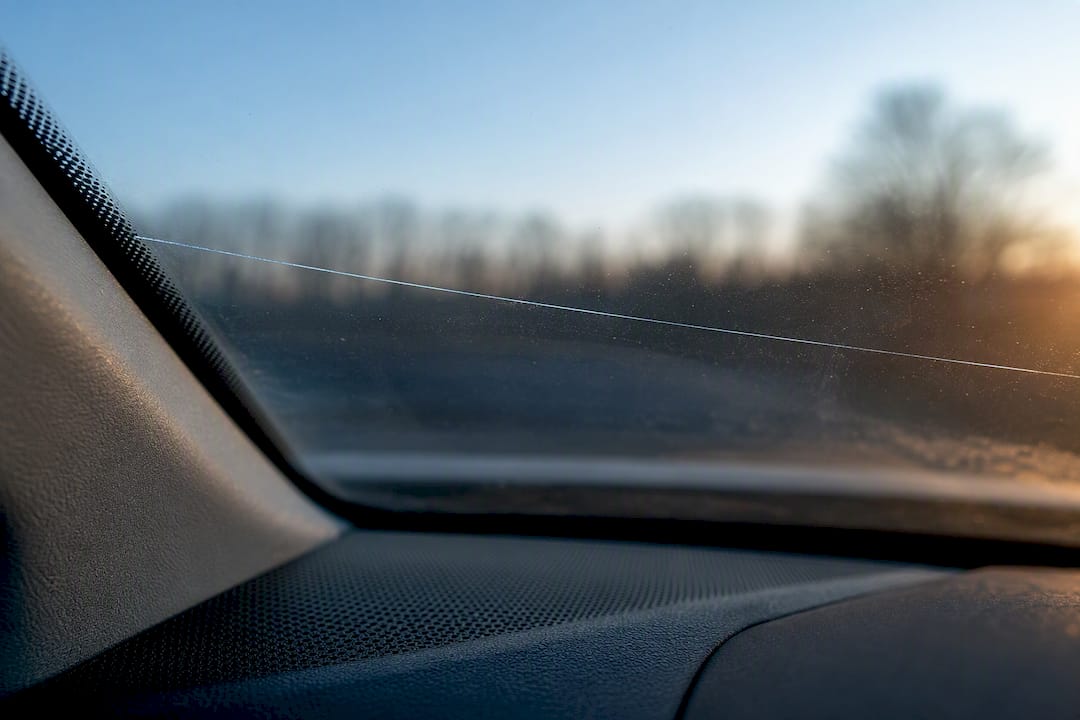
The tell is where it starts. Impact damage begins at a visible point, a small crater surrounded by radiating lines. A stress crack has no point of impact and commonly originates at or near the edge of the windshield, often close to where the glass meets the frame, a defroster vent, or a tint line.
Before you call anyone, run a quick check:
- Clean the area and look for a pit or crater. None usually means no impact.
- Trace the crack’s path. Does it run to the edge, or start there?
- Photograph it in daylight and again with a phone flashlight held at an angle. Angled light reveals depth and length better than a flat photo.
- Check for old chips nearby that might have gone unnoticed and slowly spread.
Edge origin matters more than most owners realize. Glass edges carry tiny manufacturing and installation stresses that make them the weakest point in the whole windshield, which is why a crack starting there rarely stays small.
Common Causes of Stress Cracks
Most stress cracks trace back to temperature, not trauma. Windshield glass expands and contracts with heat, and when one part of the glass changes temperature faster than the rest, it creates internal tension the glass can’t absorb.
The classic scenario: a car sits in full sun until the dashboard and glass are hot, then the driver cranks the AC to max. Or the reverse: a frozen windshield gets blasted with hot defroster air on a cold morning. Rapid temperature swings like these are a leading cause of stress cracks, and they can turn a barely visible flaw into a foot-long crack in seconds.
Thermal shock isn’t the only culprit. Consider these contributing factors:
- Improper prior installation. A windshield seated incorrectly, or with adhesive that cured unevenly, carries baked-in stress from day one.
- Frame and body stress. A car that’s been in a prior accident, or has a slightly warped frame or corroded pinch weld, can flex just enough to crack glass that would otherwise be fine.
- Manufacturing flaws. Lamination defects or microscopic edge chips from the factory sometimes surface as cracks within the first weeks or months of ownership.
Edge-origin cracks spread faster. Windshield edges accumulate micro-flaws from cutting, handling, and installation, which is why cracks starting there tend to escalate quickly instead of stabilizing on their own.
Why a Stress Crack Is More Than a Cosmetic Problem
A windshield isn’t just a window. It’s a structural panel that helps support the roof in a rollover and gives passenger-side airbags something solid to deploy against. A cracked windshield compromises that support exactly when you’d need it most.
Visibility is the more immediate concern for most drivers. A crack running through your sightline distorts light and creates a distraction that gets worse in rain, glare, or nighttime glare from oncoming headlights.
Modern vehicles add another layer: many forward cameras and sensors for lane-keeping, automatic braking, and adaptive cruise mount directly to the windshield. A poorly calibrated system after replacement can misread lane markings or following distance, and skipping recalibration can leave those systems misaligned in ways you won’t notice until they matter.
Quick guidance on driving with a stress crack:
- Short, careful trips to a repair shop are generally acceptable if the crack is small and away from your direct sightline.
- Avoid highway speeds and rough roads if the crack is long or growing.
- Never ignore a crack that crosses your driver-side sightline.
Pro Tip: Take a photo of any crack next to a ruler or coin for scale before your appointment. Technicians and insurance adjusters both move faster with a clear size reference.
Repair vs. Replacement: The Rules That Actually Matter
Four things decide whether a crack gets repaired or replaced: where it starts, how long it is, where it sits on the glass, and how deep it runs.
Chips smaller than about an inch across, and short cracks that don’t touch the edge or the driver’s direct line of sight, are often good repair candidates. Anything longer, anything starting at the edge, or anything sitting in the driver’s sightline usually points toward replacement. Cracks that begin at the edge tend to spread, which is exactly why repair resin rarely holds up on a true stress crack.
Insurance changes the math considerably. Comprehensive auto policies frequently cover windshield damage, and depending on your carrier and state, glass claims can sometimes be processed with little or no out-of-pocket cost. Some insurers waive the glass deductible entirely or carry separate glass coverage, so it’s worth calling your provider before assuming you’ll pay full price.
Cost factors worth knowing before you book anything:
- OEM-quality glass generally costs more than generic aftermarket glass but fits and performs closer to factory spec.
- ADAS recalibration adds time and cost but is often required, not optional, on newer vehicles.
- Mobile service eliminates a shop visit and lets you keep your schedule, without changing the underlying repair standards.
What a Professional Inspection and Replacement Actually Involves
A real inspection starts with a magnifier and sometimes a dye test to trace the crack’s exact origin and depth, followed by a check of the frame and pinch weld for prior damage or corrosion. Technicians photograph and document everything at this stage, which matters if you’re filing an insurance claim and need proof of the damage’s condition.
Replacement itself follows a set sequence: removing the old adhesive and glass, inspecting the pinch weld underneath, setting new OEM-quality glass, then sealing and allowing proper cure time before the car goes back on the road.
- Old adhesive and glass removed without damaging the frame.
- Pinch weld inspected for rust or prior repair work.
- New glass seated, sealed, and given cure time before driving.
- ADAS sensors recalibrated in-house where the vehicle requires it.
Pro Tip: Ask upfront whether recalibration happens in-house or gets outsourced. A separate appointment means a second delay and a second chance for something to go wrong in transit.
A lifetime warranty and direct insurance billing are two signals worth asking about anywhere you go. They tell you whether the shop stands behind its own adhesive and calibration work.
Immediate Steps and Prevention
- Photograph the crack today, in daylight and with a flash, before it changes.
- Skip the max-blast defroster and AC. Ease into temperature changes instead.
- Park in shade or a garage when you can, especially in summer heat.
- Keep moisture out of the crack with a strip of clear tape over the outside surface only, as a short-term measure.
- Drive gently. Avoid potholes, railroad tracks, and slamming doors, all of which flex the frame.
- Book a professional inspection rather than waiting to see if it “stays small.”
DIY resin kits have their place, but not here. Kits reliably work on small chips and short cracks away from the edge, yet manufacturers themselves generally limit kit use to damage under about an inch and recommend a professional for anything larger or in the driver’s sightline. A stress crack starting at the edge is exactly the case a kit isn’t built for.
Stress Cracks vs. Other Cracks: Why the Repair Approach Differs
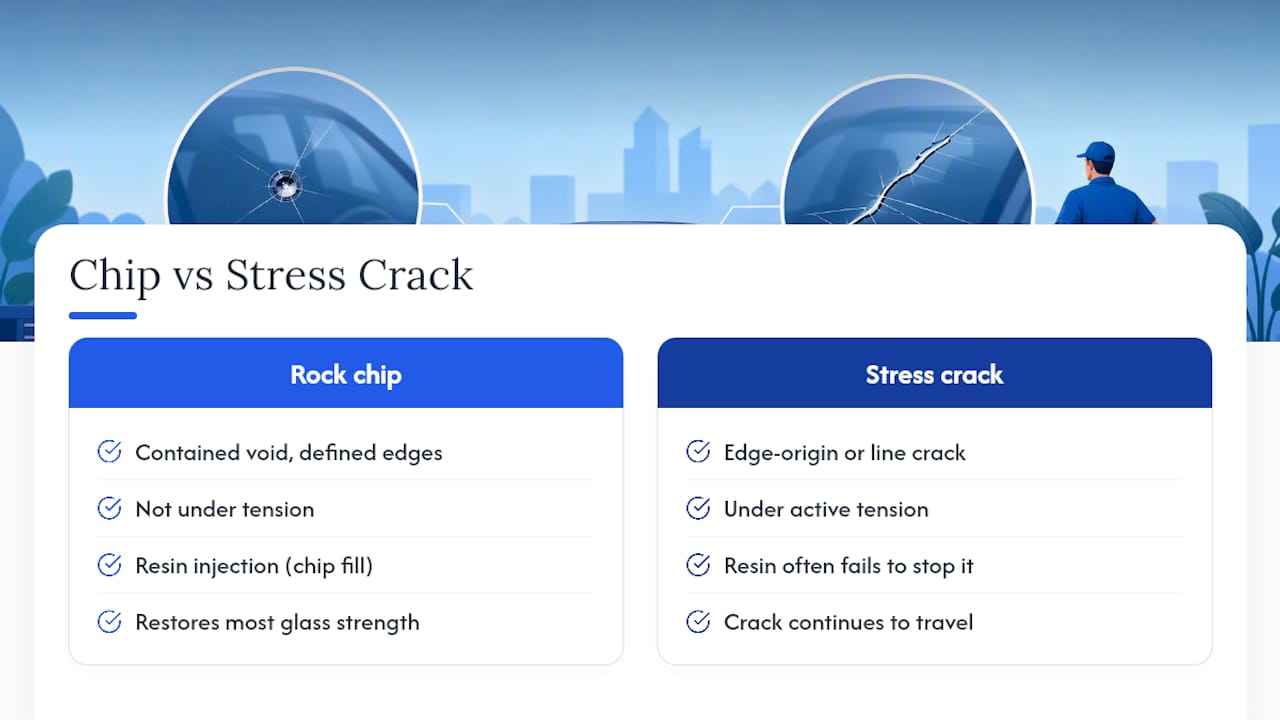
Repair technicians treat a stress crack differently from a rock chip almost from the moment they see it, and the reason comes down to physics, not preference. A chip repair injects resin into a contained void, a small pocket of broken glass with defined edges. The resin fills that space, cures under UV light, and restores most of the glass’s strength because the damage never had anywhere else to go.
An edge-origin stress crack behaves like a crack in a windshield under active tension. The glass is already trying to pull apart along that line. Injecting resin into a crack that’s still under stress often doesn’t stop it from continuing to travel, because the resin bonds the surfaces it touches but does nothing to relieve the pressure pushing the crack forward. That’s the core reason technicians steer stress cracks toward replacement far more often than toward repair.
Length plays into technique too. A short crack away from the edge might get a specialized long-crack resin injection, a more involved process than a simple chip fill, requiring a bridge tool and multiple resin passes. But once a crack exceeds roughly six inches, most technicians won’t attempt repair at all, regardless of where it started, because the structural math no longer favors resin over a full pane replacement.
Does a Stress Crack Hurt Your Car’s Resale Value?
Buyers notice cracked glass before they notice almost anything else about a car’s condition, and a windshield crack tends to read as neglect even when the rest of the vehicle is immaculate. It signals to a buyer, or to a dealer doing a trade-in appraisal, that other maintenance items might have been deferred too.
The bigger issue is what happens during inspection. Any prospective buyer running a pre-purchase inspection, and any dealer appraising a trade-in, will flag windshield damage as a line-item deduction. On a used vehicle listing, that deduction often exceeds the actual repair cost, because buyers price in the hassle and the uncertainty of unresolved damage, not just the glass itself.
Fixing it before you sell or trade in almost always pays for itself. A freshly replaced windshield with documented OEM-quality glass and a warranty on file removes the question mark entirely, and it lets you list or negotiate from a position of “this car has no outstanding issues” rather than explaining away a crack during every showing.
A Technician’s Honest Take on Owner Mistakes
The mistake I see most often isn’t ignorance, it’s optimism. Owners watch a hairline crack for weeks, hoping it stalls, while temperature swings quietly push it further. Two things fix that: a fast professional inspection and honest ADAS recalibration guidance, not guesswork.
— Matt
Get Your Windshield Fixed Right the First Time
Autoglasskings handles the entire stress-crack problem in one mobile visit, without shuffling you between a glass shop and a separate calibration center. Its technicians inspect the crack, replace the glass with OEM-quality materials, and complete ADAS recalibration in-house on the same appointment, which cuts out the second stop most competitors require.

Some installers offer a lifetime warranty on their work and may bill insurance carriers directly, potentially reducing out-of-pocket costs for customers. Early-morning mobile appointments can help avoid losing a workday waiting around. If that crack near your windshield edge has you wondering whether it’s time to replace rather than wait, book a windshield replacement and get an inspection scheduled before the crack decides your timeline for you.
Sources
- Can a Cracked Windshield Be Repaired? – Nationwide
- Does car insurance cover cracked windshields? – Policygenius
- DIY windshield repair tips – Popular Mechanics
Recommended
- Auto Glass Replacement: A Complete Guide for US Drivers
- Auto glass replacement: 7 common mistakes to avoid
- Top 5 Benefits of Mobile Windshield Repair Near You
- Windshield Chip Repair Orange County
🎧 Listen to This Article
Share
Recent Posts

October 27, 2026
Windshield Frit Band: What the Black Edge Does
What is the black band and dot pattern around your windshield? Learn what frit is, why it matters for adhesive bonding, and what...

October 26, 2026
Heads-Up Display Windshield: What Changes When You Replace It
A HUD windshield is built differently from standard glass. See how it works, what to check before replacement, and why calibration matters in...
October 25, 2026
Lifetime Windshield Warranty: What It Covers and What It Doesn’t
A lifetime windshield warranty rarely covers everything. Learn what it should include, what it excludes, and how ADAS calibration and insurance fit in....