
Automotive
OEM glass is made for your automaker to its exact specifications and usually carries the automaker’s logo. OEE glass is made by independent suppliers to equivalent standards, without the logo. On a car with no driver-assistance cameras, the two are often hard to tell apart in daily use. On a car with lane-keeping, automatic braking or a camera behind the mirror, the choice matters a lot more, because the glass is part of the sensor system.
This guide explains the real differences, where the marketing stops and the engineering starts, and what to ask before anyone cuts out your windshield.
TL;DR
- OEM is the same glass, from the same supplier, that your car had at the factory. OEE is built to equivalent safety standards by an independent maker, minus the automaker’s license and logo.
- For cars without ADAS, quality OEE glass is a sound, lower-cost choice. For cars with a forward camera, OEM is the safer bet, and some automakers require it.
- The risk with ADAS is not clarity. It is the fit of the camera bracket, which can stop a calibration from completing.
- In California, you choose your glass shop, and an insurer must disclose in writing before using aftermarket glass. Ask for that disclosure.
- Whichever glass you choose, calibrate after installation, and ask the shop to do it in the same visit.
Table of Contents
- What OEM and OEE actually mean
- Is OEE glass as good as OEM?
- Why ADAS changes the answer
- A quick decision guide
- What it costs, and who pays
- Your rights in California
- Our perspective
- Questions to ask any shop before you say yes
- Book glass and calibration in one visit
- FAQ
- Sources
What OEM and OEE actually mean
Automotive glass falls into three basic categories: original equipment, original equipment equivalent and aftermarket. Here is the practical meaning of each.
OEM (Original Equipment Manufacturer). When automakers build a model, they bid out the right to supply the glass, and the winning supplier fabricates it to the carmaker’s exact specifications. That is the glass in your car when it leaves the factory. It often carries the automaker’s logo.
OEE (Original Equipment Equivalent). This glass is manufactured to the same safety and production standards but typically by independent suppliers, without the vehicle brand’s license or logo. It is designed to match the original in shape, thickness and fit.
Aftermarket. A broader, looser term. Quality ranges widely, which is why “OEE” exists as a label for the better end of the market. In everyday shop talk, people often use “aftermarket” and “OEE” interchangeably, so ask what exactly is being quoted.
| OEM | OEE | |
|---|---|---|
| Made by | The automaker’s original supplier | Independent supplier |
| Automaker logo | Usually yes | No |
| Built to | Automaker’s proprietary specs | Equivalent standards |
| Typical cost | Higher | Lower |
| Best fit | ADAS cars, newer models, leased vehicles | Older cars, no camera or sensor behind the glass |
Is OEE glass as good as OEM?
For many cars, yes, it is good enough that you would not notice. The clear glass, the laminate layers and the safety certification can all be equivalent. The differences show up in the details:
- Logo and markings. The most visible difference, and a cosmetic one.
- Acoustic layer and tint. Many vehicles use sound-dampening laminate or specific tint bands. Verify that your replacement has the same features as your original. Owners on enthusiast forums regularly ask this, and it is a fair question for any quote.
- Fit tolerance. Even small differences in curvature or edge dimensions can show up as wind noise or water leaks if the installer does not catch them.
- Camera bracket and optical zone. This is where the comparison stops being cosmetic.
If you drive an older car with no cameras, the bigger variable is usually the installer’s skill and the urethane they use, not the label on the glass.
Why ADAS changes the answer
The windshield used to keep the rain out. Now it holds a camera in a precise position and lets that camera see through it. Glass makers describe the modern windshield as a critical piece of safety technology that supports the sensors behind features such as lane-keeping and emergency braking.
That has three practical consequences.
The bracket is the weak point
Calibration is not only software. It depends on the physical position of the camera mount bonded to the glass. Industry technical writing notes that OEM glass is made with proprietary tooling for these brackets that independent manufacturers are often not privy to. A slight misalignment can leave the camera unable to calibrate even when the glass is optically perfect. The result is a persistent warning light or a safety feature that stays disabled.
To be fair, this is a risk, not a guarantee. Plenty of OEE windshields calibrate fine. But with OEM you remove one variable, and with a safety system that is worth something.
Some automakers require OEM
Ford has told repairers that only its OEM replacement glass provides the fit, function, safety and structural integrity it expects for the repair. Subaru has required OEM glass for models with its EyeSight system. If your owner’s manual or the automaker’s repair guidance says OEM, follow it. It can also matter if your car is leased or still under warranty.
Calibration is non-negotiable either way
OEM glass does not excuse you from calibration. Any windshield replacement on a camera-equipped car should be followed by it. Our ADAS calibration page explains the static and dynamic methods, and our guide to ADAS calibration costs covers what drives the price. Teslas have their own process, covered in our Tesla camera calibration guide.
A quick decision guide
Use this as a starting point, then confirm with your automaker’s guidance.
- Does your windshield have a camera, rain sensor, heads-up display or heating element? If there is a camera or HUD, lean OEM.
- Does your automaker require OEM glass for ADAS repairs? If yes, it is not really a choice.
- Is the car leased or under warranty? Lean OEM to avoid disputes.
- Is it an older car with no sensors, and the OEM price is steep? Quality OEE is reasonable.
- Is the vehicle a classic or high-end model? Availability varies; ask what can be sourced before assuming.
For a deeper look at matching glass to HUD and sensors, see our piece on OEM vs aftermarket glass for HUD and ADAS.
What it costs, and who pays
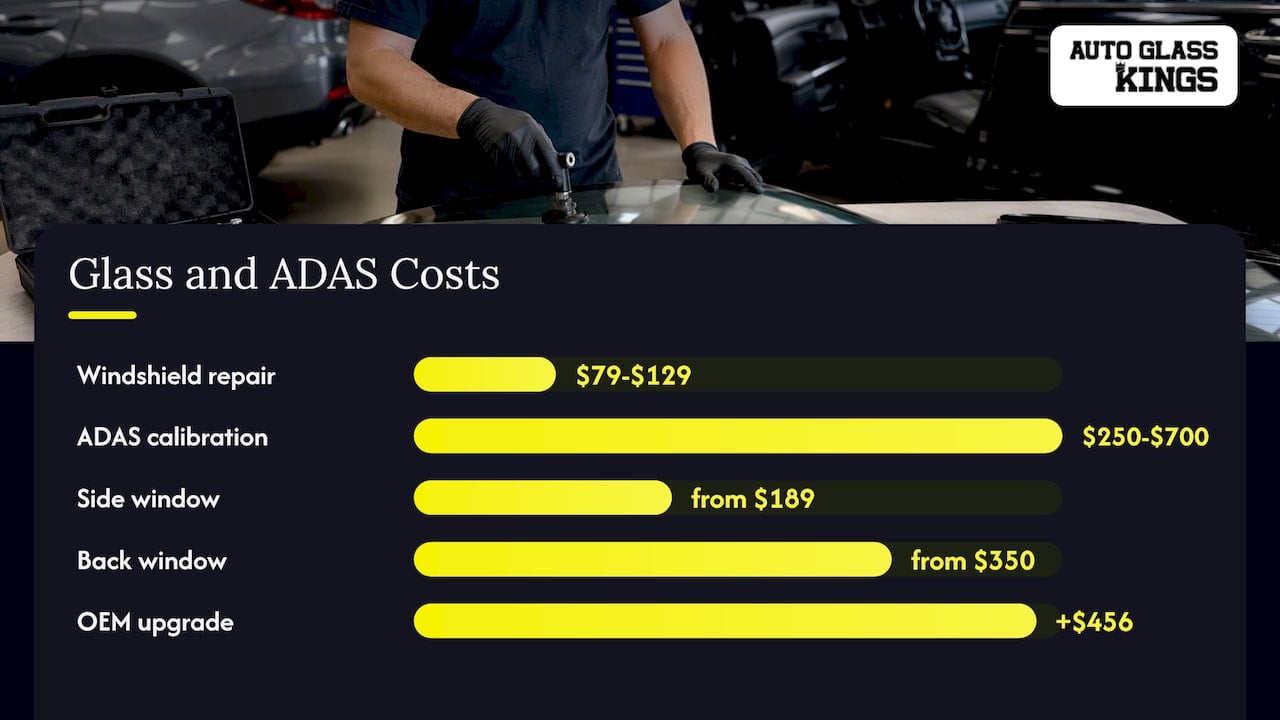
OEM glass usually costs more. One driver in a public forum thread described being offered the option to pay an extra $456 through their insurer to upgrade to OEM. That is one anecdote, not a rule, and the gap varies by vehicle, so get the exact figure for your car in writing.
Our own published pricing for related work: windshield repair runs $79 to $129, and ADAS calibration runs $250 to $700 depending on the vehicle. Side window replacement starts from $189 and back window replacement from $350. Windshield replacement pricing depends on the vehicle and glass, so we quote it per car. For how insurance changes the math, read what you’ll pay for windshield replacement with insurance.
Your rights in California
California gives drivers more leverage than many realize.
- You choose the shop. Under Insurance Code §758.5, an insurer cannot force you to use its preferred glass shop.
- You get disclosure. California’s Business and Professions Code requires insurers to give written disclosure before aftermarket crash parts are used on a repair. You have the right to know what glass goes in your car.
- Ask before the work starts. If you prefer OEM, say so when you file the claim and ask for the disclosure in writing. Whether your policy pays for OEM, or you cover the difference, depends on your policy. Call your agent or read your glass coverage terms. If you have full glass coverage, ask whether OEM is covered at the insurer’s discretion.
This is general information, not legal advice. If an insurer pushes back on your choice of shop or glass, the California Department of Insurance is the body to contact.
Our perspective
We replace glass for Orange County drivers every day, and the pattern is consistent. The glass label is rarely the problem. The trouble starts when a car with a camera gets a windshield installed in one place and is sent somewhere else for calibration, or told to “just drive it.” Two appointments, two chances for it to go wrong.
So we do it differently. We do the glass and the required ADAS calibration ourselves, on-site, in a single visit, with OEM-quality materials and a lifetime warranty on every install. We start from 5 AM daily because most people cannot lose a workday over a windshield. And we bill insurance directly, so many customers pay nothing out of pocket.
Our advice on OEM vs OEE is simple. If your car has a forward camera or a heads-up display, we steer you toward OEM, or at minimum glass we can verify will calibrate. If it is a simpler car, we will tell you honestly where OEE makes sense. We would rather you have a working safety system than a bigger invoice.
— Auto Glass Kings
Questions to ask any shop before you say yes
- Is the glass OEM, OEE or aftermarket, and who manufactured it?
- Does it carry the same acoustic layer, tint and HUD zone as my original?
- Will calibration be done at the same visit, and where?
- Do I get proof of the calibration, such as a report?
- What does the warranty cover, and for how long?
- Is it a one-off promise or in writing?
A shop that answers these plainly is a shop worth trusting. A shop that cannot say who made the glass is not.
Book glass and calibration in one visit
If your windshield is cracked and your car has driver-assistance features, we come to your home or workplace anywhere in Orange County, replace the glass and complete the calibration on-site. See our windshield replacement service or contact us through the site to get a quote for your exact vehicle. If it is only a small chip, windshield repair may be all you need, and it is far cheaper.
FAQ
Is OEE glass as good as OEM?
On vehicles without cameras or sensors, quality OEE glass is generally an acceptable equivalent, built to similar safety standards. On ADAS vehicles, the fit of the camera bracket can affect calibration, so OEM is the lower-risk option. Check your automaker’s guidance first.
What is the difference between OEE and OEM glass?
OEM glass is made by the automaker’s original supplier to its proprietary specifications and usually carries the automaker’s logo. OEE glass is made by an independent supplier to equivalent standards, without the license or logo. Features like acoustic layers and brackets should be confirmed for each.
Does my insurance have to pay for OEM glass?
Not necessarily. Coverage depends on your policy, and some insurers pay for OEM only in certain situations or if you cover the difference. California law does let you choose your own shop and requires written disclosure before aftermarket glass is used, so ask for it up front.
Do I need ADAS calibration with OEE glass?
Yes. Calibration is needed after any windshield replacement on a camera-equipped car, whatever the glass type. With OEE glass, a calibration that will not complete can point to a bracket fit problem, which is worth catching on the day.
Sources
- ADAS Education Series: OE vs OEE vs Aftermarket (Opti-Aim)
- The Enhanced Role of OEM Glass in the Age of ADAS (On Target)
- OEM Glass and Aftermarket Glass 101: A Comparison (MOTOR)
- Ford stresses importance of installing OEM glass (Repairer Driven News)
- Subaru Requires OEM Glass for Windshield Replacement (AGSC)
- Advanced Driver Assistance Systems (Pilkington)
- California Business and Professions Code, Chapter 20.1 (Legislative Information)
Recommended
- Match Glass to Your Sensors: OEM vs Aftermarket for HUD and ADAS
- Auto Glass Replacement in the US: What You Need to Know
- Auto glass replacement: 7 common mistakes to avoid
- The Cost Difference Between Windshield Repair and Replacement
🎧 Listen to This Article
Share
Recent Posts

October 27, 2026
Windshield Frit Band: What the Black Edge Does
What is the black band and dot pattern around your windshield? Learn what frit is, why it matters for adhesive bonding, and what...

October 26, 2026
Heads-Up Display Windshield: What Changes When You Replace It
A HUD windshield is built differently from standard glass. See how it works, what to check before replacement, and why calibration matters in...
October 25, 2026
Lifetime Windshield Warranty: What It Covers and What It Doesn’t
A lifetime windshield warranty rarely covers everything. Learn what it should include, what it excludes, and how ADAS calibration and insurance fit in....