
Automotive
Optical distortion is the warping, waviness or stretching you see when you look through a windshield and the road no longer keeps its true shape. A little of it at the far edges of the glass is normal, even on brand-new factory glass. Distortion in the center of your view, where you look while driving, is not something to live with. Fixing it starts with knowing which kind you have. Here is how to tell the difference, what causes it, and what to do next, whether you’re in Orange County or anywhere else.
TL;DR
- Mild “cross-car” waviness when you look through the edge of the windshield at a sharp angle is normal. NHTSA has said so in a technical bulletin about windshields from all manufacturers.
- Distortion in the area straight ahead of the driver, or anything that causes double images, headaches or trouble judging distance, deserves attention before you keep driving on it.
- Causes include how the glass was curved and laminated, where on the glass you’re looking, and the quality of the glass itself. Moisture trapped in the laminate can also be a factor.
- A two-minute check against a straight-lined background tells you a lot. Do it parked, in daylight, before you decide anything.
- On cars with driver-assistance cameras, the glass in front of the camera matters too, and a calibration after replacement is part of getting the view right.
Table of Contents
- What optical distortion in a windshield actually is
- Is it normal for a new windshield to have distortion?
- Why the center of the glass is held to a tighter standard
- What the law requires
- What causes distortion in laminated glass
- How to check your windshield for distortion
- When distortion becomes a safety issue
- Distortion, cameras and ADAS
- Special cases: classics, high-end cars and side glass
- What you can do if your new windshield looks wrong
- Perspective: why glass quality and calibration belong together
- Need the glass looked at or replaced?
- FAQ
- Sources
What optical distortion in a windshield actually is
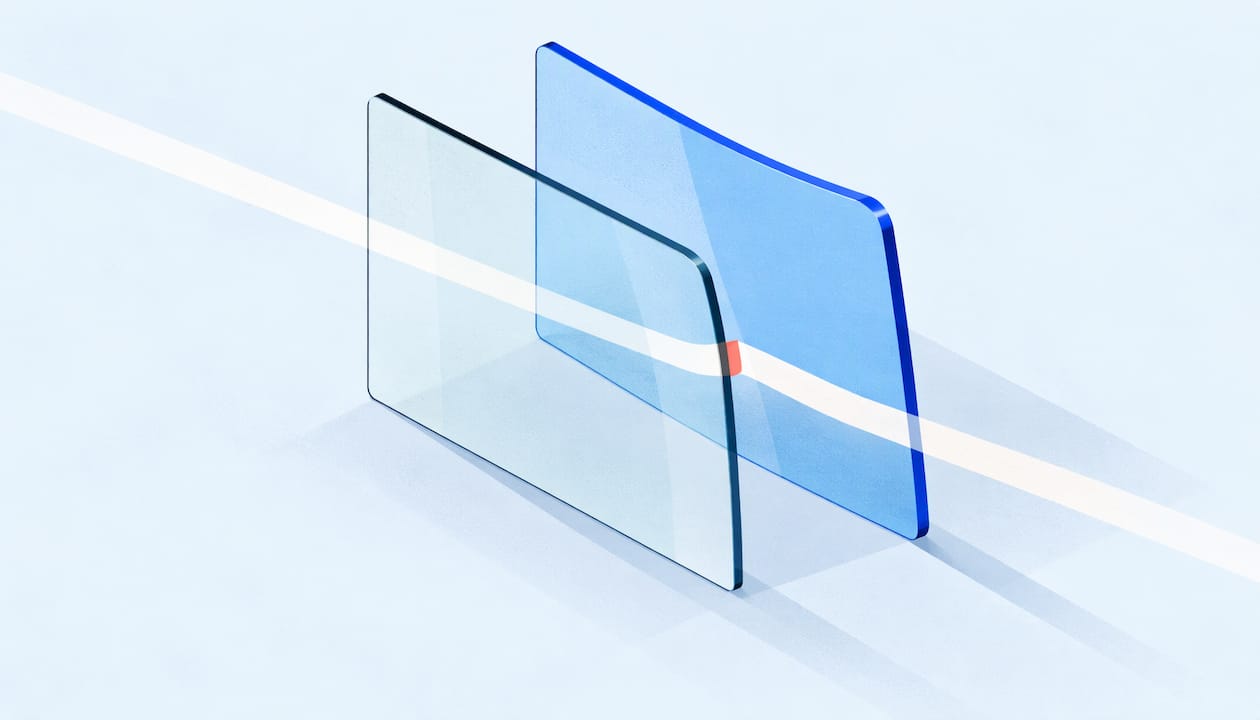
Glass bends light. On a flat pane of uniform thickness, that bending is invisible. A windshield is neither flat nor a single layer: it is curved in two directions and made of two sheets of glass with a plastic layer between them. Any tiny variation in thickness, curvature or the bond between layers changes the angle the light travels, and your eye reads that as a wave, a bend or a stretched reflection.
Engineers measure this as refractive power: how much the light’s direction changes over a given distance, expressed in diopters. A patent describing windshield production explains that large production lines scan each piece of glass and produce a contour map of distortion, and that at a high enough level the result becomes noticeable to the eye. Ansys, which makes optical simulation software, describes the same idea: the test compares the deflection angle of light rays across the glass and divides by distance.
You don’t need the math. You need to know that distortion is a property of the glass, that it varies from one part of the windshield to another, and that where it sits matters more than how much of it there is.
Is it normal for a new windshield to have distortion?
Yes, in a limited form. The National Highway Traffic Safety Administration (NHTSA) is the federal agency that regulates vehicle safety. In a 2016 technical bulletin, VST-16-01, it describes “cross-car distortion”: wavy images you see when looking through the side of the windshield at an angle. The bulletin says this occurs in windshields from all manufacturers, has existed since curved glass arrived in the 1950s, and is acceptable within industry specifications. It also advises against replacing a windshield for that condition alone.
Note what that covers. It describes waviness seen at an angle, toward the sides. It does not describe a ripple straight ahead of you or a double image of a taillight.
A simple way to think about it:
| Where you see it | What it usually means | What to do |
|---|---|---|
| Far edges or corners, only when you look sideways through the glass | Normal cross-car distortion | Nothing; it is part of curved glass |
| Near the black dotted band around the edge | Common, because the glass bends most there | Usually nothing unless it reaches your line of sight |
| Center of the driver’s view, visible while looking straight ahead | Outside what you should accept | Have the glass inspected |
| Double images, shimmering lines, or a lens-like bulge | Quality or installation concern | Have the glass inspected |
Why the center of the glass is held to a tighter standard
On a modern car the windshield is steeply raked, so you look through it at a shallow angle rather than straight on. That makes small imperfections more visible than they would be on a vertical pane. Distortion testing is therefore done with the glass at its installed angle and the observer placed at the driver’s eye position. The glass is divided into zones, and the area of the driver’s primary view is held to the tightest limits.
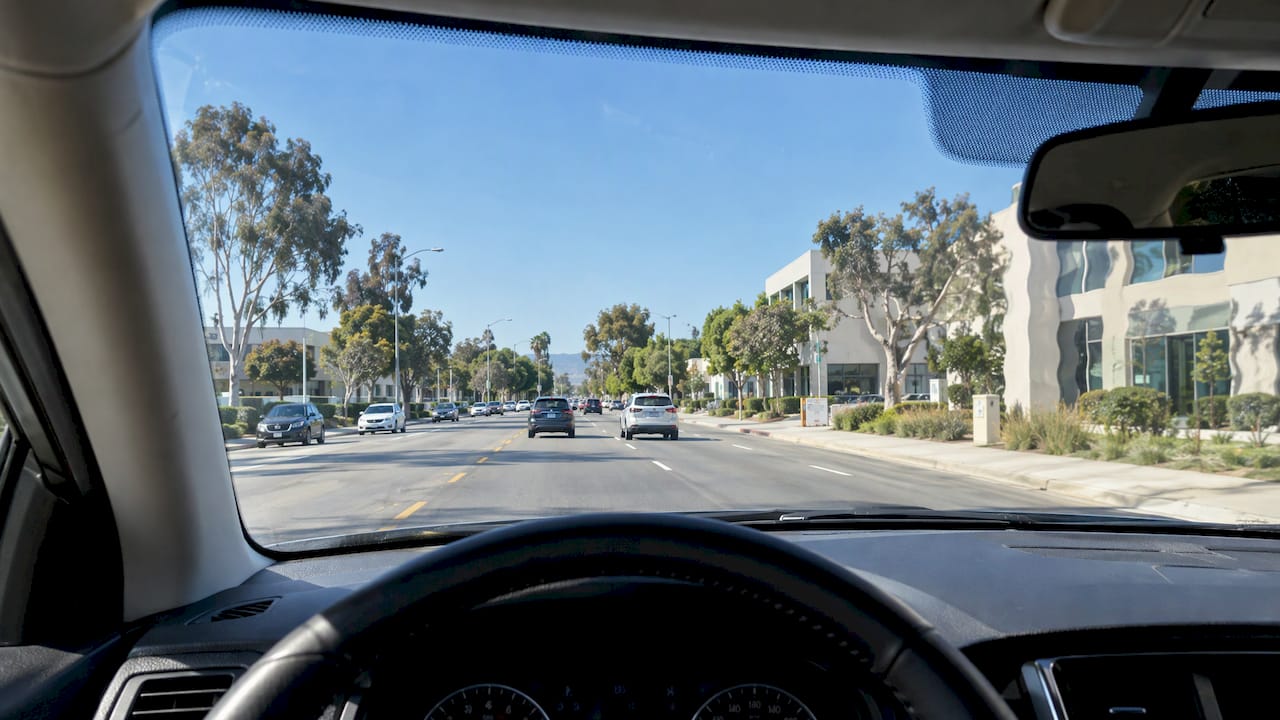
That is why a faint wave at the edge is shrugged off while a wave in your main field of view is a legitimate complaint. The same logic applies when a vehicle manufacturer writes its own specification: it can be stricter than the legal minimum, particularly for the part of the glass a camera looks through.
What the law requires
Under 49 CFR 571.205, known as Federal Motor Vehicle Safety Standard (FMVSS) No. 205, glazing used in motor vehicles must conform to the ANSI/SAE Z26.1-1996 standard, and replacement glass sold in the aftermarket must meet FMVSS 205 as well. The standard’s stated purposes include reducing injuries from impact with the glass and ensuring enough transparency for the driver to see.
That last purpose is where distortion and visibility meet. If you want the detail on light transmission, checking tint’s visible light transmission explains the 70 percent visible-light-transmission requirement that applies to glass needed for driving visibility and why the number matters at night.
Two practical takeaways:
- A legitimate replacement windshield carries markings in a lower corner showing it was made to the safety standard. Look for them on yours.
- The standard was written long before today’s camera-based safety systems. Windshield Advisor’s April 2026 technical analysis notes that the referenced standard has no provisions for camera sensor performance, and reports that carmakers set their own optical requirements for the camera zone, often far tighter than a general-purpose limit.
If you drive a newer car, that second point is the one to remember.
What causes distortion in laminated glass
A windshield is laminated: two layers of glass bonded around a clear plastic interlayer. Distortion can come from several places.
Bending. Flat glass is heated and shaped over a mold. If the heating or the mold isn’t perfectly even, the surface picks up tiny ripples. Windshields that curve sharply, or that have to include a camera area, a heads-up display zone or a heated section, are harder to make perfectly.
Lamination. The interlayer has to be uniform in thickness and bonded cleanly. Variations here show up as a faint lens effect. Production lines scan finished windshields for this, which is why consistent glass quality matters.
The dark band around the edge. The black ceramic print and dots at the perimeter hide the adhesive and help the glass handle heat. Glass near that band bends more, which is why distortion tends to be strongest right there. The patent cited above notes that the way the band is applied can affect distortion near it.
Moisture in the laminate. Moisture or a damaged edge seal can swell the interlayer locally and produce a patch of distortion that wasn’t there on day one.
Your viewing angle and your sunglasses. Polarized lenses can reveal stress patterns in glass that are invisible without them. A pattern that appears only through polarized lenses is not something you’d see in normal driving.
Installation. Distortion is mostly a glass-manufacturing matter, but how the windshield sits in the opening matters too. Uneven adhesive or pressure during setting can change how the glass is seated, and it is one reason a careful technician matters. Aftercare in the first days also counts; our 48 to 72 hour windshield aftercare guide covers what to avoid while the adhesive cures.
How to check your windshield for distortion
This check needs a parked car, daylight and about two minutes.
- Park facing a straight-lined background. A garage door, a tiled wall, a fence or a building with clear vertical and horizontal lines works well.
- Sit in the driver’s seat in your normal driving position. Look straight ahead through the area in front of you.
- Move your head slowly a few inches left and right, then up and down. Watch the straight lines. Do they stay straight, or do they ripple, bow or jump?
- Look at a distant, high-contrast object, such as a utility pole or a light post. A double image or a stretched shape is a red flag.
- Repeat from the passenger seat and through different parts of the glass. Edge distortion that disappears as you look closer to center is the normal kind.
- Do a second look at dusk or in rain. Streetlights and wet glass exaggerate problems that are subtle at noon.
- Photograph what you see with your phone held where your eyes would be. It helps if you later describe the issue to a technician.
Also compare with a car you know well. If you recently had a windshield replaced and the view feels different from the old one, trust that impression and note where on the glass it shows.
When distortion becomes a safety issue
Distortion matters when it interferes with seeing the road clearly. Signs that it does:
- Eye strain or headaches after short drives
- Trouble judging distance or the position of other cars
- Road lines or signs that seem to bend as you move your head
- Double images of lights at night
- A sense of motion sickness only in this car
If you notice these, stop driving on it for anything beyond essential trips until the glass has been inspected. If symptoms persist even in other cars, see an eye doctor: vision changes can look like a windshield problem and aren’t.
Cracks and chips can cause their own local distortion because they break up the glass’s surface. Small chips are best dealt with early. A chip repair is far cheaper than a replacement, and our windshield repair page lists a published price range of $79 to $129. Pitting from years of road debris produces a hazy, sandblasted look instead of waves, and we explain why polishing isn’t the answer for pitted glass in a separate guide.
One more point: don’t try to fix distortion by polishing. Polishing removes glass and can create new distortion. Our guide on windshield polishing after replacement explains why.
Distortion, cameras and ADAS
Many cars built in the last several years have a camera mounted behind the windshield that watches lane lines, signs and vehicles ahead. This camera sees the world through the same glass you do. Distortion that is tolerable to your eye can still confuse a camera, because the camera’s software expects the light to arrive the way the original glass delivered it.
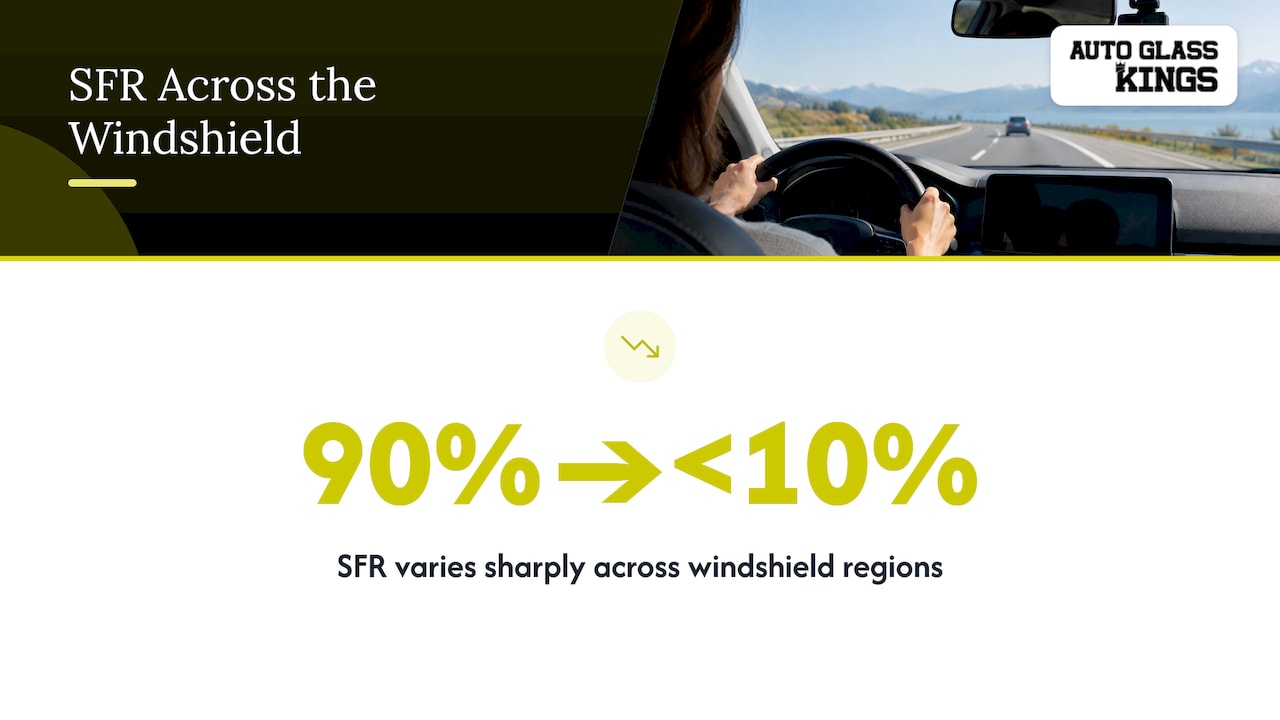
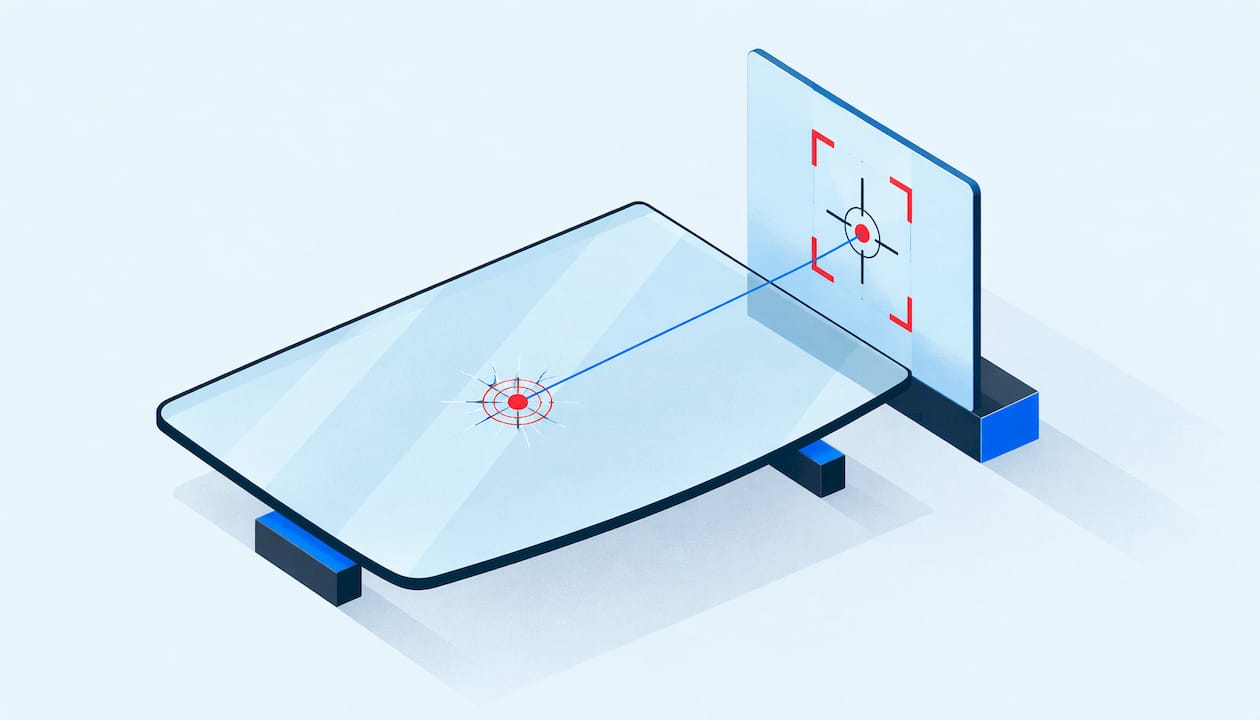
Windshield Advisor’s April 2026 analysis cites measurements showing that a sharpness metric called SFR can vary from around 90% to below 10% across different regions of the same windshield. In plain terms: the camera’s patch of glass is the part that has to be right.
This is the reason glass choice and calibration go together on newer vehicles. Our guide to OEM versus aftermarket glass for HUD and ADAS shows how to match the glass to the sensors on your car. After a windshield replacement, the camera also has to be recalibrated to its new position and view. Our guide on static versus dynamic ADAS calibration explains the two methods.
If you recently had a windshield replaced and a lane-keeping or collision warning light has appeared, treat that as a prompt to have calibration verified. Our ADAS calibration cost guide breaks down what affects the price, and ADAS calibration on our service page is listed at $250 to $700.
Special cases: classics, high-end cars and side glass
Classic cars. Older windshields were often made with less precise processes, and period glass can have its own character. If you’re restoring a classic, match the glass type to the car and expect the view to differ from a modern windshield.
High-end vehicles. Premium cars often have acoustic laminates, heads-up display layers, heated elements and multiple sensors. Each adds a layer of complexity, which is why part selection matters. We service a range of vehicles from classics to Teslas and Bentleys.
Side windows. Many cars now use laminated side glass for noise and security. Which cars have laminated side windows and why is covered in a separate guide. Distortion there is usually only noticed when looking at a reflection.
What you can do if your new windshield looks wrong
Start with your documentation: photos, the location on the glass, and the date of installation. Then:
- Run the check above to make sure the distortion is in your driving view, not just at the edges.
- Contact the installer promptly. Don’t wait weeks. Tell them where the distortion is and whether it affects your view.
- Ask which glass was installed and whether it is the OEM-spec type for your car.
- If you have an ADAS camera, report any warning lights as well as the view.
- If a claim paid for the replacement, tell your insurance contact too, since they can be part of the follow-up.
For a car that needs a new windshield in Orange County, we handle replacement on site, using OEM-quality materials, with a lifetime warranty on every install. Our windshield replacement service covers everything from the glass to the finishing.
Perspective: why glass quality and calibration belong together
We install windshields every day, and the most common question we hear about the view through new glass is whether it should look like that. The honest answer is that the edges can show some waviness on any curved glass, but the part you look through while driving should look clean and natural.
That is why we use OEM-quality materials and why we do not treat the glass and the camera as two separate jobs. A windshield that looks right to your eye still has to work for your car’s sensors. We complete all required ADAS calibration in-house, in a single visit, so you don’t have to chase down a second appointment or a dealership after the glass is in.
We start as early as 5 AM daily, because a clear view of the road is not something drivers should wait on. Every install carries a lifetime warranty, and we bill your insurance directly so that most customers pay nothing out of pocket.
Auto Glass Kings
Need the glass looked at or replaced?
If you’re in Orange County and your windshield is cracked, chipped or showing distortion in your driving view, we come to you at home, at work or at the school drop-off line. Mobile service is free, we handle ADAS recalibration in the same visit, and we can bill your insurer directly.
Book through our windshield replacement page, or start at autoglasskings.com to tell us about your vehicle.
FAQ
Is it normal for a new windshield to have some distortion?
Yes, mild distortion toward the edges is normal. NHTSA’s bulletin on the subject says cross-car distortion occurs in windshields from all manufacturers and is acceptable within industry specifications. Distortion in your straight-ahead view is different and should be looked at.
What is optical distortion?
It is a change in how light travels through the glass, so that straight lines look bent or objects look stretched, doubled or magnified. It is measured as refractive power, which describes how much the light’s direction changes over a distance, in diopters.
Can distortion affect my driver-assistance camera?
It can. The camera looks through a specific patch of the windshield, and the glass there needs to be clean optically. After glass replacement, recalibration sets the camera for its new view. Our ADAS calibration page explains how we handle it.
How can I test for windshield distortion?
Park facing a wall or garage door with straight lines. Sit in your normal driving position and slowly move your head side to side and up and down. Lines that stay straight in your central view are a good sign. Lines that wave, bow or double are not.
Should I keep driving if I see distortion?
If it is only at the edges, yes. If it makes it hard to judge distance, gives you headaches or doubles lights at night, have the glass inspected before regular driving. See an eye doctor if the problems follow you into other vehicles.
Sources
- NHTSA technical bulletin VST-16-01, Windshield Distortion
- eCFR, 49 CFR 571.205, Standard No. 205, Glazing materials
- Windshield Advisor, Aftermarket Windshield Tint and ADAS Camera Systems
- Ansys Optics, Windshield Optical Distortion Analysis
- US patent 10780674, automotive laminate with improved optical quality
Recommended
- Windshield Polishing After Replacement: What to Know
- 3 in and 14 in Repair Rules: Windshield Crack Types & ADAS Notes
- Drivers: Spot Windshield Delamination Before It Disrupts ADAS
- Stop Polishing: Windshield Pitting Repair for ADAS Drivers
🎧 Listen to This Article
Share
Recent Posts
November 18, 2026
Sticker Transfer on a Windshield: What Moves, What Doesn’t
Moving a windshield sticker to a new windshield or another car: which stickers can be reused, how to peel and reapply them, and...
November 17, 2026
Optical Distortion in a Windshield: What’s Normal, What Isn’t
Wavy or warped view through your windshield? Learn what optical distortion is, what causes it, what’s normal on new glass, and how to...
November 16, 2026
Calibration After Chip Repair: When You Need It
Does a windshield chip repair mean ADAS calibration? Learn when a chip near the camera calls for replacement, what that triggers, and how...