
Automotive
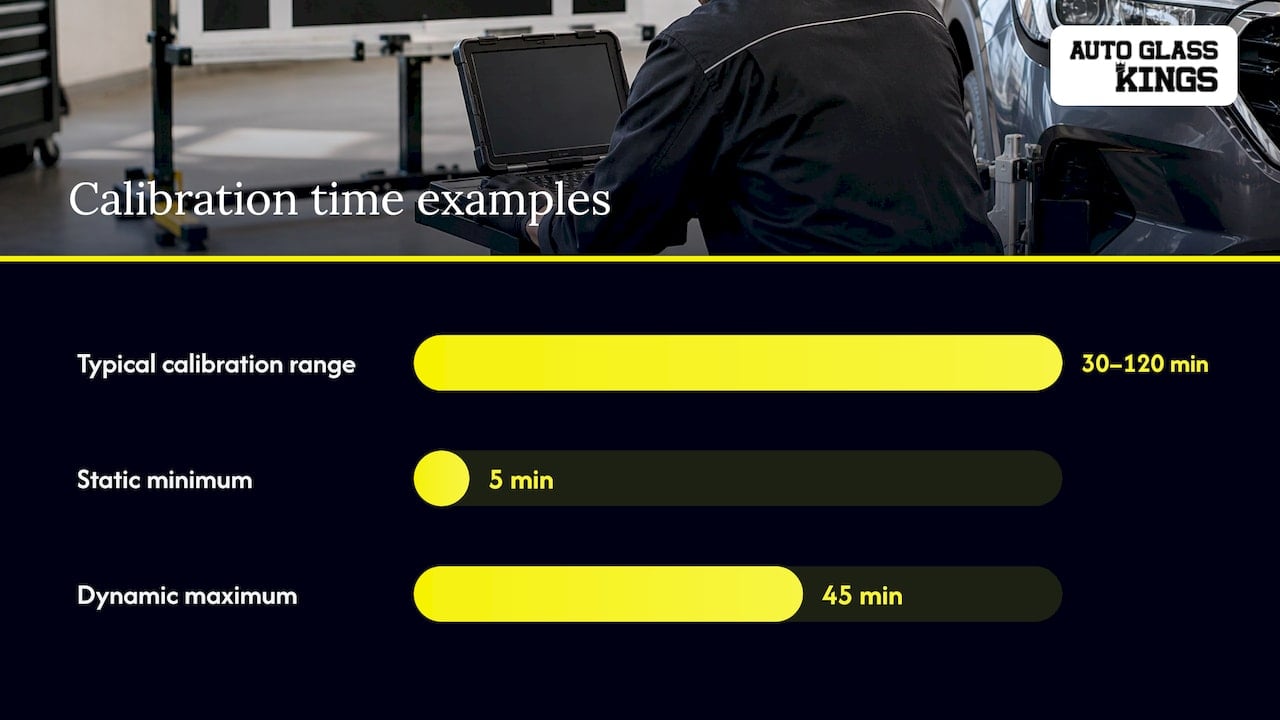
Most ADAS calibrations take between 30 minutes and 2 hours, according to the Auto Glass Safety Council (AGSC). The exact time depends on your vehicle, the type of calibration it needs, and the conditions on the day. Some static calibrations finish in minutes. Some dynamic or dual procedures take far longer. This guide shows what drives the number, so you can plan your morning, your carpool run or your workday around it.
TL;DR
- Plan on 30 minutes to 2 hours for the calibration itself, per AGSC. Some vehicles take less and some take more.
- Static calibration happens with targets and can be quick. Dynamic calibration needs a road drive, so traffic, lane markings and weather matter.
- The adhesive on a new windshield has a minimum drive-away time. Dynamic calibration cannot begin until it has passed.
- Problems like warning lights, tire pressure, uneven ground or poor lighting can stretch a job.
- At Auto Glass Kings, we do the glass and the calibration in one visit, at your home or workplace.
Table of Contents
- The short answer: 30 minutes to 2 hours
- Static, dynamic and dual: how the type changes the time
- What can make calibration take longer than expected
- The adhesive clock: why you cannot always calibrate right away
- How much time to set aside for the whole appointment
- Why the time is worth spending
- Book calibration and glass together in Orange County
- How to keep your calibration on schedule
- FAQ
- Sources
The short answer: 30 minutes to 2 hours
The AGSC, the industry body behind the ANSI auto glass standards, says calibration typically takes 30 minutes to 2 hours, depending on the vehicle and the equipment used. That is the range to keep in mind when you book.
There is no single universal figure, and anyone quoting one is simplifying. The make and model, the calibration type, the road test and the final system check all feed into the total. A compact sedan with a single forward camera is a different job from an SUV with a camera, radar and surround sensors.
Trade coverage shows how wide the spread can be. AGRR Magazine reported in 2023 that some static calibrations can be done in as little as 5 minutes, while some Subaru dynamic or dual calibrations can take as long as 45 minutes. The same article notes that a few vehicles need a static calibration followed by a dynamic one, which adds up.
Static, dynamic and dual: how the type changes the time
Every ADAS calibration falls into one of three families. Your owner’s manual or the repair information for your vehicle decides which one applies. We explain the differences in more detail in our guide to static vs. dynamic ADAS calibration.
| Type | How it works | What drives the time |
|---|---|---|
| Static | The vehicle sits in a controlled space while targets or patterns are placed at measured distances | Accurate target placement, level ground, lighting, a clear area |
| Dynamic | The vehicle is driven on suitable roads at set speeds so the system relearns its aim | Lane markings, traffic that allows required speeds, weather |
| Dual (static plus dynamic) | Both procedures, in the order the manufacturer specifies | The sum of both, plus the verification between them |
Static calibration
Static work is about setup. Once the targets are placed correctly and the scan tool runs the routine, the procedure itself can be short. AGRR Magazine’s reporting puts the fastest static jobs at around five minutes, though that figure depends on the make and model. Most of the clock goes to measuring and positioning, not to the routine itself.
Dynamic calibration
Dynamic calibration is a drive. The technician follows the manufacturer’s procedure on real roads, and the system needs clear lane markings and enough traffic flow to hold the required speeds. AGRR Magazine notes that well-marked streets, traffic that allows the required speeds, and weather such as fog or precipitation all affect how long it takes. A rainy rush hour is not a quick calibration.
Dual calibration
When the manufacturer calls for both, you get both. Time adds up, and some vehicles are known for laborious procedures. The same reporting says some customers may be asked to leave a vehicle all day for demanding Subaru calibrations. This is the exception, not the rule, but it is why a good shop asks for your exact year, make, model and trim before it gives you a time estimate.
What can make calibration take longer than expected
The AGSC lists the conditions that can prevent a calibration from completing: diagnostic trouble codes, modified vehicles, different tire sizes or pressures, fuel level or load, voltage drain, rain, snow, unlevel surfaces, background disturbances, lighting, sunlight, and incorrect target placement.
In plain terms, here is what that means for you:
- Warning lights. A stored trouble code can block the procedure until it is addressed. Tell the technician about any dashboard light before the visit.
- Tires. CIECA’s calibration workflow guidance calls for correct tire size and pressure, OEM-specified vehicle loading and ride height, and any required wheel alignment to be finished before calibration. Underinflated tires or a trunk full of gear can throw off the geometry.
- Battery and voltage. A weak battery can interrupt a routine partway through.
- Lighting and surroundings. Strong sun, glare, reflective surfaces and cluttered backgrounds can interfere with camera-based procedures.
- Modifications. Lift kits, lowered suspension, unusual wheels and heavy accessories change the geometry the system expects.
Calibration also sometimes fails on the first try. Tomorrow’s Technician reported in 2025 that failures commonly involve a procedure that cannot start or complete, a comeback after the vehicle is released, or a false activation of an ADAS warning or corrective action. A shop with the right equipment and a repeatable process catches these before you drive away.
The adhesive clock: why you cannot always calibrate right away
If your calibration follows a windshield replacement, there is a second timer running: the urethane adhesive. Every adhesive has a minimum drive-away time, and it changes with the product, the atmospheric conditions and other factors. AGSC says the vehicle should stay stationary until that time has passed.
This matters for the two calibration types differently:
- Static calibration can follow the adhesive manufacturer’s guidance. Sika’s 2026 U.S. vehicle glass guideline says it may be performed right after glass positioning, subject to the adhesive’s minimum drive-away restriction.
- Dynamic calibration has to wait. The same guideline says the road drive begins only after the minimum drive-away time has elapsed, and the 2022 ANSI/AGSC AGRSS standard says the same.
So a vehicle that needs a dynamic calibration may have a built-in pause between finishing the glass and starting the drive. A technician who plans the order of work well uses that pause for the static portion, the paperwork and the final checks. For more on the waiting period itself, see our page on how long until you can drive after windshield replacement.
How much time to set aside for the whole appointment
Calibration is only one part of a windshield job. If you are replacing the glass, the total is glass removal and installation, the adhesive wait, calibration and a final check. Our walkthrough of the windshield replacement clocks breaks down the glass side, and our page on the mobile windshield replacement process shows how the visit flows.
For a planning rule, one technician quoted by AGRR Magazine asks customers for a two-hour drop-off and says the vehicle may be ready in one, two or three hours. That is a sensible mental model for any shop: leave a buffer, not a stopwatch.
Here is a simple way to plan:
- Calibration only (for example after a collision repair or a sensor replacement): block 30 minutes to 2 hours.
- Windshield replacement plus calibration: block a half-morning and treat anything faster as a bonus.
- Vehicles known for long procedures: ask the shop in advance whether the job could run longer.
With a mobile service, the clock changes in your favor. You are not sitting in a waiting room or arranging a ride home. The work happens where your car is parked, so you can keep working, handle the school run or take calls while it is done.
Why the time is worth spending
Calibration is not an optional extra. Windshield replacement is one of the situations where it is needed: safety-system components are disturbed, and the camera behind the glass must be re-aimed to the new position. The AGSC explains that without calibration, ADAS may be inaccurate or malfunction, and that a one-degree camera aiming error can shift collision-avoidance performance by 8 feet at 100 feet.
A “calibration complete” message on the scan tool is not the whole story either. AGSC notes that wrong environmental conditions or target placement can still produce a passing indication, which is why a test drive is needed to assess accuracy. That is one more reason a rushed job is a poor trade for a few saved minutes.
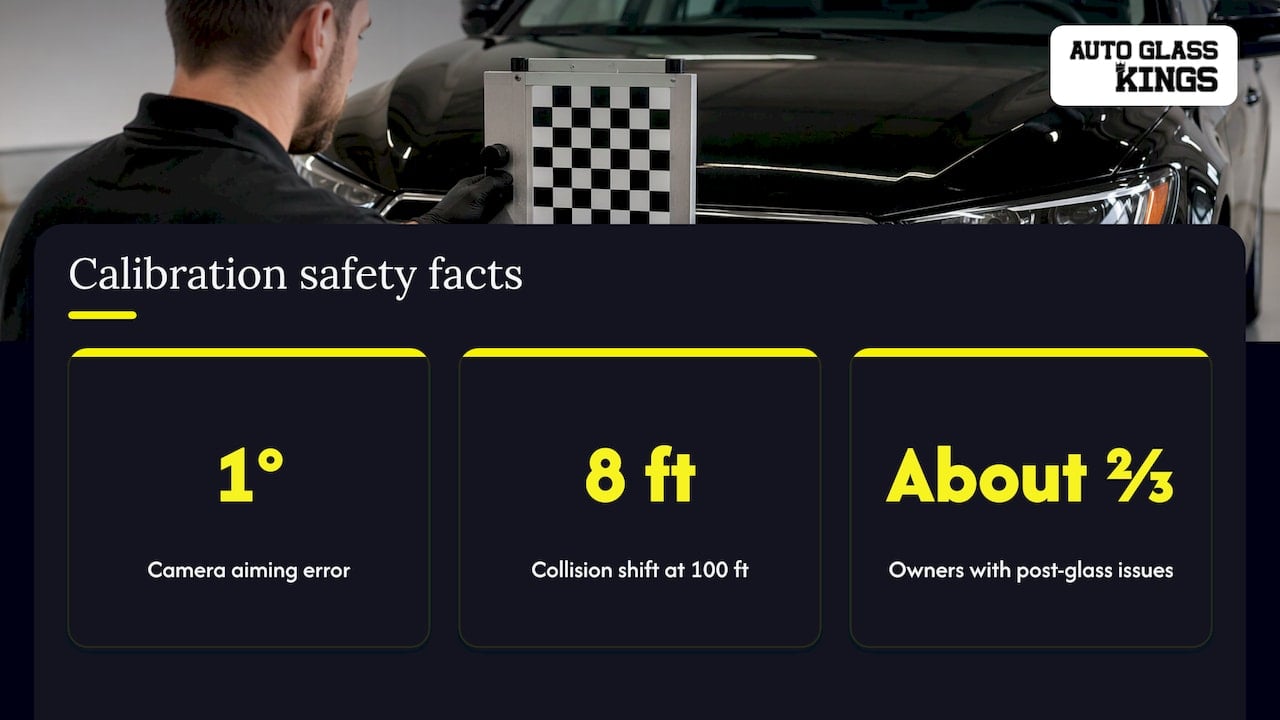
The repair industry as a whole is still working on this. The IIHS reported in 2023 that about two-thirds of owners whose crash-avoidance repairs involved windshield replacement experienced technology issues afterward. It attributed the difficulty partly to complex procedures, specialized equipment, software updates and nonstandardized processes. Careful, documented work matters.
The ANSI/AGSC AGRSS standard also expects qualified personnel and proper equipment, the calibration outcome to be provided to the owner, and the customer to be notified if the provider cannot perform a required calibration. When you book, expect to receive documentation of what was done.
Our view on calibration time
We hear the same question every week: “Can you do it before work?” The honest answer is that calibration time is not what hurts most drivers. The scattered logistics do: one appointment for the glass, another for the calibration, a dealership drop-off in between.
That is why we built our service around doing all of it in one visit. We complete the glass work and the required ADAS calibration in-house and on site, so you do not need a second appointment or a trip to a dealership. We use OEM-quality materials, and every install carries our lifetime warranty.
Our approach is simple: we match the procedure to your vehicle, give you a realistic window, and do not cut steps to hit a number. We are available from 5 AM daily, so most of our customers have their car back before the day gets going.
Auto Glass Kings
Book calibration and glass together in Orange County
If your windshield was just replaced, or your car needs recalibration after other work, we come to you. Our ADAS calibration service is published at $250 to $700, depending on the vehicle. Mobile service is free, and we bill insurance directly, with many customers paying nothing out of pocket.
We cover windshields, side and back glass, quarter and vent glass and sunroofs, on everything from classics to Tesla and Bentley. If you want to compare how a calibration is priced and billed, see our guide to ADAS calibration cost. If you own a Tesla, our page on Tesla camera calibration explains your options.
How to keep your calibration on schedule
A few small steps help the job go as fast as the vehicle allows:
- Share the details. Give us your year, make, model, trim and whether the car has had suspension or wheel changes.
- Mention warning lights. A lit dashboard icon is useful information, not a problem to hide.
- Check your tire pressure. Set tires to the pressure on the door-jamb label.
- Empty the trunk. Remove heavy cargo, roof boxes and anything unusual so the vehicle sits at its normal load.
- Pick a flat, open parking spot. Level ground and clear space around the car make target placement easier.
- Keep the car charged or fueled. A healthy battery avoids interruptions.
- Leave time after the install. Respect the adhesive wait and follow our windshield replacement aftercare steps.
FAQ
How long does ADAS calibration take?
The AGSC says it usually takes between 30 minutes and 2 hours. The make, model and calibration type decide where your car falls in that range. Dynamic and dual procedures take longer than most static ones because of the road drive and verification.
Can I drive right after a windshield replacement if I need calibration?
Not until the adhesive’s minimum drive-away time has passed. That time varies with the adhesive and the weather. Dynamic calibration starts only after that point, so your technician will tell you when it is safe to drive.
Why does calibration take longer on some cars?
Some manufacturers require static and dynamic procedures together, and some procedures are simply more detailed. Trade reporting says certain Subaru calibrations can take as long as 45 minutes for dynamic or dual work, and sometimes a car is kept longer. Weather, lighting, tire pressure and stored trouble codes can also add time.
What happens if ADAS is not calibrated?
The systems may be inaccurate or malfunction. AGSC says a one-degree aiming error in a camera can shift collision-avoidance performance by 8 feet at 100 feet. Calibration after windshield replacement is how you restore the correct aim.
Do I have to leave my car at a shop?
Not with us. We bring the equipment to your home or workplace in Orange County and complete the glass work and calibration in one visit. Call us for a window that fits your vehicle and schedule.
Sources
- AGSC: Understanding the Importance of Calibration
- AGRR Magazine: Tackling Calibration
- CIECA Calibration Workflows
- Tomorrow’s Technician: ADAS Calibration Aborts
- AGSC: Minimum Drive Away Times
- Sika: General Guideline for Vehicle Glass Replacement
- ANSI/AGSC AGRSS 005-2022 standard
- IIHS: Crash avoidance features improve safety but complicate repairs
Recommended
- ADAS Calibration Orange County
- 60–120 Minutes: Drivers, Know the 3 Windshield Replacement Clocks
- Static vs Dynamic ADAS Calibration: How They Differ
- Windshield Replacement Aftercare: 48–72 Hour Steps for US Drivers
🎧 Listen to This Article
Share
Recent Posts

November 18, 2026
Sticker Transfer on a Windshield: What Moves, What Doesn’t
Moving a windshield sticker to a new windshield or another car: which stickers can be reused, how to peel and reapply them, and...
November 17, 2026
Optical Distortion in a Windshield: What’s Normal, What Isn’t
Wavy or warped view through your windshield? Learn what optical distortion is, what causes it, what’s normal on new glass, and how to...
November 16, 2026
Calibration After Chip Repair: When You Need It
Does a windshield chip repair mean ADAS calibration? Learn when a chip near the camera calls for replacement, what that triggers, and how...