
Automotive
Most star breaks are repairable if the damage stays under 3 inches across, sits away from the windshield’s edge, and hasn’t broken through the inner layer of glass. Photograph the damage now, keep it dry, and avoid blasting the defroster or parking in direct sun until it’s looked at. If the crack reaches the edge or looks deep, call a mobile technician before driving much farther.
TL;DR:
- Most star breaks are repairable if their diameter remains under 3 inches, away from the windshield edge, and they do not penetrate the inner glass layer.
- Proper repair involves cleaning, vacuuming, resin injection, curing with UV light, and polishing to restore strength and optical clarity.
- DIY kits are suitable only for very small, shallow damage; larger or edge-reaching cracks should be handled by certified technicians to avoid further problems.
- Repair costs average around $165, while full windshield replacement can cost between $350 and $1,500, making early repairs more cost-effective.
- Using a mobile technician offers the benefits of quality OEM materials, same-day ADAS recalibration, and direct insurance billing, often with little or no out-of-pocket expense.
Table of Contents
- What a star break is and the rules that decide if it’s fixable
- How a technician actually repairs a star break
- DIY kits vs. calling a professional
- What repair and replacement actually cost
- Why a mobile technician is often the smarter call
- Book a mobile star break repair with Auto Glass Kings
- FAQ
- Sources
What a star break is and the rules that decide if it’s fixable
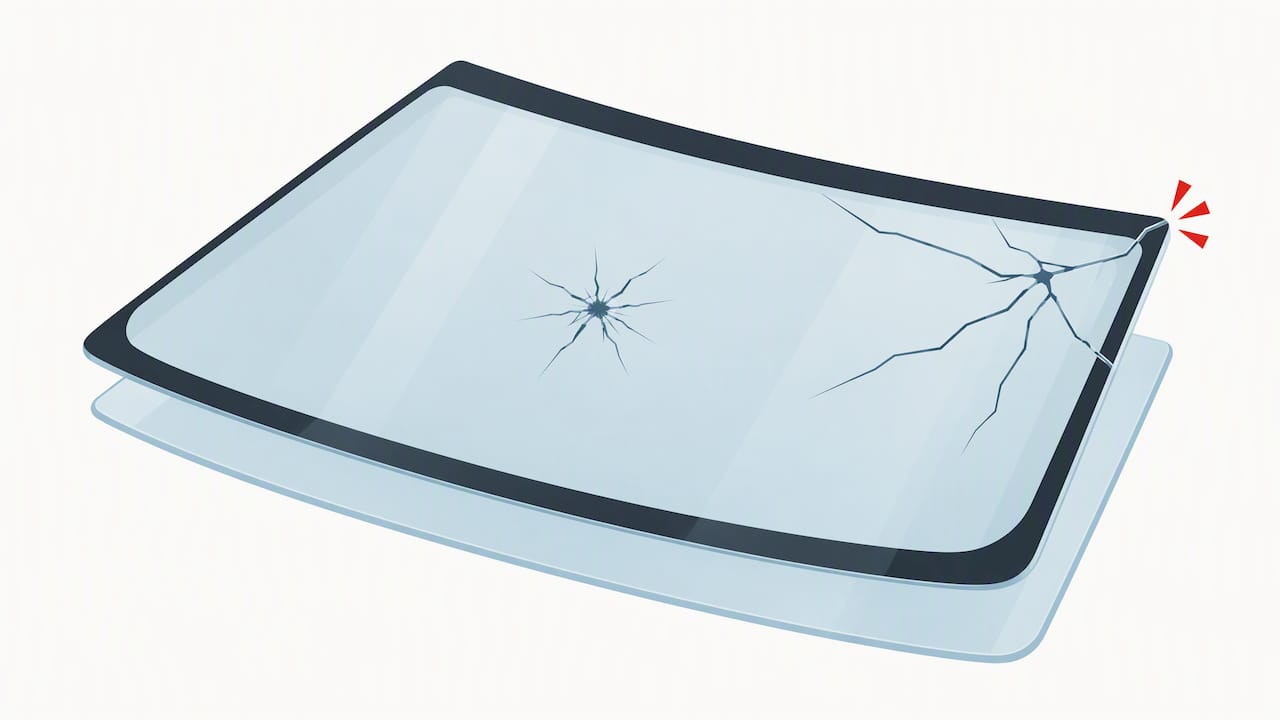
A star break gets its name from the pattern: a central impact point with cracks, or “legs,” radiating outward like a star. It’s different from a bullseye, which is a single circular cone of damage, and from a combination break, which mixes a bullseye with cracking legs and is harder to repair cleanly. Not every star break qualifies for a resin fix, and the line between repairable and replace-it-now comes down to measurable criteria, not guesswork.
The ANSI/ROLAGS standard sets the benchmark the glass industry uses to judge repairability. Under that standard, a star break qualifies for repair when:
- The total diameter doesn’t exceed 3 inches (75 mm).
- The damage doesn’t intersect the windshield’s edge.
- The break hasn’t penetrated the inner layer of the laminated glass.
A repairable star break is limited in diameter under ANSI/ROLAGS criteria to a size that avoids compromising the structural integrity of the glass, and that number matters because anything larger has usually compromised too much of the glass’s structural layer to hold a resin fill reliably.
Watch for signs that push a break past the repair threshold: cracks running to the edge, more than a few long legs branching from the center, or visible separation between the glass layers. When a repair is done within those limits and with the right materials, it should restore most of the windshield’s strength and keep optical distortion within a normal, unnoticeable range.
How a technician actually repairs a star break
A proper repair follows a sequence, and skipping steps is usually why a fix fails. Technicians typically work through this order:
- Inspect the break from inside and outside the vehicle, checking for moisture, dirt, or glass shards trapped in the legs.
- Clean the impact area and remove loose debris before any resin touches the glass.
- Seal an injector tool over the break to create a vacuum.
- Pull air out of the crack through repeated vacuum cycles, which displaces trapped air and pulls resin in behind it.
- Inject the resin, working it into each leg of the star pattern.
- Cure the resin, usually with UV light.
- Polish the surface flush and clear away excess cured resin.
The quality of the resin matters as much as the technique. Certified products undergo ANSI/ROLAGS-based testing protocols, which check for durability under thermal cycling and clarity under optical deviation standards. A resin that passes those tests is far less likely to let a leg reopen months later.
Pro Tip: Ask whether the shop uses a resin tested to ROLAGS performance standards. It’s a quick way to gauge whether you’re getting a repair built to last or just a cosmetic patch.
Most star break repairs take under an hour once a technician arrives, and reputable shops back the work with a warranty against the repaired area cracking further.
DIY kits vs. calling a professional
Drugstore and auto parts store repair kits can work for very small, shallow damage, but they have real limits. A DIY windshield repair guide from AutoZone notes that these kits are best suited to small chips and short legs, and they tend to produce a cosmetic fill rather than a structural one.
The risks are worth knowing before you try:
- Trapped air bubbles can remain in the legs, leaving weak points that spread later.
- Mismatched resin refractive index can leave a visible cloudy or distorted spot where the light bends differently than the surrounding glass.
- An improperly cured fill may shrink or crack again within weeks.
- A failed DIY attempt can complicate matters if you later file an insurance claim or bring the car to a shop, since some providers won’t warranty glass that’s already been worked on.
DIY makes sense for a tiny, centered star break with very short legs, especially if you’re far from a shop and just need to stop dirt and moisture from getting in before a proper repair. Anything larger, closer to the edge, or with several branching legs is a job for a trained technician, not a tube of resin from a parts store.
What repair and replacement actually cost
Repair costs are modest compared to replacement. According to an insurance coverage guide from InsureMojo, the average chip or small-crack repair runs about $165, while full windshield replacement typically falls between $350 and $1,500 or more depending on the vehicle and its glass technology.

The average windshield chip repair costs around $165, compared to $350 to $1,500 or more for a full replacement, according to InsureMojo’s coverage breakdown, which is exactly why catching a star break early and getting it repaired, rather than waiting for it to spread, is the cheaper path in nearly every case.
Comprehensive auto insurance generally covers non-collision glass damage, and a few states, including Florida, Kentucky, and South Carolina, require insurers to waive the deductible for windshield replacement entirely. If your vehicle has driver assistance cameras or sensors mounted near the windshield, replacement usually triggers ADAS recalibration, which runs $250-$700 one-off.
Before you book anything:
- Photograph the damage clearly from a few angles.
- Check your policy for glass coverage and deductible terms.
- Ask any shop you call whether they bill your insurer directly.
Why a mobile technician is often the smarter call
A star break doesn’t wait for a convenient Saturday, and neither should the fix. Having a technician come to your driveway or office lot means the repair happens in a controlled setting, away from the heat and vibration of a shop parking lot, which matters for resin cure quality.
We’ve found that pairing that convenience with OEM-quality glass and a lifetime warranty gives drivers a repair they don’t have to think about again. When a replacement is unavoidable, having ADAS recalibration done in the same visit, rather than a separate trip to the dealership, cuts both cost surprises and downtime. Direct insurance billing removes another layer of hassle from a situation that’s already an inconvenience.
— Auto Glass Kings
Book a mobile star break repair with Auto Glass Kings
We handle star break repairs on-site, so there’s no need to drive on a cracked windshield or rearrange your day around a shop appointment. Our technicians use OEM-quality materials and back every completed repair and replacement with a lifetime warranty.
- We come to you, with early morning availability.
- ADAS recalibration happens during the same visit when a replacement is needed.
- We handle insurance billing directly, and many customers pay nothing out of pocket.
If your star break is small and fresh, request a repair and we’ll assess whether it qualifies under standard repair criteria. If the damage has already spread too far, our windshield replacement service includes the recalibration your vehicle’s safety systems need. Either way, you can get a quote in minutes and get back on the road without a second appointment.
FAQ
Can a star break be repaired?
Yes, most star breaks qualify for repair when the total diameter stays under 3 inches, the damage doesn’t reach the windshield’s edge, and it hasn’t penetrated the inner glass layer, per ANSI/ROLAGS criteria. Breaks that exceed those limits or involve multiple deep legs typically need full replacement instead, as outlined in Nationwide’s windshield repair guide.
Can a star windshield crack be fixed?
A star-shaped crack can usually be fixed with resin injection if it meets the same size and location limits used for any star break. Combination breaks or cracks running to the edge generally require replacement rather than repair.
How much does it cost to fix a star on a windshield?
A typical chip or small star break repair costs around $165 on average, according to InsureMojo’s cost breakdown. Repair pricing runs from $79 to $129 one-off depending on the damage. Many insurers are billed directly and some customers pay little or nothing out of pocket.
Does comprehensive insurance cover a star break repair?
Comprehensive coverage generally covers non-collision glass damage like a star break, and a few states require zero-deductible replacement by law. Check your policy’s glass coverage terms and ask your repair shop whether they handle direct billing.
Sources
- Repair of Laminated Automotive Glass Standard (ROLAGS) – ANSI
- Cracked windshield insurance: coverage & claims guide – InsureMojo
- How to fix small windshield cracks – AutoZone
- Can a cracked windshield be repaired? – Nationwide
Recommended
- Auto Glass Kings Review: ADAS Calibration After Glass Replacement
- ADAS Calibration Orange County
- Auto Glass Replacement in Orange County: Cost, Process, and What to Expect
- Auto Glass Replacement: A Complete Guide for US Drivers
🎧 Listen to This Article
Share
Recent Posts

October 26, 2026
Heads-Up Display Windshield: What Changes When You Replace It
A HUD windshield is built differently from standard glass. See how it works, what to check before replacement, and why calibration matters in...
October 25, 2026
Lifetime Windshield Warranty: What It Covers and What It Doesn’t
A lifetime windshield warranty rarely covers everything. Learn what it should include, what it excludes, and how ADAS calibration and insurance fit in....
October 24, 2026
Rearview Mirror Reattachment: DIY Steps and When to Call a Pro
Rearview mirror fell off the windshield? Learn when a DIY glue kit works, when the glass is damaged, and how a mobile pro...