
Automotive
Windshields are bonded to the car with a one-part polyurethane adhesive, usually called urethane. It is not a generic glue. It is a structural adhesive that holds the glass in place in a crash, helps the airbags deploy correctly, and stiffens the body. How strong it is on day one depends on the product, the primer, the prep work and the weather during the install. This guide explains each of those so you know what a good installation looks like.
TL;DR
- Modern windshields are bonded with moisture-curing polyurethane. Industry sources call it the standard for vehicle glass worldwide.
- The main families are conventional-cure, advanced-cure and primerless-to-glass urethanes. They differ in how fast they build strength and in which prep steps they need.
- Primer prepares the surfaces for bonding. Whether your car needs it depends on the adhesive system the installer uses.
- Drive only after the installer’s stated safe drive-away time. It can run from about 30 minutes to several hours, depending on the product, temperature and humidity.
- Full cure takes much longer than drive-away time. Follow the aftercare instructions for the first days.
Table of Contents
- What windshield urethane adhesive actually does
- The main types of windshield urethane
- Why windshield primer matters
- How the adhesive is applied correctly
- Cure time: when is it dry, and when is it safe to drive?
- Our perspective on urethane
- What to ask your installer about the adhesive
- Book a mobile windshield replacement in Orange County
- FAQ
- Sources
What windshield urethane adhesive actually does
Most people think of a windshield as a window. Engineers treat it as a structural part. Sika, a major adhesive maker, describes polyurethane as the standard for bonding vehicle glass worldwide. It meets the strength requirements of vehicle producers and holds up in harsh conditions. It also supports the windshield’s safety functions.
Sika also notes that the windshield adds a lot to the overall stiffness of the vehicle. That is why manufacturers can build with thinner steel. In practice, the urethane bead around the frame is part of your car’s crash performance. A bead that is too thin, skipped in a spot, or applied to a dirty surface is a safety problem, not a cosmetic one.
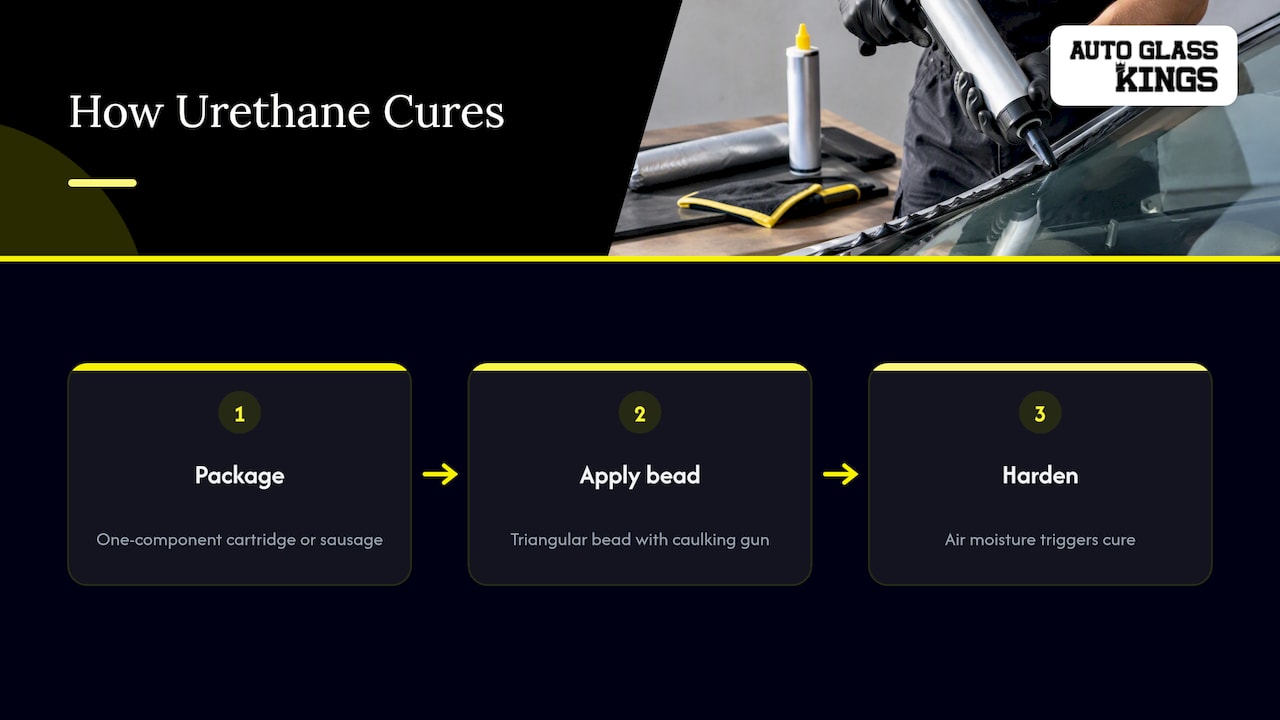
The adhesive is a one-component, moisture-curing product. It sits in a sausage or cartridge, goes on in a triangular bead with a caulking gun, and then reacts with moisture in the air to harden. That moisture dependence explains most of what follows about cure time.
The main types of windshield urethane
You will see three terms on product sheets and in installer training. They overlap, because one adhesive can be both advanced-cure and primerless.
| Type | How it cures | What sets it apart |
|---|---|---|
| Conventional-cure | Relies on atmospheric moisture to trigger the reaction | Longer safe drive-away times, and more sensitive to cold, dry weather |
| Advanced-cure | Uses enhanced crosslinking to build strength faster | Works well in lower-moisture conditions and allows shorter drive-away times |
| Primerless-to-glass (P2G) | Bonding functionality is built into the adhesive itself | Adheres to clean glass without a separate glass primer |
The first two rows come from DuPont’s glass-replacement training guide. It says conventional-cure adhesives rely on atmospheric moisture, while advanced-cure products use enhanced crosslinking to develop strength faster and perform in lower-moisture conditions. The same guide explains that primerless-to-glass technology builds bonding functionality into the adhesive backbone. That lets it stick to clean glass without a separate primer.
An industry trade magazine reports that recent innovations include shorter minimum drive-away times, higher viscosity and primerless-to-glass adhesives. Higher viscosity matters because a thicker bead holds its shape when a heavy windshield is set into it.
Black, one-part and medium viscosity
Product sheets for consumer-grade and professional tubes use similar language. 3M’s auto glass urethane, for example, is a one-part, moisture-curing product. The black color is deliberate. It protects the bond line from sunlight through the glass edge and hides the bead behind the ceramic frit band.
A tube that says “urethane” is not automatically right for every job. The adhesive, the primers and the cleaners are meant to work as a system. DuPont’s guide says reaching 100% bond strength requires chemical and mechanical compatibility of the whole system, including every primer and cleaning product. Mixing brands to save money is exactly how that compatibility gets lost.
Why windshield primer matters
Primer is the step people ask about most, and the one that gets skipped most often in poor installs.
Glass and painted or bare metal surfaces are not naturally ideal for urethane to grip. Primer reacts with the surface molecules and prepares them for the adhesive. DuPont’s training guide is clear on the rule: use primer when the adhesive system calls for it. Primerless-to-glass adhesives are built to bond to clean glass without it.
That last phrase hides a few catches:
- “Primerless” often applies only to the glass side. Pinch-weld surfaces with scratched paint or exposed metal may still need a body-side primer.
- Glass that is not clean is not ready, with or without primer.
- Primer must go on in a thin, even coat and flash off for the time the manufacturer specifies before the urethane goes on. One manufacturer’s installation manual says its primer normally dries in 4 to 6 minutes, depending on conditions. Different products have different times, so the technician should follow the product’s own sheet.
The same manual says its primer can be used on bare metal once surface rust or corrosion has been removed. It also says the primer is not a replacement for automotive paint primer coatings in major restorations. This matters to classic car owners. A rusty pinch weld has to be treated properly before any glass goes in. Adhesive on top of rust only bonds to the rust.
How the adhesive is applied correctly
The steps below follow what DuPont’s guide lays out for professionals.
- Protect the car. Covers go over the dashboard, hood and roof. Adhesives and primers can permanently stain interiors if spilled, so this is not optional.
- Remove the old glass and trim the old bead. A thin layer of cured urethane is usually left on the frame as a base for the new bead.
- Clean with an approved agent. Every bonding surface is checked and ready before anything is applied.
- Prime where required. A thin, even coat, then the full flash-off time.
- Apply the bead with a caulking gun. The size and shape follow the manufacturer’s specification, with no gaps and no breaks at the corners.
- Set the glass. It goes in once, in position, and is not slid around.
- Record the conditions. Installers are supposed to document temperature and relative humidity at the time of installation, so the chosen product’s safe-release requirements can be checked.
- Give you the drive-away time. In writing or by text, with when the clock started.
The responsibility sits with the shop. Training material from another adhesive maker states that occupant safety is the primary directive in glass bonding, and that the replacement facility and technicians must follow all manufacturers’ guidelines and procedures.
Cure time: when is it dry, and when is it safe to drive?
Two different clocks run after installation, and people mix them up.
Safe drive-away time (SDAT) is the minimum wait before the car can be operated. The adhesive manufacturer’s data sheet sets it, and it is a mandatory waiting period, not a suggestion. The vehicle stays out of service until it is met.
Full cure is when the bead has reached final strength all the way through. It takes far longer. 3M’s data sheet for its windshield urethane gives 24-hour cure-through at 50% relative humidity and 75°F.
| Clock | What it means | Typical source of the number |
|---|---|---|
| Safe drive-away time | Earliest the car may be driven | Adhesive data sheet, set by temperature and humidity |
| Cure-through | Bead is fully hardened | Adhesive data sheet, in hours at stated conditions |
| Aftercare window | Days when you avoid stress on the new glass | Installer instructions |
Some real numbers
Safe drive-away times vary a lot between products:
- DuPont says some advanced-cure adhesives, such as BETASEAL Xpress30, allow a minimum drive-away time of 30 minutes at temperatures of 0°F (-18°C) and higher.
- Some other DuPont urethane formulations sold in the U.S. require a minimum of 2 hours when applied at 40°F (4.4°C) or warmer.
So “30 minutes” and “2 hours” can both be correct. They are different products. Any single number on a blog is an average at best. Ask your installer for the figure for the product on your car.
Why the weather changes the answer
Because the adhesive cures with moisture, conditions matter. DuPont’s guide says higher temperatures and humidity generally speed up the reaction, while colder, drier conditions slow it. Orange County is mild, but a dry Santa Ana wind day or a cool, damp morning on the coast still shifts the numbers for conventional products. Advanced-cure adhesives reduce that sensitivity, which is one reason a mobile installer working outdoors benefits from them.
We cover the driving rules in more detail in how long until you can drive after a windshield replacement, and the whole job timeline in the three windshield replacement clocks.
After you drive away
The adhesive is not at full strength when you leave. For the first days, follow the installer’s instructions on car washes, slamming doors, and leaving a window cracked. Our windshield replacement aftercare guide covers the 48 to 72 hours, and the car wash wait time gets its own page, because pressure washers are hard on a fresh bond.
Our perspective on urethane
We replace windshields on driveways, in office parking lots and at curbs across Orange County, so we think about urethane every working day. Here is how we see it.
The adhesive is where a replacement is won or lost. Customers judge us by the glass, but the glass is only as safe as the bond holding it. That is why we use OEM-quality materials and put a lifetime warranty on every install. We would not offer that warranty on a bond we were not sure about.
We also think the second half of the job matters as much as the first. A modern windshield carries the camera for lane-keeping and emergency braking. If the glass is set properly but the camera is not recalibrated, the car is not truly fixed. We do the required ADAS calibration in-house, on-site, in the same visit, so you do not need a second appointment or a trip to a dealership.
What we would tell any driver: ask for the safe drive-away time by name, ask when the clock started, and be wary of any shop that answers “you’re good to go” with no number.
— Auto Glass Kings
What to ask your installer about the adhesive
You are not going to pick the urethane yourself, but you can tell a careful shop from a rushed one with a few questions.
- Which adhesive system do you use, and is it approved for my vehicle? The answer should name a product line, not just “urethane.”
- What is the safe drive-away time today? It should reflect the day’s temperature and humidity.
- Do you prime, and with what? If the adhesive is primerless-to-glass, the shop should still be able to explain what gets primed on the body side.
- Will you calibrate the ADAS camera after install? Many cars with a camera behind the mirror need it after any windshield replacement.
- What does the warranty cover? Leaks and bond failures should be included.
If you have an older or classic car, add one more question: how will they handle rust or old sealant on the pinch weld? It is the most common trouble spot on vintage bodies.
One note on tubes from a parts store. Consumer kits exist, and they use real urethane. But windshield bonding is a safety job with a strict process, a stated drive-away time and often a camera to calibrate. We do not recommend treating it as a weekend project.
Book a mobile windshield replacement in Orange County
If your glass is cracked, leaking or pitted, we come to you from 5 AM, with the adhesive, primer and calibration equipment on board. Our windshield replacement service includes free mobile service, OEM-quality materials and a lifetime warranty, and we bill your insurance directly. Many customers pay nothing out of pocket.
If the damage is a small chip, repair may be enough and costs $79 to $129 on our windshield repair page. When your car needs its camera recalibrated, ADAS calibration runs $250 to $700 depending on the vehicle. Not sure which path fits? Our breakdown of repair versus replacement costs helps you decide.
FAQ
What glue is used for car windows?
Windshields and other bonded glass use one-part, moisture-curing polyurethane adhesive, called urethane. It is paired with primers and cleaners from the same system. Side and rear glass on some cars are bonded this way too, while others use clips, channels or other fasteners.
How long does windshield urethane take to cure?
It depends on the product and conditions. Safe drive-away time can be as short as 30 minutes for some advanced-cure products and 2 hours or more for others. Full cure-through is longer, with one 3M product listing 24 hours at 50% humidity and 75°F. Your installer’s stated time is the one to follow.
Can a leaking windshield be resealed?
Sometimes a small leak at the edge can be addressed, but it depends on why the seal failed. If the bond is weak because of rust, bad prep or old urethane, the glass may need to be removed and rebonded properly. A leak also means the structural bond may be compromised, so have a glass technician look at it rather than squeezing sealant around the outside.
Is windshield primer really necessary?
It is required when the adhesive system calls for it. Primerless-to-glass adhesives are designed to bond to clean glass without a separate glass primer, but body-side surfaces such as bare metal may still need priming. Follow the manufacturer’s instructions for the product being used.
Does cold or dry weather change how long I should wait?
Yes, for many products. Colder, drier air slows the moisture cure, while warmth and humidity speed it up. Advanced-cure adhesives are made to hold their drive-away times in a wider range of conditions, so ask the technician what time applies on the day of your install.
Sources
- Polyurethane the Windshield Adhesive | Sika
- DuPont glass replacement training guide (AGSC)
- The Urethane That Binds | AGRR, Fall 2024
- 3M Auto Glass Windshield Urethane data sheet
- SRP installation manual
- DuPont: Auto Glass Replacement General Information
- DINITROL AGR Training Manual 2024
- DuPont: Safe Windshield Replacement Facts
- DuPont: Glass Replacement NA
Recommended
- Drivers, Follow Your Installer’s Wash Time After Windshield Replacement
- 60–120 Minutes: Drivers, Know the 3 Windshield Replacement Clocks
- How Long Until You Can Drive After Windshield Replacement
- Windshield Replacement Aftercare: 48–72 Hour Steps for US Drivers
🎧 Listen to This Article
Share
Recent Posts
November 18, 2026
Sticker Transfer on a Windshield: What Moves, What Doesn’t
Moving a windshield sticker to a new windshield or another car: which stickers can be reused, how to peel and reapply them, and...
November 17, 2026
Optical Distortion in a Windshield: What’s Normal, What Isn’t
Wavy or warped view through your windshield? Learn what optical distortion is, what causes it, what’s normal on new glass, and how to...
November 16, 2026
Calibration After Chip Repair: When You Need It
Does a windshield chip repair mean ADAS calibration? Learn when a chip near the camera calls for replacement, what that triggers, and how...