
Automotive
A chip filled with resin while the windshield stays on the car is a different job from replacing the glass. Calibration follows the second one. The catch is that a chip in the wrong spot, in front of your driver-assistance camera, may mean the glass has to come out after all. At that point calibration is required. We handle the repair or replacement and any calibration in one on-site visit in Orange County, so you don’t have to work out which case you’re in alone.
TL;DR
- A routine chip repair leaves the glass in place. Vehicle makers tie calibration to removing or replacing the windshield or camera, as GM’s windshield position statement does.
- Location decides everything. A chip in the camera’s field of view can make a repair off-limits, and replacement then brings calibration with it.
- Your vehicle’s own rules count more than a general inch-size rule. Tesla and Polestar, for example, publish strict camera-zone limits.
- A quiet dashboard doesn’t prove the system is aligned. Ask for a written record of any calibration.
- Our windshield repair is $79 to $129, and ADAS calibration is $250 to $700. Both are done at your home or office, and we bill insurance directly.
Table of Contents
- Why a chip repair and calibration get mentioned together
- Does a chip repair itself require calibration?
- When the chip is in the camera zone
- What happens when the answer is replacement
- What skipping calibration can cost you
- Glass quality also matters to the camera
- How to confirm calibration was actually done
- Cost and insurance
- Fixing it before work: how our visit goes
- Our perspective
- Book your repair or replacement
- FAQ
- Sources
Why a chip repair and calibration get mentioned together
Modern cars use a forward-facing camera, usually mounted behind the windshield near the mirror. It feeds features such as automatic emergency braking, lane keeping and adaptive cruise control. Those features are called ADAS (advanced driver assistance systems). Calibration is the process of teaching the camera exactly where it sits and where it points, so the software reads distances and lane lines correctly.
The camera looks through the glass. That is why a windshield job can matter to it. Two things can go wrong. The camera’s position can change when glass is removed and a new one is installed. Or the view itself can be disturbed by damage or a repair in its line of sight.
The two cases are often blurred together in search results. They need to be kept apart:
- Chip repair away from the camera. The glass stays bonded to the car. Nothing that holds the camera has moved.
- Chip or crack in the camera’s view. Makers often want the glass replaced, not repaired.
- Full replacement. The camera or glass has been removed or reinstalled, so calibration is part of the job.
Does a chip repair itself require calibration?
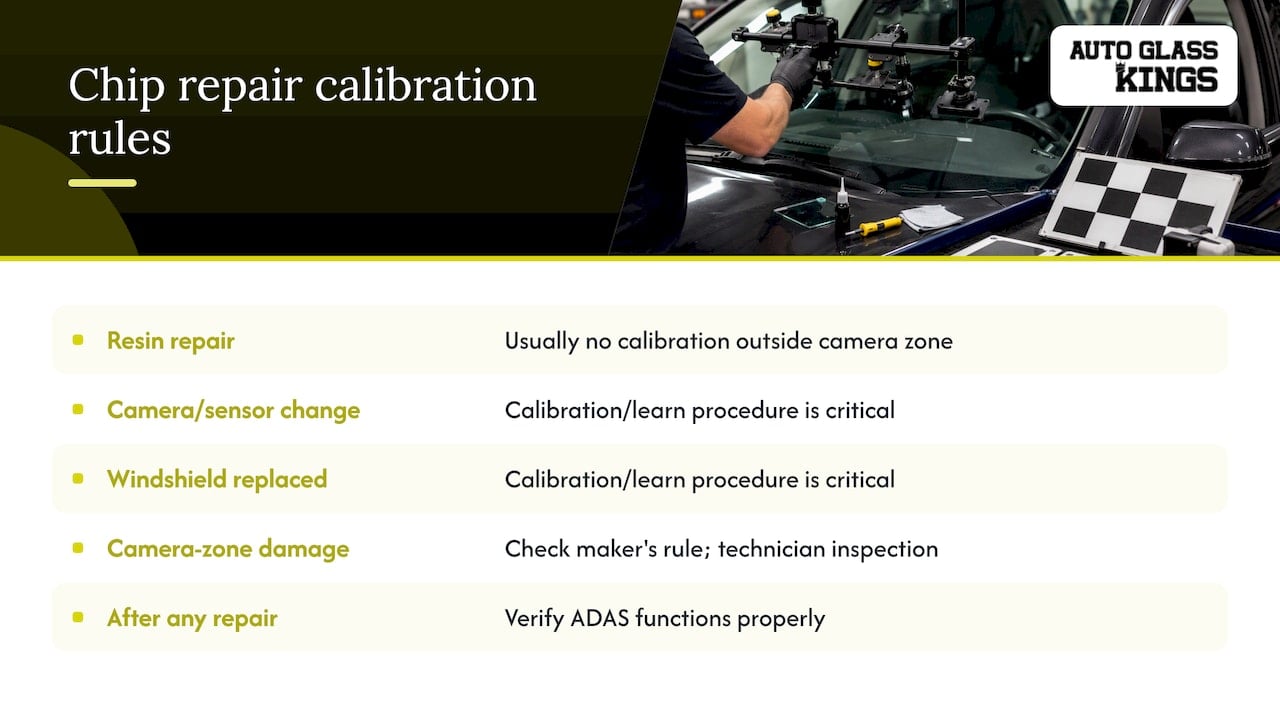
For a standard chip repair, where resin is injected into the damage and the windshield is never removed, the usual trigger for calibration isn’t present. GM’s position statement says a calibration or learn procedure is critical whenever a front-view camera or sensor is removed, reinstalled or replaced, or when the windshield itself is removed and replaced. A resin repair does none of those things.
That is the general logic, and it is not a promise for every car. Some makers write their own rules, and a few say plainly that damage in the camera area should be handled by a technician. So the honest answer is: usually no calibration for a chip repair outside the camera zone, but check the maker’s rule for your vehicle if the chip is anywhere near the camera.
After any repair, the system should still be working. I-CAR, the collision-repair training body, says technicians should always verify that ADAS is functioning properly after completing repairs. See its collision warning and braking note.
When the chip is in the camera zone
This is where most drivers get caught out. Look at the area behind and around your rearview mirror. The camera’s field of view is a cone of glass, and a chip inside it can distort what the camera sees, even if the repair looks clean to your eye.
The vehicle makers are direct about it:
- Tesla. Its Model 3 body repair guidelines ban any repair in the windshield area that covers the camera’s field of view plus 25 mm of surrounding glass, the frit (the black ceramic band) and the passenger side. Damage there has to be replaced. Tesla also caps any windshield at three repairs of any kind before replacement is required. Read the Tesla windshield repair guidelines.
- Polestar. Its 2025 Polestar 3 owner’s manual says any damage in the camera and sensor area, even small chips or scratches, can affect forward detection and needs a technician’s inspection. Polestar recommends replacing the windshield in that area rather than repairing it, and says the forward camera needs checks and calibration after any windshield installation. See the Polestar 3 windshield damage page.
- I-CAR. For camera-based collision warning and braking systems, it says in most cases any damage to the windshield in front of the camera’s view is not repairable, and a stone chip by the camera may require replacement.
Tesla also shows that location is not everything. Outside the camera area it allows resin repairs in defined zones, for example chips under 50 mm wide in the exterior glass layer in its green zone, and rock chips or spherical damage up to 25 mm in the wiper-sweep zone. Damage that reaches the inner layer always means replacement.
If you want a plain-language read on size, our guide to windshield chip size limits explains why the familiar one-inch rule of thumb can yield to your vehicle’s own rule.
A quick way to size up your chip
Before you call, note three things:
- Where it is. Is it within a few inches of the mirror mount or the camera housing? Is it on the driver’s side, in the wiper sweep, or at the edge?
- How big. Roughly a coin or smaller, or longer than that? Is there a crack running from it?
- Your car. Year, make and model, and whether it has lane-keeping, automatic braking or a camera at the mirror.
Those three answers are what a technician needs to tell you whether a repair is on the table or whether the maker’s rule points to replacement.
What happens when the answer is replacement
Once the windshield comes out, calibration is no longer a maybe. GM, Polestar and most makers treat it as required after a windshield replacement. Burke Porter ADAS, an equipment maker, states that most manufacturers mandate recalibration after any windshield replacement, however minor the prior damage was. It adds that neither a visual check nor a dashboard light can confirm the systems work correctly.
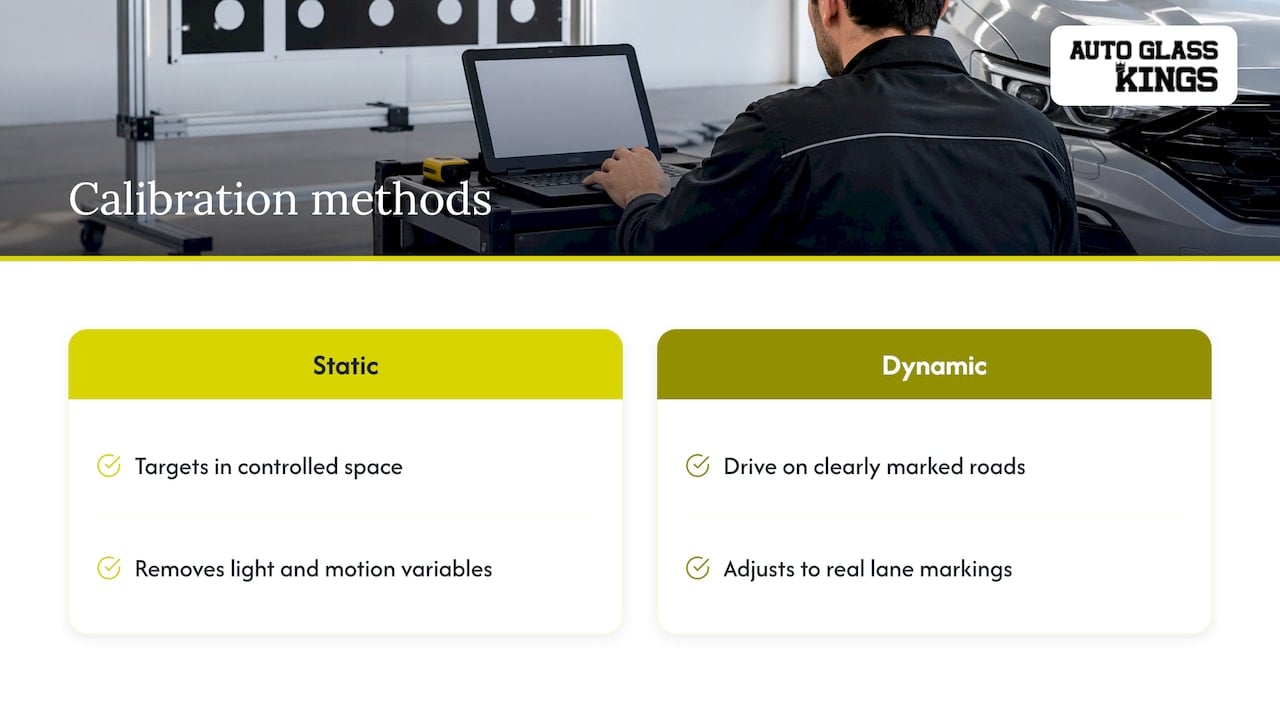
There are two main ways to do it. Static calibration uses targets placed in front of the car in a controlled space. Dynamic calibration uses a drive on roads with clear lane markings. Some vehicles need one, some need both. John Bean USA explains that the controlled setting of static calibration removes variables such as changing light and moving objects, while dynamic calibration lets the camera adjust to real lane markings. We explain the difference in our guide to static vs dynamic calibration.
This is not a home job. It takes vehicle-specific procedures and equipment, which is why we do all required calibrations in-house instead of sending you to a dealership for a second appointment.
What skipping calibration can cost you
If calibration is needed and gets missed, the car may look completely normal. That is the problem. The software doesn’t know anything changed, and being off by a degree or two can produce wrong inputs, warnings or unsafe behavior on the road, according to Burke Porter ADAS.
The numbers are sobering. An IIHS survey, reported by glassBYTEs, found 66% of drivers whose windshield was replaced and camera reinstalled had ADAS malfunctions afterward. Misaligned systems may activate when they shouldn’t or fail to work at all.
For a parent on the school run or a commuter on the 405 at 6 a.m., that means an emergency braking system that may react late, or brake for nothing.
Signs something is off after glass work
- A new driver-assistance warning light or message
- A feature reporting itself unavailable or turned off
- Lane warnings or steering nudges at odd times, or none when you drift
- Collision alerts with nothing ahead, or alerts that seem late
If you see any of these, treat the features as off, don’t test emergency braking against an object, and get the car rechecked, including a scan and calibration.
Glass quality also matters to the camera
The camera reads the world through the glass, so the glass itself matters. GM says its windshield optical quality testing exceeds the federal FMVSS 205 standard and that inferior glass can increase distortion and impair driver vision. It also says it does not run structural or safety testing with aftermarket glass. For that reason we use OEM-quality materials, and our guide to OEM vs aftermarket glass for HUD and ADAS shows how the choice affects sensors and head-up displays.
Whatever sits on the camera zone should be clear and approved for your vehicle. If you are weighing add-ons such as a ceramic coating on glass, match them against your maker’s guidance for the area in front of the camera.
How to confirm calibration was actually done
A dashboard that stays quiet is not proof. Ask for a record. A good calibration report lists the VIN, date, shop, the systems calibrated, the method (static, dynamic or both), the final result, scan results before and after, and the glass installed. Keep it with your vehicle records. It helps if a problem appears later, if you sell the car or if it is repaired again.
Daily Genius, summarizing I-CAR guidance, notes that pre- and post-repair scanning is part of Volvo’s statement and specifically lists windshield replacements. The point for you: scanning is a normal part of professional glass work on ADAS cars.
Cost and insurance
Here is what we publish. Windshield repair is $79 to $129. ADAS calibration is $250 to $700, depending on the vehicle. Side window replacement starts at $189 and back window replacement at $350. Windshield replacement has no published price because it depends on the glass your vehicle uses, so we quote it for your car.
If you carry comprehensive coverage, we bill your insurance directly, and many of our customers report paying nothing out of pocket. Your own policy sets deductibles and terms, so have your policy details ready when you call. For a deeper look, read what you’ll pay for windshield replacement with insurance and our ADAS calibration cost guide.
Fixing it before work: how our visit goes
We come to you, starting at 5 a.m. daily, with free mobile service anywhere we cover in Orange County. For a chip, that means a fast resin repair in your driveway or the office lot. If your vehicle’s rules or the chip’s position call for replacement, we do the glass and any required calibration in the same visit, so there’s no second trip to a dealership. Our mobile windshield replacement process page walks through the timing, and ADAS calibration time covers how long the calibration step takes.
Every install carries a lifetime warranty. We work on everything from classics to Teslas and Bentleys, so whether you drive a 1969 Camaro with no sensors at all or a new EV full of cameras, the same visit covers it.
Our perspective
Most drivers ask us the wrong question. They ask whether a chip repair needs calibration. The better question is whether the chip is where the camera looks, and whether your maker lets that area be repaired at all.
When the answer is yes, the safest path is a clean replacement with the calibration finished before you drive away. That is why we keep glass work and calibration under one roof, in one visit, and why we use OEM-quality materials. A cracked windshield on a sensor-equipped car is not just a glass problem.
If you are unsure, tell us the vehicle and where the chip sits. We will tell you whether a repair makes sense or whether the camera zone calls for something more.
Auto Glass Kings
Book your repair or replacement
If you have a chip and a car with driver-assistance features, we can inspect it where you park and do whatever your vehicle calls for, including calibration, in a single visit. See our windshield repair and ADAS calibration services, or book through Auto Glass Kings.
FAQ
Do I need to recalibrate after windshield replacement?
Yes, in nearly every case on a car with a windshield camera. GM and Polestar both say calibration is needed whenever the windshield or camera is removed and replaced. Most makers follow the same approach, so plan for it whenever the glass is replaced.
What happens if calibration is not done?
The camera may read distances and lanes wrongly, so automatic braking or lane keeping can fail to act or act at the wrong moment. An IIHS survey reported by glassBYTEs found 66% of drivers with a replaced windshield and reinstalled camera had ADAS malfunctions afterward.
Can a chip in a windshield be repaired?
Often yes, if it is small and outside the camera’s view. Makers such as Tesla set size and location limits, and damage in the camera zone usually means replacement. Our windshield chip size guide shows how to judge yours.
How much does it cost to calibrate a windshield?
Our ADAS calibration runs $250 to $700 depending on the vehicle. If you have comprehensive coverage, we bill your insurer directly, and many customers pay nothing out of pocket.
Sources
- Windshield Replacement Guidelines for GM Vehicles | GM Parts
- Windshield and Roof Glass Repair and Replacement Guidelines | Tesla Service
- Windshield damage | Polestar 3 owner’s manual
- When ADAS Can’t See: Collision Warning and Braking System | I-CAR
- Do I Really Need to Recalibrate After Glass Repair? | Burke Porter ADAS
- Windshield Camera Calibration | John Bean USA
- A Matter of Millimeters | glassBYTEs
- ADAS Calibration Dealer vs Shop: Questions Before Repair | Daily Genius
Recommended
- ADAS Calibration Time: How Long It Takes After Glass Work
- $150–$800: ADAS Calibration for US Owners, Insurance & Mobile Billing
- Windshield Chip Repair Orange County
- Auto Glass Kings Review: ADAS Calibration After Glass Replacement
🎧 Listen to This Article
Share
Recent Posts
November 18, 2026
Sticker Transfer on a Windshield: What Moves, What Doesn’t
Moving a windshield sticker to a new windshield or another car: which stickers can be reused, how to peel and reapply them, and...
November 17, 2026
Optical Distortion in a Windshield: What’s Normal, What Isn’t
Wavy or warped view through your windshield? Learn what optical distortion is, what causes it, what’s normal on new glass, and how to...
November 16, 2026
Calibration After Chip Repair: When You Need It
Does a windshield chip repair mean ADAS calibration? Learn when a chip near the camera calls for replacement, what that triggers, and how...