
Uncategorized
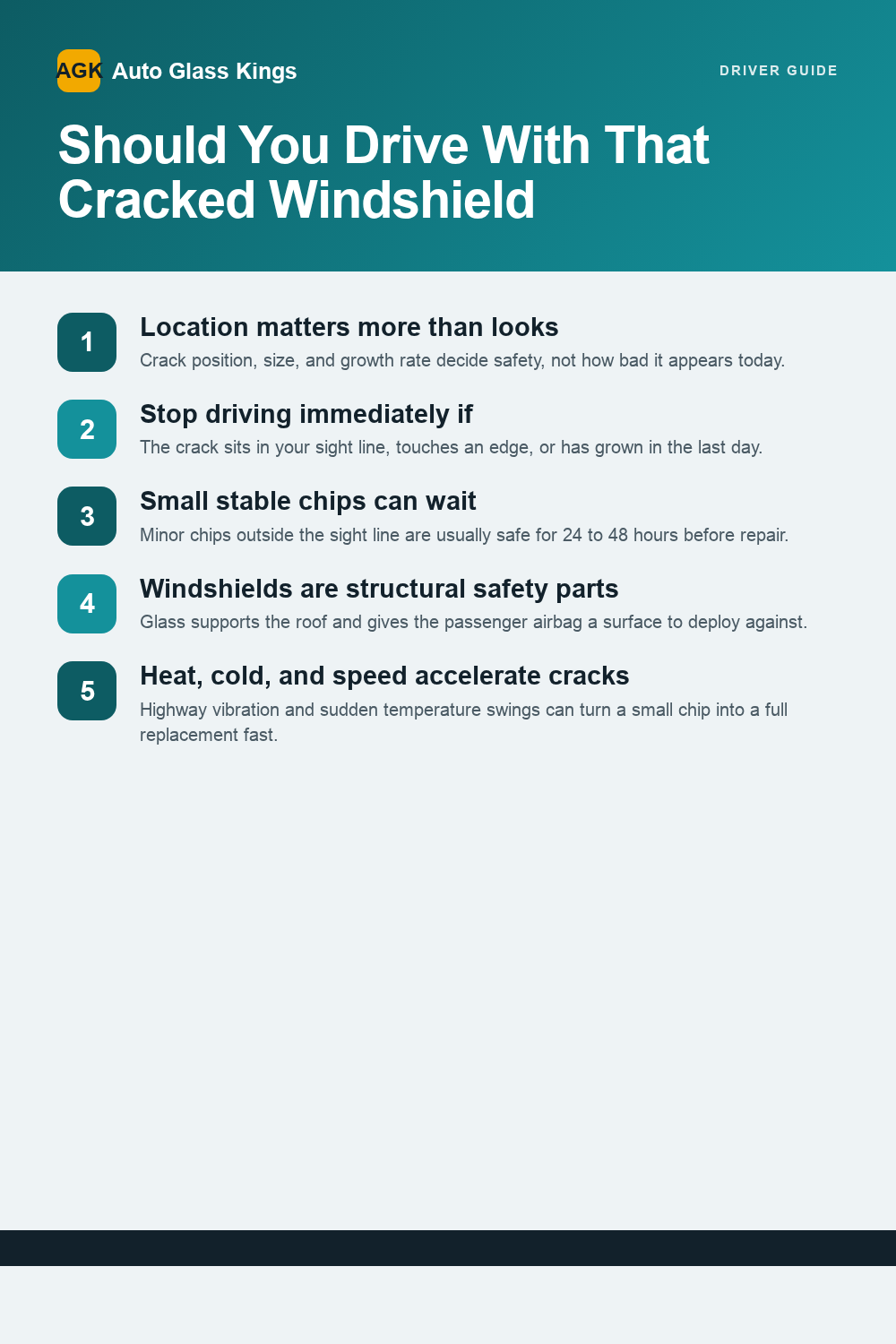
Stop driving now if the crack sits in your direct line of sight, touches an edge, or has grown in the last day. If it’s a small chip off to the side and stable, you can drive short distances at reduced speed, but get it inspected within 24 to 48 hours. Location, size, and growth rate decide the answer, not how the crack looks to you today.
TL;DR:
- Cracks in the driver’s line of sight or touching the edge of the windshield require immediate repair or replacement, as they compromise safety and structure.
- Damage near the frame bond or exceeding a few inches, especially if it intersects or spreads quickly, typically demands a full windshield replacement.
- Small chips outside the sight line can be temporarily stabilized with resin or tape and are usually safe to wait 24 to 48 hours before repair.
- Driving at highway speeds, under extreme temperature changes, or with cracks in critical areas significantly accelerates crack growth and increases safety risks.
- Many states enforce strict penalties for cracks in the visual or structural areas, including fines and inspection failures, making timely repair essential.
Table of Contents
- Quick Checklist: When a Crack Makes Driving With Windshield Damage Unsafe
- How a Cracked Windshield Affects Safety and Vehicle Structure
- How Long Can You Drive With a Cracked Windshield?
- Temporary Measures to Slow Crack Growth Before Repair
- When to Stop Driving Immediately: Emergency Signs
- Insurance, Inspections, and Fines for Driving With Windshield Damage
- Repair vs. Replacement and ADAS Recalibration Timeline
- What to Do Right Now
- Legal Penalties and Fines for a Cracked Windshield
- Potential Hazards and Increased Accident Risk
- Impact of a Cracked Windshield on Resale Value
- Windshield Repair vs. Replacement: Cost and Process
- Where the Common Advice Gets This Wrong
- Get Your Windshield Fixed Without the Runaround
- Sources
Quick Checklist: When a Crack Makes Driving With Windshield Damage Unsafe
Not every crack demands you pull off the road right now, but a few conditions do. Run through this list before you turn the key.
- Line of sight or wiper zone: any crack crossing the driver’s direct view or sitting inside the wiper sweep area is an immediate problem, even if it’s small.
- Edge cracks: damage that reaches within an inch or two of the windshield’s frame weakens the seal and often means replacement, not repair.
- Length: cracks longer than a few inches, and especially anything intersecting another crack, push you toward replacement territory.
- Spreading fast: if the crack visibly lengthened after a hot day, a cold snap, or a pothole, that’s a sign the glass is actively failing.
- Cloudy or bubbled spots: delamination, where the layers of glass separate, signals the windshield’s structural layers are compromised.
If you check even one of these boxes, treat the windshield as a today problem, not a someday problem.
How a Cracked Windshield Affects Safety and Vehicle Structure
A windshield isn’t just a window. It’s a structural component that helps hold up the roof and gives the passenger airbag something to push against when it deploys. Federal vehicle equipment standards recognize this, which is why 49 CFR part 393 prohibit cracks larger than three quarters of an inch in diameter, intersecting cracks, and any damage in the driver’s critical viewing area.
Edge cracks are the real danger here. Once damage reaches the frame bond, the seal between glass and body weakens, and that bond is part of what keeps the roof from collapsing in a rollover. It’s also what gives a deploying passenger airbag a solid surface to bounce off instead of punching straight through cracked glass. A windshield with a compromised edge can lose a meaningful share of its rated structural strength, and that loss shows up exactly when you need it most: in a crash.
Heat, cold, and road vibration all accelerate crack growth, turning a two-inch chip into a windshield replacement in a matter of days.
How Long Can You Drive With a Cracked Windshield?
There’s no universal countdown clock here. A crack’s safe lifespan depends on where it sits, how long it is, and what kind of driving you’re about to do, not a fixed number of days.
A few conditions shrink that window fast: damage in your direct sight line, any crack touching an edge, sustained highway speeds, and sudden temperature swings from a blasting defroster or an ice-cold morning. Highway vibration and thermal stress are two of the biggest triggers for sudden crack propagation, which is exactly the environment where you least want glass failing.
As a practical rule: a small chip outside your sight line can usually wait 24 to 48 hours for a repair appointment. A crack anywhere in your view should ground the car today. And don’t count on a legal cushion. Many states have no formal grace period once damage meets the threshold for an equipment violation, so “I was getting it fixed this weekend” won’t get a ticket dismissed on its own.
Temporary Measures to Slow Crack Growth Before Repair
You can buy yourself some time without making the problem worse. A few habits matter more than people think.
- Skip the temperature shocks. Don’t blast the defroster on a frozen windshield or point the AC directly at hot glass. Rapid temperature differentials are a proven driver of crack growth.
- Slow down and back off. Lower speeds and more following distance reduce vibration and the odds of road debris hitting the damaged area.
- Consider a resin patch. A professional resin repair, or a single-use consumer kit in a pinch, can stop a small chip from spreading, though DIY kits rarely restore full clarity or strength.
- Avoid rough treatment. Skip high-pressure car washes, don’t slam the doors, and steer around potholes when you can.
Pro Tip: Keep a strip of clear packing tape in the glove box. Pressed flat over a fresh chip, it keeps dirt and moisture out until you can get a proper repair, and it costs nothing.
When to Stop Driving Immediately: Emergency Signs
Some situations call for pulling over right now, not at the next exit.
- The crack visibly lengthens while you’re driving, especially with a popping or cracking sound.
- Your view through the glass becomes distorted or partially blocked.
- You notice new rattling or wind noise that wasn’t there before, suggesting the glass has shifted.
If any of that happens, pull over safely, turn on hazards, and assess. A short, slow drive to the nearest reputable shop is usually fine if visibility is intact. If the glass is compromised badly enough that you can’t see clearly, call roadside assistance or a tow instead of pushing on.
Insurance, Inspections, and Fines for Driving With Windshield Damage
Comprehensive coverage typically pays for windshield work, and many insurers waive the deductible entirely for small repairs while still applying it to full replacements. That’s a meaningful reason to report the damage early instead of waiting.
States that require vehicle inspections often flag cracked windshields as a fail point, and officers commonly focus enforcement on damage inside the wiper sweep area or driver’s sight line. A repair receipt can sometimes get a fix-it ticket dismissed, but only if you act before the deadline the citation sets. Beyond tickets, a cracked windshield can complicate an accident claim: if reduced visibility contributed to a collision, an adjuster may factor that into a comparative negligence assessment.
Document everything. Photograph the crack the day it appears, note the date, and save every receipt.
Repair vs. Replacement and ADAS Recalibration Timeline
Small chips away from the edges and out of your sight line are usually repairable in under 30 minutes. Cracks that reach the edge, exceed a few inches, or sit over a camera or sensor mount almost always call for full replacement instead.
- Repair territory: chips smaller than a quarter, cracks under three inches, away from edges and sensors.
- Replacement territory: edge cracks, long cracks, anything crossing the driver’s sight line, or damage near an ADAS camera housing.
After a replacement, most shops recommend waiting at least 60 minutes before highway speeds and up to 24 hours for the adhesive to fully cure. Modern vehicles with lane-departure warnings and automatic braking also need camera recalibration after any windshield swap, since the camera’s mounting position shifts even with a millimeter of variance.
Cure Time and Recalibration at a Glance
| Step | Typical Wait |
|---|---|
| Drive at low speeds | Immediate to 60 minutes |
| Highway speeds | After 60 minutes minimum |
| Full adhesive cure | Up to 24 hours |
| ADAS recalibration | Same visit, before highway driving |
Shops that handle ADAS recalibration in-house cut out the extra trip to a dealer, which matters if your car relies on a forward camera for basic safety features.
What to Do Right Now
Stop driving immediately if the crack sits in your sight line or touches an edge. Otherwise, limit speed, skip the highway, and get to a shop within 24 to 48 hours.
Call your insurer before the appointment. Ask whether the deductible applies and whether mobile service with in-house ADAS recalibration is available, since that saves a second trip. Photograph the damage now, save every receipt, and keep them on hand in case an inspector or officer asks for proof of a scheduled or completed repair.
Legal Penalties and Fines for a Cracked Windshield
Fines for driving with an illegal windshield crack vary widely by state and even by county, but they generally fall into two categories: equipment citations and inspection failures. An equipment citation usually comes with a fine in the range of $50 to a few hundred dollars, plus court fees in some jurisdictions. States with mandatory vehicle inspections, common in the Northeast and parts of the Midwest, will simply fail the car outright, blocking registration renewal until the glass is fixed.
Many states classify a cracked windshield as a “fix-it” or correctable violation rather than a moving violation, meaning you can often get the ticket dismissed by bringing proof of repair to the court or DMV within a set window, typically 14 to 30 days. Miss that window and the fine stands, sometimes with an added late fee.
Commercial drivers face stricter enforcement. Federal rules for commercial vehicles are explicit about windshield condition, and a citation there can affect a driver’s safety record, not just their wallet. Passenger vehicle drivers don’t face that same federal scrutiny, but state troopers and local police still have discretion to pull you over for a crack that obviously obstructs your view, even without a formal inspection program in that state.
The bottom line: assume any crack in your direct sight line is a ticket waiting to happen, regardless of which state you’re driving through.
Potential Hazards and Increased Accident Risk
A cracked windshield doesn’t just look bad. It changes how you see and react to the road, and that shows up in ways drivers don’t always expect.
Glare is the most common complaint. Sunlight, oncoming headlights, and streetlights all scatter differently through a crack, creating a starburst effect that can blind you for a split second at exactly the wrong moment. That flash of glare during a lane change or a sudden stop is where a cosmetic annoyance turns into a real hazard.
Cracks also distort your depth perception at the edges of your vision, which matters more than people realize when judging the gap to merge into traffic or the distance to a pedestrian crossing the street. A crack near the top of the windshield can obscure a traffic light. One low near the dash can hide a stop sign until you’re nearly on top of it.
There’s also the sudden-failure risk. A crack under stress from heat, cold, or a pothole can spread across the entire windshield in an instant, sometimes while you’re moving. That kind of abrupt visibility loss at speed is far more dangerous than the slow, predictable buildup drivers imagine when they put off getting it fixed. Combine that with a compromised structural bond and reduced airbag support, and a cracked windshield stacks several independent risks on top of each other rather than just one.
Impact of a Cracked Windshield on Resale Value
A cracked windshield is one of the fastest ways to tank a used car’s asking price, and it’s disproportionate to what the actual repair costs. Buyers see a crack and assume neglect, even if the rest of the car is spotless. That perception costs sellers far more than the glass itself is worth.
Dealers and private buyers alike use visible damage as a negotiating lever. A windshield crack invites a lowball offer that often exceeds the real repair cost by several times over, simply because it signals “this owner didn’t maintain the car” before anyone even checks the engine bay. Trade-in appraisals work the same way: an inspector who spots a cracked windshield will often flag the whole vehicle for a closer look, which can turn up more deductions than the glass alone justifies.
The fix here is simple math. A basic chip repair costs a fraction of what a buyer will knock off the asking price for the same damage. If you’re planning to sell or trade in within the next few months, repairing or replacing the windshield before listing the car almost always pays for itself, and it removes the one visible flaw that buyers fixate on before they’ve even sat in the driver’s seat. It also avoids the awkward conversation about whether the crack affected the car’s safety systems, a question increasingly common with ADAS-equipped vehicles.
Windshield Repair vs. Replacement: Cost and Process
Repair and replacement follow very different paths, both in what happens to your car and what it costs you.
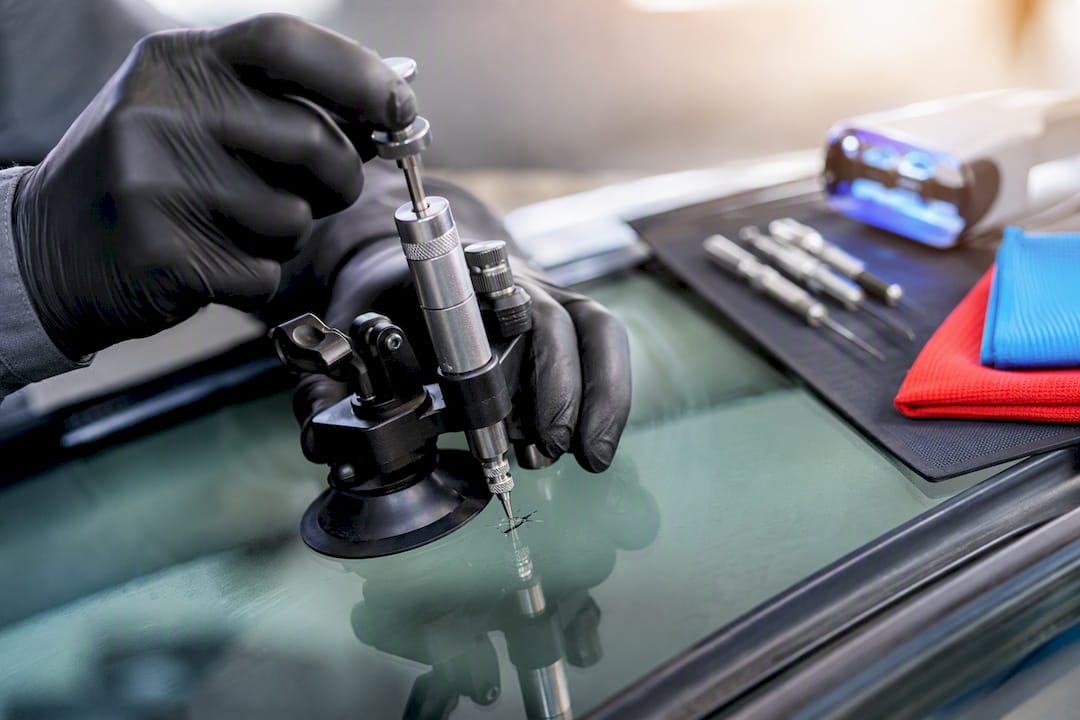
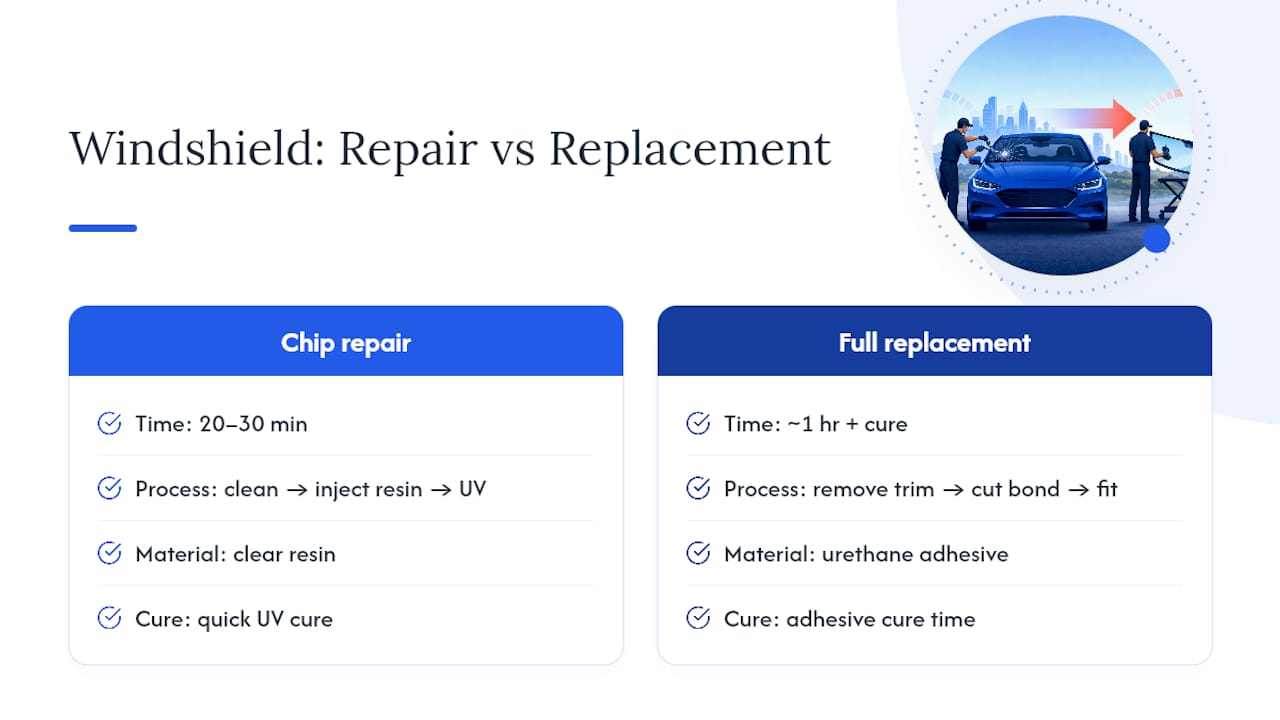
A standard chip repair takes roughly 20 to 30 minutes. A technician cleans the damaged area, injects a clear resin under pressure to fill the crack, then cures it with UV light. The repair won’t be invisible, but it stops the crack from spreading and restores most of the glass’s structural integrity. Costs for a single chip repair typically run far below the cost of a full replacement, and as noted earlier, many insurers cover it with no deductible.
Replacement is a longer process. Techs remove the trim, cut out the old adhesive bond, lift out the damaged windshield, and set a new one using urethane adhesive that needs time to cure. Expect the appointment itself to take about an hour or so, plus that cure time before the car is safe for highway speeds. Replacement costs more than repair, and the total climbs further if the vehicle needs ADAS camera recalibration afterward, which is standard on most cars built in the last several years.
The decision usually comes down to the checklist covered earlier: size, location, and whether the damage touches an edge or a sensor housing. When in doubt, a quick inspection settles it faster than guessing, and it’s worth reading through common mistakes people make during replacement before booking any appointment.
Where the Common Advice Gets This Wrong
Most articles on this topic hedge everything into vague territory: “it depends,” “consult a professional,” “cracks can be dangerous.” That’s technically true and practically useless. The honest answer is that location beats length almost every time. A three-inch crack tucked in the passenger corner is a lower priority than a half-inch chip sitting dead center in your sight line, and treating every crack as equally urgent, or equally ignorable, misses the point.
The other place conventional advice falls short is the legal side. Drivers assume there’s a grace period, a few weeks to “get around to it.” In practice, enforcement varies by officer and state, and a fix-it ticket can turn into a real fine if you miss the paperwork deadline. Treat the legal risk as immediate, not eventual.
If I had to boil this down to one priority: figure out where the crack sits before you worry about how long it is. Everything else, from repair urgency to ticket risk to airbag concerns, follows from that one detail.
— Matt
Get Your Windshield Fixed Without the Runaround
Some shops handle cracked or chipped glass repairs with fast, quality service that can combine the glass replacement and camera recalibration into a single visit to your location.

Some services offer in-house ADAS recalibration, avoiding the need to visit a dealer separately for camera alignment by combining it in a single mobile appointment, often at a convenient location like home or office. Some companies provide warranties on installs and use OEM-quality glass, and may offer direct insurance billing to reduce customer out-of-pocket expenses. Different vehicle types, including modern luxury models, may receive in-house calibration services, offering convenience without needing specialist referrals. If your crack matches any of the stop-driving signs covered above, book a windshield replacement today and get a technician to your location before the crack decides your timeline for you.
This article is general information, not a substitute for advice from a qualified lawyer. Consult a qualified legal professional about your own circumstances before acting on anything here.
Sources
- Is It Illegal to Drive With a Broken Windshield? – LegalClarity
- Cracked windshield laws | Progressive
Recommended
- Auto Glass Replacement: A Complete Guide for US Drivers
- ADAS Calibration
- Windshield Replacement
- Auto Glass Kings Review: ADAS Calibration After Glass Replacement
🎧 Listen to This Article
Share
Recent Posts

October 27, 2026
Windshield Frit Band: What the Black Edge Does
What is the black band and dot pattern around your windshield? Learn what frit is, why it matters for adhesive bonding, and what...

October 26, 2026
Heads-Up Display Windshield: What Changes When You Replace It
A HUD windshield is built differently from standard glass. See how it works, what to check before replacement, and why calibration matters in...
October 25, 2026
Lifetime Windshield Warranty: What It Covers and What It Doesn’t
A lifetime windshield warranty rarely covers everything. Learn what it should include, what it excludes, and how ADAS calibration and insurance fit in....