
Automotive
A rear window antenna is usually not a separate part at all. On most sedans, hatchbacks and SUVs, it is a thin conductive line printed on the back glass, often right beside the defroster grid. When the radio fades, crackles or dies, the cause is usually a break in those lines, a loose connector, or glass that was swapped for a piece without the right antenna circuit. This guide shows you how to tell which one you have, what a proper repair looks like, and when the whole back glass needs to be replaced.
TL;DR
- Many cars use the rear glass as the radio antenna. The defroster grid, or a trace next to it, does the receiving.
- Static that appears when the defroster is on, or weak FM that used to be fine, often points to a broken grid line. A conductive silver repair can fix it without new glass.
- A shattered or badly damaged back glass needs replacement with glass that has the correct antenna and defroster circuits for your vehicle.
- Glass-mounted aftermarket antennas, for CB or cell use, have their own limits, and the defroster grid is the main thing to stay away from.
- In Orange County, we replace back glass on site. Back window replacement starts from $350.
Table of Contents
- What a rear window antenna actually is
- Signs your rear window antenna is failing
- Why the defroster and the radio fight each other
- How to find the break: a simple test
- Repairing a broken grid line
- When replacement is the better answer
- Perspective: what we see in the field
- Glass-mount antennas: CB, cell and TV
- What to expect when we replace back glass
- Before you book: a quick checklist
- Book mobile back window service in Orange County
- FAQ
- Sources
What a rear window antenna actually is
Pick up almost any late-model sedan or hatchback and look at the back glass. The horizontal orange-brown lines are the defroster grid, a printed conductive ink that heats when you press the button. On many vehicles, one section of that pattern, or a separate set of lines near the top, is wired to the radio as the AM/FM antenna.
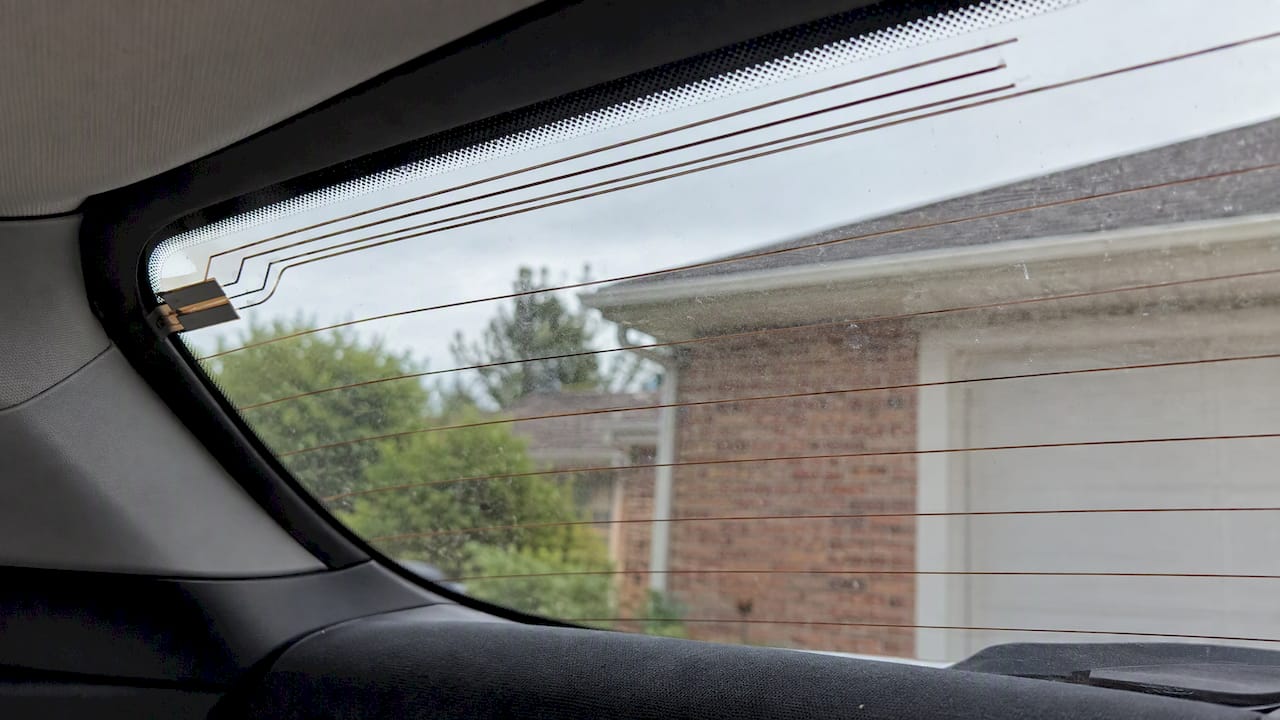
Manufacturers do this because it removes the mast, the car wash damage, the wind noise and the theft target. The tradeoff is that the antenna is now part of a piece of glass that can crack, scratch or be replaced.
It is not only the back window. Some vehicles bond the antenna element to a side piece instead. The factory manual for the 2007 Jeep Liberty, for example, says the integral radio antenna element is bonded to the right rear quarter glass and is replaced as part of the glass assembly only. So if your radio dies after a break-in or a cracked side glass, the antenna may be hiding in a window you did not expect.
Signs your rear window antenna is failing
The symptoms are consistent across makes:
- FM stations that fade or hiss in places where they used to play cleanly.
- Static or noise that starts when you switch on the rear defogger.
- A defroster that clears only part of the glass, with some lines staying fogged.
- Radio reception that dropped right after new tint, a sticker, a window film or a glass replacement.
- AM stations that vanish while FM still works, or the reverse.
A partly clearing defroster is the most useful clue. Fog that lingers in one band tells you exactly where a line is broken.
Why the defroster and the radio fight each other
Because the grid and the antenna share the same glass, a fault in one shows up in the other. Service bulletins from automakers describe this directly. A Subaru bulletin on radio static with the defogger on says the problem is often traced to a break in the grid lines that creates a high-resistance area. A GM bulletin for the 2007 Saturn Sky covers the same complaint: poor reception or static with the defogger on, or some grid lines not working.
The usual causes of a break:
- Scratches from the inside. Cargo, a seat belt buckle, a ring, or an aggressive scraper can slice a grid line.
- Aggressive cleaning. Abrasive pads or razor blades used on the inside of the glass remove conductive ink.
- Age and heat cycling. Lines can lift or crack at solder points where the terminals attach.
- Loose or corroded connectors. The tabs at the edge of the glass carry both the heating current and the antenna signal.
- Window film or metallic tint. Some films attenuate signal, particularly if they overlap the antenna area.
How to find the break: a simple test
The factory procedure is not complicated. The Subaru bulletin describes using a portable radio tuned to the same frequency as the affected station and moving the antenna outside near the glass to locate the break. The static changes as you pass the damaged spot.
A practical version for a driver:
- Park the car with the engine in accessory mode, so the defogger can be switched on.
- Look at the grid in good light. Photograph any line that looks faint, scratched or missing.
- Run the defogger for a few minutes with the glass cool. Mist the glass lightly with water and watch which lines clear first. A line that stays wet is not carrying current.
- Check both edge terminals for a loose or corroded connector.
- If you have a multimeter, a technician can measure along a suspect line. A good line reads continuous, and a break reads open.
If you do find a break, stop scrubbing at it. Do not use glass cleaner with ammonia on a damaged line, and keep rings and tools away until it is fixed.
Repairing a broken grid line
A broken line does not mean new glass. The same Subaru bulletin says the grid can be repaired with a conductive silver repair kit instead of replacing the whole glass. Products such as Permatex Quick Grid and Motorcraft PM-11 are the kind of kits named in that procedure.
The repair has four parts:
- Clean the area and mask the gap precisely, so the new line matches the width of the original.
- Apply the conductive compound across the break with a small overlap on each side.
- Cure it. Air drying takes about 24 hours, and the GM bulletin describes technicians fast-curing with a heat gun and checking the temperature with an infrared thermometer so the grid works before the car is returned.
- Test the result. A good repair carries current end to end, with resistance across it near zero.
The heat step is where DIY goes wrong. Glass tolerates heat unevenly, and a heat gun held in one spot can crack a rear window. Interior trim, tint film and the rubber seal around the glass can also be damaged. If your glass has a crack anywhere, or the line break sits close to the edge, treat this as a job for a technician.
When replacement is the better answer
Repairing a line makes sense when the glass is otherwise sound. Replace the glass when:
- The glass is cracked, shattered or chipped at the edge. A grid repair does nothing for structural damage. If it has just happened, see our emergency plan for a shattered rear window.
- Several lines are broken, or the ink is lifting across a large area.
- The antenna terminal or trace is damaged beyond a patch.
- Water has leaked in, corroded the connections and affected the module the antenna feeds.
The replacement glass must match the original in what it carries. Some back glass has only a defroster grid. Some adds an AM/FM antenna, a separate amplifier connection, a high-mount brake light opening, a wiper hole, or a privacy tint. Order the wrong variant and you may get glass that fits but gives you no radio reception.
Why OEM-quality glass matters for the antenna
Stellantis, in its Mopar guidance on glass replacement, makes a point that applies well beyond its own brands. It says aftermarket glass often lacks the engineered coatings and integrated antenna and sensor hardware of original glass, and that it can interfere with electronic systems. For a rear window antenna, the practical meaning is simple: the circuit on the glass has to line up with the connector on the car and with the radio’s expectations.
We discuss the same tradeoff for windshields, where cameras and HUDs are involved, in our guide on OEM versus aftermarket glass.
Perspective: what we see in the field
Most people call us about a rear window because the glass is shattered. The antenna usually comes up afterward, when the new glass is in and someone asks whether the radio will work the same.
Our view is that the antenna and defroster are part of the job, not an afterthought. When we replace back glass, we think about what the original carried: defroster, antenna, tint, brake light opening. We use OEM-quality materials and back every install with a lifetime warranty, because a back window that looks right and receives nothing is not a finished repair.
We also tell people honestly when glass does not need replacing. A single scratched grid line is a repair, not a new window. If your problem is a loose connector or a film that covers the antenna, no glass company should sell you a new piece.
Because we work mobile, we do the job where you are: in your driveway, at your office, or in a parking lot before your shift starts. We are available from 5 AM daily, so a busy morning does not have to be lost to a shop waiting room.
— Auto Glass Kings
Glass-mount antennas: CB, cell and TV
The keyword also catches people who want to add an antenna to the back window. That is a different project, with different rules.
Through-the-glass antennas. These mount with an adhesive pad on the outside and a coupling pad on the inside, and the signal passes through the glass by capacitive coupling. Hobbyist forums discuss this and advise staying away from the rear window’s heater elements. If you stick one over a grid line, you will degrade reception and may cover a line you later need to repair. Place it on clear glass, and read the antenna maker’s guidance on where.
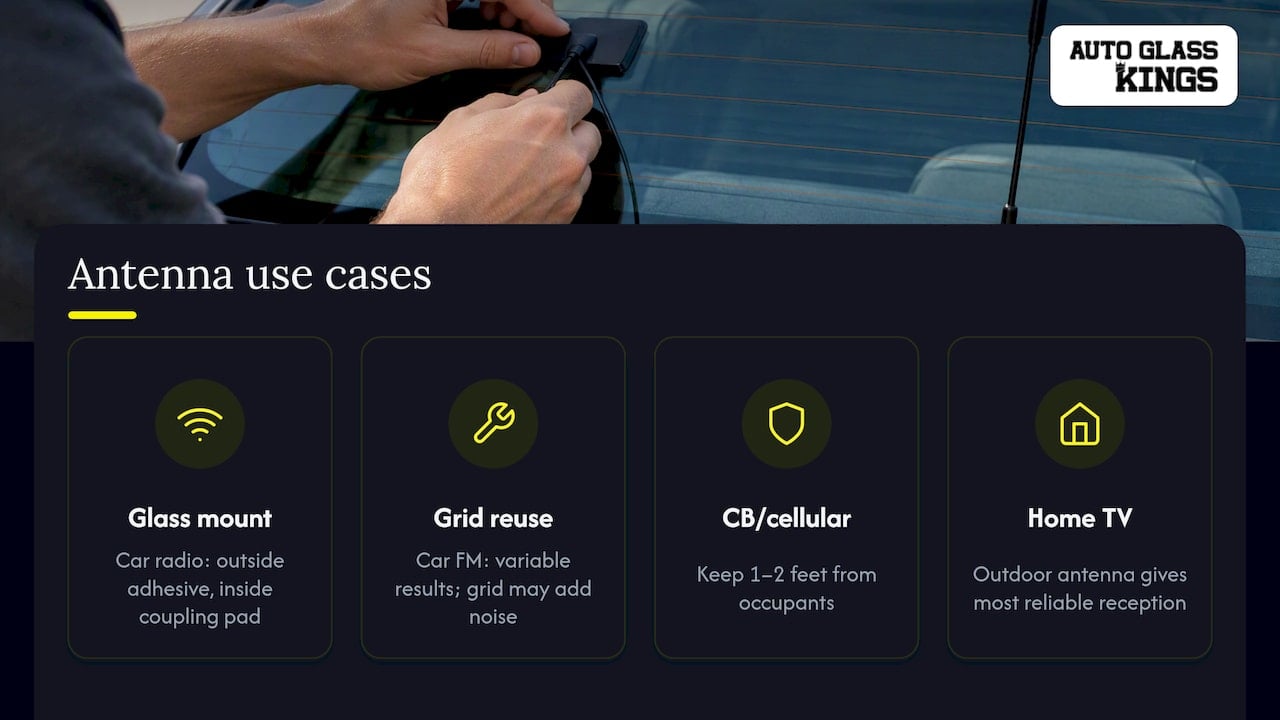
Using the defroster as an antenna. Some owners of older cars rewire the grid as the radio antenna, usually for FM. Results vary by car, and the defroster current can introduce noise. It is a hobby fix, not something we would do on a vehicle you rely on every day.
Safety distance. The FCC says vehicle antennas used for wireless communications normally operate at three watts or less, and that those mounted on the rear window should be kept a foot or two from occupants. The FCC also notes that the vehicle body provides shielding. This applies to transmitting antennas such as CB and cellular boosters, not to the passive radio antenna in your glass.
TV antennas. The question of whether a TV antenna belongs near a window is a home question, not a car one. For what it is worth, AntennaWeb recommends an outdoor antenna for the most reliable digital TV reception and, if you must go indoors, a window facing the broadcast towers. The FCC adds that you need an antenna that handles both VHF and UHF channels to get every local station. None of that applies to your car’s radio.
What to expect when we replace back glass
Here is how the job goes with us in Orange County:
- You call with the vehicle, the symptom and your insurer. We confirm what the original glass carried.
- We come to you. Mobile service is free, so there is no charge to bring the shop to your home or office.
- We remove the broken glass and vacuum the cargo area and seats. Shattered tempered glass spreads far.
- We fit the new glass with the correct adhesive and attach the defroster and antenna connections.
- We test the defroster and the radio before we hand the car back.
- We bill your insurer directly if you have glass coverage. Many customers pay nothing out of pocket.
On price, back window replacement starts from $350. The final figure depends on the vehicle and the glass specification, so we quote after we know what your car has. If your insurance includes glass coverage, ask us to check it. For a wider view of how replacement costs and claims work in the county, see our guide to auto glass replacement in Orange County.
Does a back window affect ADAS?
Usually not directly. Most driver-assistance cameras sit behind the windshield, so a back window swap does not normally require camera calibration. Some vehicles have rear sensors and cameras mounted elsewhere, though, and any job that touches those parts should follow the manufacturer’s procedure. If your vehicle also needs a windshield, we complete the required ADAS calibration in house, in the same visit.
Before you book: a quick checklist
- Note the symptoms: static, weak FM, or a partly clearing defroster.
- Take a photo of the glass, inside and outside, in daylight.
- Remove window film or stickers near the top of the glass and see if reception returns.
- Look for a connector at either edge of the grid and make sure it is seated.
- Write down your year, make, model and trim, plus any options such as privacy glass or a rear wiper.
- Have your insurance details ready.
If the glass is cracked or shattered, skip the testing. Cover it, keep the vehicle indoors if you can, and call.
Book mobile back window service in Orange County
If your back glass is broken, or you have found that the antenna and defroster are beyond a patch, we can replace it on site. Check the details on our back window replacement page, or reach us through Auto Glass Kings. We come to you, we back the install with a lifetime warranty, and we can handle the insurance billing.
FAQ
Is the rear window defroster the same as the radio antenna?
On many cars they share the same glass, and sometimes part of the same printed pattern. Others use a separate antenna trace beside the grid. The two circuits are connected to different terminals, so check your owner’s manual or ask a technician about your model.
Why does my radio get static when the rear defogger is on?
The most common cause named in manufacturer service bulletins is a break in a grid line, which creates a high-resistance spot. A loose connector can do the same. A technician can locate the break and repair it with a conductive silver kit if the glass itself is sound.
Can a broken defroster line be repaired without replacing the window?
Yes, in many cases. Conductive repair kits are designed for a clean break in a grid line. The repair has to be cured and tested, and it will not help if the glass is cracked or many lines have failed.
Will new back glass keep my radio working?
It should, if the replacement has the same antenna and defroster circuits as the original and is connected correctly. That is why the glass specification matters. We test the radio and the defroster before we leave.
Can I put a stick-on antenna on the rear window?
Through-the-glass antennas exist, but keep them off the defroster lines and on clear glass. Transmitting antennas, such as CB, should also be kept away from occupants, as the FCC advises. Follow the antenna maker’s instructions for placement.
Sources
- Subaru service bulletin 15-126-07: radio static when the rear window defogger is on
- GM bulletin for the 2007 Saturn Sky: diagnosing and repairing the rear defogger grid
- FCC: Human exposure to RF fields from vehicle-mounted antennas
- FCC: Antennas and digital television
- AntennaWeb: antenna information
- Stellantis Mopar glass replacement guidance
- 2007 Jeep Liberty KJ factory service manual: quarter glass integral antenna
Recommended
- Under 2 Hours: Car Owners’ Emergency Plan for a Shattered Rear Window
- Fix an Off Track Car Window in an Afternoon, Safety Steps First
- DIY or Mobile Pro: Quarter Glass Replacement, ADAS and Drive Away Rules
🎧 Listen to This Article
Share
Recent Posts

October 27, 2026
Windshield Frit Band: What the Black Edge Does
What is the black band and dot pattern around your windshield? Learn what frit is, why it matters for adhesive bonding, and what...

October 26, 2026
Heads-Up Display Windshield: What Changes When You Replace It
A HUD windshield is built differently from standard glass. See how it works, what to check before replacement, and why calibration matters in...
October 25, 2026
Lifetime Windshield Warranty: What It Covers and What It Doesn’t
A lifetime windshield warranty rarely covers everything. Learn what it should include, what it excludes, and how ADAS calibration and insurance fit in....