
Automotive
A persistent whistle or hiss after a windshield replacement is not normal, and it almost always means an unsealed gap, a loose molding, or a misfit trim panel. Note the speed and side where it happens, run a quick window-up sound check and a water test, and skip the urge to pry at trim. Then call your installer. If a workmanship warranty came with the job, this is exactly what it covers.
TL;DR:
- Windshield whistling at high speeds usually indicates a pinhole gap in the urethane bead or a misfitted trim panel, not a normal post-replacement sound.
- Post-replacement noise mostly stems from gaps, unseated moldings, or loose trims caused by installation issues, which are covered under workmanship warranties.
- Diagnosing wind noise involves simple tests like taping suspect areas and conducting water sprays, with proof speeding up repairs and warranty claims.
- Fixes range from reseating moldings or clips to full reinstallation, with accurate diagnosis essential for effective, warranty-covered repairs.
- Persisting wind noise beyond initial curing typically signals an installation flaw that requires prompt inspection and correction by a qualified technician.
Table of Contents
- What Does Windshield Whistle Vs. Hiss Vs. Buzz Actually Mean?
- Why Do Windshields Whistle Or Buzz After A Replacement?
- How To Diagnose Wind Noise Yourself Before Calling The Shop
- What Repairs Fix Wind Noise After A Windshield Replacement?
- Does Windshield Replacement Affect ADAS Calibration Too?
- How Do I Get My Shop To Fix Wind Noise Under Warranty?
- How Auto Glass Kings Approaches A Wind Noise Complaint
- Can You Temporarily Reduce Wind Noise Before Getting It Fixed?
- Does Driving Speed Or Weather Change Windshield Wind Noise?
- What Owners Get Wrong About Post-Replacement Noise
- Book A Wind Noise Diagnostic With Auto Glass Kings
- Sources
- FAQ
What Does Windshield Whistle Vs. Hiss Vs. Buzz Actually Mean?
The sound your windshield makes tells you where to look before you ever pop the hood or grab a hose. Air noise breaks down into a handful of recognizable signatures, and each one points toward a different problem.
- Whistle: A thin, high-pitched tone, usually starting around 55 to 70 mph, often traced to a pinhole gap in the urethane bead or a small void where trim meets glass.
- Hiss or roar: A broader, steadier sound across a wider speed range, typically from a longer gap along the molding or an unseated edge trim run.
- Flutter or buzz: A rattling, vibrating noise that comes and goes with wind gusts or road texture, often a loose clip or a trim piece that isn’t seated flush against the pillar.
- Crackle or tick: A brief popping sound, most common in the first day or two, usually just the urethane adhesive settling into its final position.
The location matters as much as the sound. A whistle coming from the top corner points to the A-pillar area. A hiss along the whole top edge suggests a longer run of unseated molding. Knowing which one you’re hearing saves the technician time and helps you describe the issue precisely when you contact the shop for a corrective inspection.
Why Do Windshields Whistle Or Buzz After A Replacement?
Here’s what typically causes it:
- Gaps or voids in the urethane bead. Even a pinhole gap whistles at highway speed, and the same gap that lets air in can eventually let water in too. This is the cause installers take most seriously because it’s both a noise problem and a leak risk.
- Unseated exterior molding or missing clips. If the trim strip that runs along the edge of the glass isn’t fully clicked into place, or a clip broke during install, you get a whistle or roar that tracks the length of that molding run.
- Cowl panel or A-pillar trim misfit. The plastic cowl below the windshield and the trim along the pillars can hum or vibrate under crosswind if they were reinstalled loosely, a problem Cascade Auto Glass lists among the most common post-replacement complaints.
- Wrong glass specification. A replacement windshield without the original acoustic laminate can make the cabin louder overall, even when the seal itself is flawless, according to Glow Auto Glass.
- Sources that have nothing to do with the windshield. Door seals, side mirrors, and roof racks can all produce whistles that get blamed on a fresh windshield simply because of timing.
The severity ranges widely. A loose cowl clip is a five-minute fix. A gap in the adhesive bead is a warranty-covered repair that needs prompt attention, because it’s a leak waiting to happen, not just a noise annoyance.
How To Diagnose Wind Noise Yourself Before Calling The Shop
Before you pick up the phone, spend fifteen minutes gathering evidence. A vague “it’s noisy” complaint gets you a vague response. A specific one, backed by video and a repeatable test, gets you a fast fix.
Step 1: Record the baseline. Note the speed where the noise starts, which side of the vehicle it comes from, and whether weather or humidity changes it. Shoot a short phone video with audio at that speed if you can do it safely, ideally with a passenger recording while you drive.
Step 2: Run the window-up sound check. Close every window fully and drive the same stretch of road at the speed where you first noticed the noise. If it disappears with windows sealed tight but returns the moment you crack one, you may be dealing with a door seal issue rather than the windshield.
Step 3: Isolate the zone with painter’s tape. Cover suspect areas, such as the top molding, one A-pillar, or the cowl edge, with wide painter’s tape and drive the same route. Shop guidance recommends this exact method because the pass that eliminates the noise identifies the culprit zone, turning a guess into a testable finding.
Step 4: Run a controlled water test. With the engine off, run a garden hose at low pressure directly on the glass and trim, starting at the bottom and working up, while a second person checks the interior corners for moisture. A controlled water test separates a cosmetic trim rattle from an actual seal breach that needs immediate attention.

Pro Tip: Remove the painter’s tape the same day you test, especially in direct sun. Left on too long, it can bake onto clean paint and leave residue that’s more annoying than the original noise.
Never pry at the molding yourself or apply a household sealant as a quick patch. Doing either can snap a clip, damage paint, or compromise the urethane bond, and it can void the very warranty coverage that would have covered the fix for free.
What Repairs Fix Wind Noise After A Windshield Replacement?
The right fix depends entirely on what your tape and water tests reveal, and the range runs from trivial to involved.
- Reseat the molding or reset clips. If a trim piece simply didn’t click fully into place, snapping it back down or replacing a broken clip solves it in minutes. This is the most common fix and should always be covered under workmanship warranty.
- Reseat the cowl panel. A loose cowl at the base of the windshield gets pulled back into position and re-clipped. No adhesive work needed.
- Reseal or partial re-bond. If the water test shows moisture entering through a specific section of the urethane bead, the technician cuts back that section, cleans it, and rebonds it rather than redoing the whole installation.
- Full reinstallation. Reserved for cases where the bead has multiple voids or the glass was set improperly across a wide area. This means pulling the windshield, replacing the urethane entirely, and starting the cure clock over.
- Swap to correct-spec glass. If the wrong-spec windshield explains a general increase in cabin loudness rather than a specific whistle, the fix is replacing it with the correct acoustic-laminate part, confirmed against the vehicle’s VIN.
One scheduling detail matters here: urethane adhesive needs real cure time, and any correction that involves removing and resetting the glass restarts that clock. If your vehicle has forward-facing cameras or sensors mounted near the windshield, a full reinstall or reseal that shifts the glass typically requires a fresh ADAS calibration before the vehicle is considered roadworthy again.
Does Windshield Replacement Affect ADAS Calibration Too?
Wind noise and calibration problems are two separate issues that sometimes show up from the same job, and it’s worth knowing the difference. Noise is something you hear. A calibration problem shows up as a dashboard warning, a disabled lane-keep system, or an automatic braking feature that stops working.
- Static calibration happens in a controlled bay using target boards and precise measurements, usually required for certain camera-based systems.
- Dynamic calibration requires an actual road drive at specified speeds so the system can relearn its reference points.
- Some vehicles need both, and a legitimate shop will tell you which one your car requires.
If any driver-assist warning appears after the glass was replaced, that’s a calibration flag, and shop guidance is clear that it should be diagnosed and corrected as its own line item, not lumped in with a noise complaint. Ask for a written calibration report. Fixing the calibration will not stop a physical air leak, and fixing the leak will not recalibrate a camera. Both may need separate attention on the same visit.
How Do I Get My Shop To Fix Wind Noise Under Warranty?
Walking in with evidence turns a “let me take a look” into a same-visit fix. Here’s the escalation sequence that works:
- Bring your recordings. The short video with audio at the speed where the noise happens, your tape-isolation notes on which zone silenced it, and any photos from the water test.
- Bring your original invoice. This proves the installation date and confirms warranty eligibility without an argument.
- Ask for a documented process. Request a physical inspection, a road test at the speed you identified, a repeat of the controlled leak test, and a written calibration report if any ADAS component was involved.
- Watch for red flags. A shop that minimizes the complaint, refuses to road test, or tells you to just live with it is not handling it correctly.
- Escalate if needed. If the installer won’t act, request a second opinion from another certified shop or involve your insurer if the original job was billed through a claim.
How Auto Glass Kings Approaches A Wind Noise Complaint
Reputable shops run every replacement with high-quality materials and back the work with a warranty, which matters most on the exact kind of callback this article covers. When a customer reports a whistle or hiss, the process starts with the same tape-isolation and controlled water test described above, followed by a road test at the speed the customer reported. When ADAS recalibration is handled in-house rather than outsourced, any correction that shifts the glass can get a calibration readout on the same visit instead of a second appointment. Bringing recorded evidence to that appointment speeds the whole process along.
Can You Temporarily Reduce Wind Noise Before Getting It Fixed?
If you can’t get in for a repair right away, a few low-risk steps can dial down the noise without making the underlying problem worse.
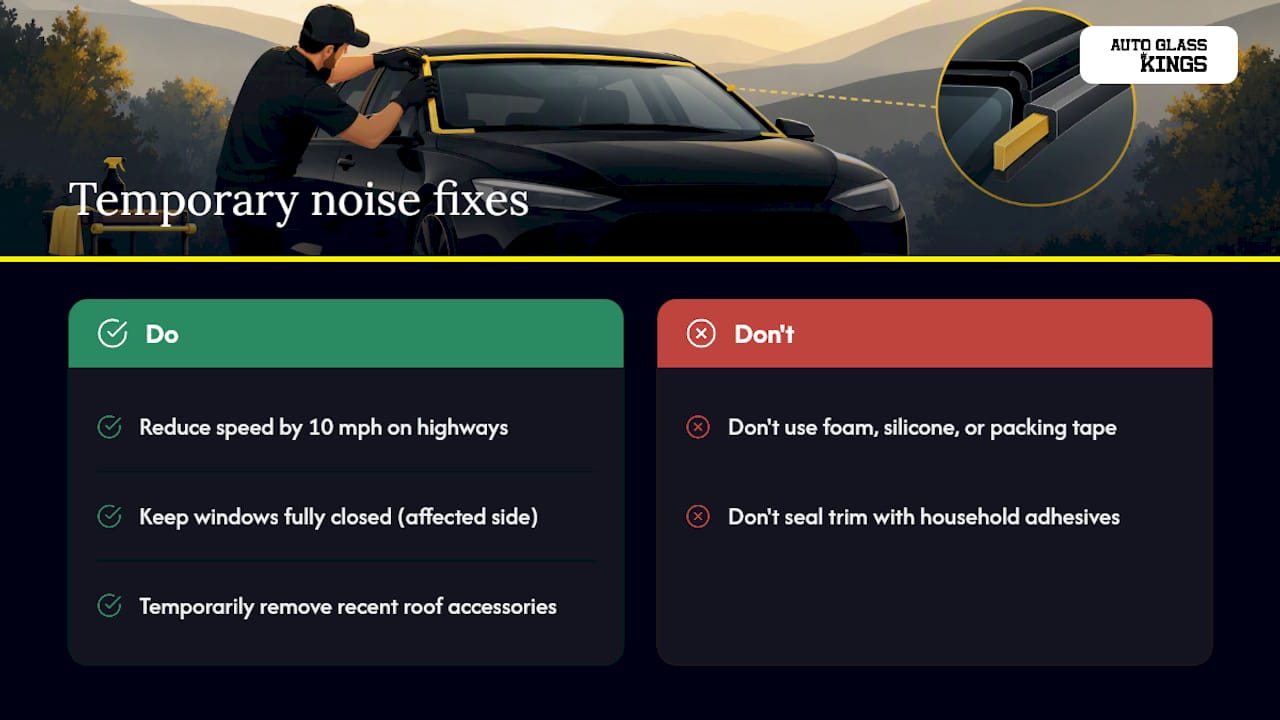
Driving a little slower helps more than most people expect, since air noise from a gap or loose trim tends to scale sharply above 55 mph rather than increasing in a straight line. Dropping ten miles per hour on the highway can take a whistle from constant and annoying down to barely noticeable.
If the sound only shows up with a window cracked, keep windows fully closed until the repair, especially on the affected side. This won’t fix anything, but it confirms your diagnosis was right and keeps the drive tolerable in the meantime.
Avoid the temptation to “fix” it yourself with foam tape, silicone caulk, or clear packing tape pressed along the trim, as explained in this guide on window tint and film removal. These household fixes trap moisture against the seal, can leave adhesive residue that complicates the real repair, and, as shop guidance warns, risk damaging the bond or paint in ways that void your warranty coverage entirely.
Roof racks, roof boxes, and antenna mounts installed around the same time as your windshield can also add or amplify wind noise. If you added any accessory around the time of the replacement, temporarily remove it before your isolation test so you’re not chasing the wrong source.
Does Driving Speed Or Weather Change Windshield Wind Noise?
Speed is the single biggest variable in how loud a windshield leak sounds, which is exactly why the speed you note matters so much for diagnosis. Air pressure against a gap increases sharply as speed climbs, so a whistle that’s inaudible at 40 mph can become impossible to ignore at 70. That relationship is also why a technician’s road test needs to hit the specific speed you reported. Testing at 35 mph in a parking lot won’t reproduce a problem that only shows up at highway speed.
Weather plays a smaller but real role. Crosswinds amplify noise from loose trim or cowl panels because the airflow hits the gap at an angle rather than straight on, which is why the same drive can sound different on a calm day versus a windy one. Cold weather can also make some noises more noticeable temporarily, since materials contract slightly and small gaps in trim can open a fraction more until temperatures warm back up.
Humidity and rain don’t usually change the pitch of the noise itself, but they turn a noise problem into a leak problem fast if the underlying cause is a gap in the adhesive bead. This is one more reason the water test matters: it tells you whether you’re dealing with an annoyance or something that needs urgent attention before the next storm.
What Owners Get Wrong About Post-Replacement Noise
The conventional advice on this topic tends to stop at “give it a few days to settle,” and that’s only half right. A brief tick or crackle while urethane finishes curing is normal and usually fades within a day or two. A whistle that’s still there on day three is a different animal entirely, and treating it with the same patience wastes time while a small gap potentially turns into a leak.
The bigger gap in most advice is the assumption that owners can’t meaningfully diagnose this themselves. They can. Tape isolation and a garden hose turn a vague complaint into evidence a shop can’t dismiss, and that evidence is what gets a same-visit fix instead of a “we’ll look into it” brush-off.
What should come first is not calling the shop, it’s documenting the problem the way this article outlines. Show up with video, a named zone, and a clear description, and a competent installer will fix it fast because the guesswork has already been done.
— Auto Glass Kings
Book A Wind Noise Diagnostic With Auto Glass Kings
If you’ve run the tape and water tests and still have a whistle, hiss, or buzz, the fastest path forward is an on-site inspection rather than another round of phone tag. The diagnostic can be brought to your driveway or office, with checks on the molding, cowl, and bead for the exact gap causing the sound, and handling any ADAS recalibration in-house on the same visit if the fix involves moving the glass. Some repairs include a workmanship warranty, so a callback down the road may cost nothing.

Bring what you already gathered: your phone video at the speed the noise happens, notes on which taped zone silenced it, and your original installation invoice. That evidence lets the technician skip straight to the fix. Ready to get it resolved? Request a windshield inspection quote and get a technician scheduled at a time that works around your day.
Sources
For more detail on causes, testing methods, and warranty expectations, see Quick Fix Windshields, Cascade Auto Glass, and Glow Auto Glass. To book a diagnostic, visit the Auto Glass Kings quote page.
- Leaks and Wind Noise After Windshield Replacement — Quick Fix Windshields
- Wind Noise After Windshield Replacement: Causes & Fixes — Cascade Auto Glass
- Wind Noise After Windshield Replacement: Causes and Fixes — Glow Auto Glass
FAQ
Is It Normal To Hear Air Noise After A Windshield Replacement?
A little settling noise in the first day or two is normal while the urethane adhesive cures, but a persistent whistle or hiss beyond that is not and usually points to a gap or loose trim.
Is Wind Noise Normal After A Windshield Replacement From Any Shop?
No. Wind noise that continues past the initial settling period signals a workmanship issue regardless of which shop performed the job, and it should be inspected under warranty rather than treated as expected.
How Long Does It Take For A Windshield Replacement To Settle?
Minor cracking or ticking sounds from adhesive settling typically fade within a day or two; noise that persists longer than that needs a proper diagnostic check.
Is It Normal For My Windshield To Make Noise After Being Replaced?
Brief settling sounds are expected initially, but ongoing whistling, hissing, or buzzing is not and usually traces to an unsealed gap, loose molding, or a misfit trim panel that a technician can identify with a tape and water test.
What Should I Bring To A Warranty Inspection For Wind Noise?
Bring a short video with audio recorded at the speed where the noise occurs, notes from any tape-isolation test showing which zone silenced it, photos from a water test if moisture appeared, and your original installation invoice.
Recommended
- Auto Glass Replacement: A Complete Guide for US Drivers
- Auto glass replacement: 7 common mistakes to avoid
🎧 Listen to This Article

Share
Recent Posts
October 6, 2026
1–3 Hours Per Door: Run Channel Replacement That Puts Fitment First
DIY run channel replacement with a fitment-first approach. Follow parts, tools, and a 1–3 hours per door procedure, plus when to call a...
October 5, 2026
Expect $305–$3,400: U.S. Tesla Windshield Costs and How to Save
U.S. model-by-model Tesla windshield price ranges ($305–$3,400 observed). Practical steps to cut out-of-pocket costs, mobile ADAS calibration options, and…...
October 4, 2026
Drivers, Follow Your Installer’s Wash Time After Windshield Replacement
Follow your installer’s written safe-wash time. If none, wait 24 hours for a hand wash and 48 to 72 hours before automatic or...