
Automotive
A sharp, slightly sweet, chemical smell in your car right after a windshield replacement is almost always the urethane adhesive that bonds the glass to the body. It is strongest in the first hours, fades as the adhesive cures, and you can speed its exit with fresh air, not heat. If it is still strong after two days, or it gives you headaches or breathing trouble, call your installer. For Orange County drivers, that call is simple: we come to you, and every install we do carries a lifetime warranty.
TL;DR
- The smell comes from the urethane adhesive and primer used to bond the glass. It is expected after a replacement and fades as the adhesive cures.
- Ventilate with fresh-air mode and a couple of partly open windows. Do not try to bake the smell out with heat.
- Inhaled urethane vapors can irritate airways in sensitive people, so leave the car and get fresh air if you feel dizzy, wheezy or short of breath.
- A smell that is still strong after about 48 hours is a reason to call your installer, because it can point to a bond that needs a second look.
- A smell with no recent glass work usually has another cause, such as exhaust, coolant or burning plastic, and needs a different check.
Table of Contents
- Why a car smells like urethane after windshield work
- How long the smell lasts
- Is the smell harmful?
- How to clear the smell without hurting the bond
- When to call your installer
- When the urethane smell is not urethane
- Why mobile installation helps with this
- Promo: glass work handled at your driveway or office
- Perspective
- FAQ
- Sources
Why a car smells like urethane after windshield work
Modern windshields are not held in by a rubber gasket alone. They are bonded to the vehicle with a polyurethane adhesive, and the glass and the metal edge (the pinchweld) are first treated with a primer. Both products contain chemicals that give off vapor while they dry and cure. Inside a closed cabin, that vapor is what you smell.
The odor is often described as sweet, sharp or like nail polish remover or new paint. It tends to be most noticeable when you first open the door after the car has sat closed, especially in warm weather, because the cabin traps the vapor.
Adhesive makers know this is a comfort and health issue. Sika, one of the large suppliers of windshield adhesives, notes that solvent smell after a windshield installation can be unpleasant and in some cases affect health, and describes its newer solvent-free formulas as leaving no unpleasant odor in the car. Which product goes into your car depends on the installer, so a noticeable smell does not by itself mean something went wrong.
If you want the chemistry behind it, including adhesive types, primer and cure times, we explain it in our guide to windshield urethane adhesive.
How long the smell lasts
There is no single number, because the odor follows the cure, and the cure depends on the adhesive product, temperature and humidity. Two clocks matter:
- Safe drive-away time. The point at which the bond is strong enough to drive on. Your technician gives you this number for your specific install. Our guide to how long until you can drive after windshield replacement explains it.
- Full cure. The point at which the adhesive has reached final strength all the way through. This takes longer than drive-away time, and the smell keeps fading as you approach it. We break down the timeline in the 3 windshield replacement clocks.
A practical way to read it: the smell should be clearly weaker on day two than on day one, and for most drivers it is gone or barely noticeable within a few days. Warm, dry weather and good airflow help. Cold or very humid conditions slow the cure and can keep the odor around longer.
The 48 hour mark matters most. A smell that is not clearly improving by then is worth a phone call, as explained below.
Is the smell harmful?
For most people a faint odor is an annoyance. But it is not something to breathe in for long, and a few groups should take it seriously.
The key ingredient to know is isocyanate. It is the reactive chemical that makes polyurethane adhesive cure. Volvo Car U.S. LLC, in its statement on replacing windshields, warns that inhaled polyurethane adhesive can cause asthma-like symptoms, that isocyanate vapor from primer or adhesive can trigger respiratory allergies, that very low levels can be enough to set off a reaction, and that the risk remains until the material is fully cured.
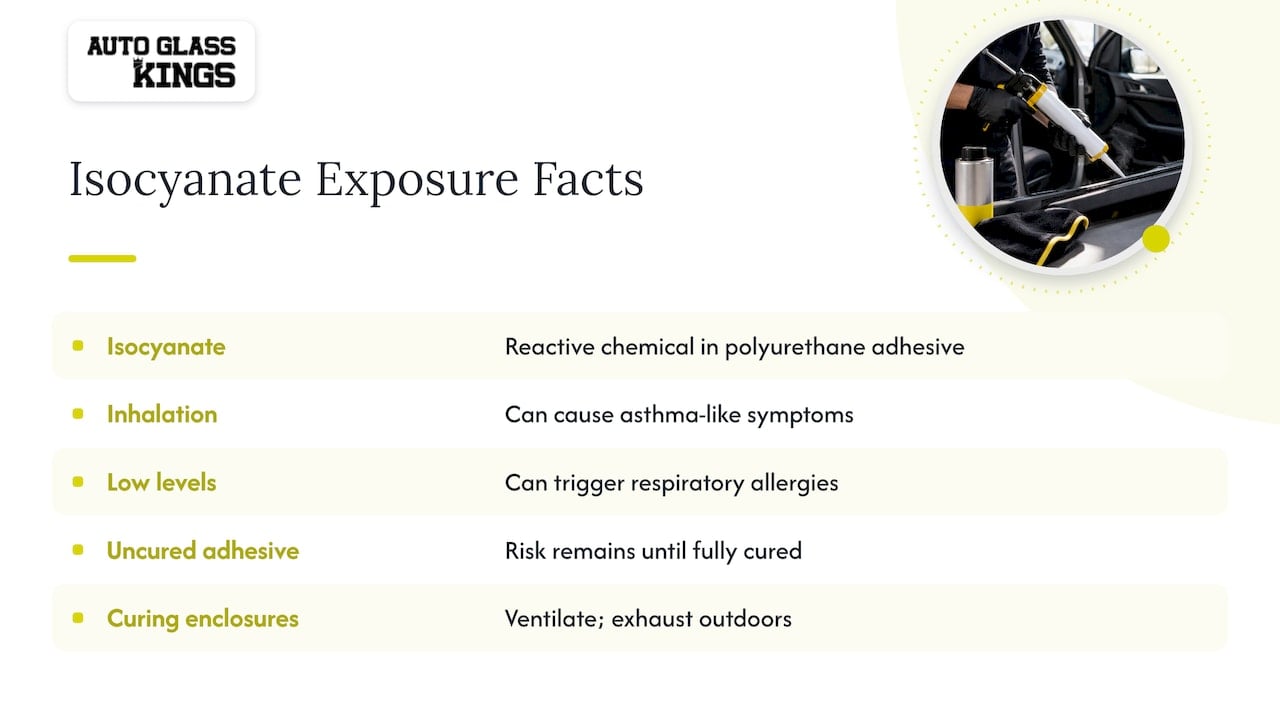
Workplace safety data gives a sense of how seriously the industry treats it. The safety data sheet for 3M Windo-Weld urethane lists a ceiling exposure limit of 0.02 ppm for MDI, a common isocyanate, and says curing enclosures must be ventilated and exhausted outdoors. That is why airflow is the right response in your own car too.
Who should be extra careful
- People with asthma or other chronic breathing conditions
- Anyone who already reacts to fumes, paint or cleaning products
- Children, pregnant passengers and older adults, who are best kept out of a freshly bonded cabin until the odor has dropped
When to stop and get help
If you notice wheezing, chest tightness, a cough that will not settle, dizziness, a severe headache or burning eyes and throat, get out of the car, get fresh air and do not keep driving it with the windows shut. Call your doctor for symptoms that persist, and call 911 for trouble breathing. Then tell your installer what happened.
How to clear the smell without hurting the bond
The goal is to move air through the cabin without disturbing the new glass or the curing adhesive. Here is the routine we would give a friend.
1. Follow the technician’s first-hours instructions
Your installer will tell you how long to wait before driving, what to do about the tape that holds the glass, and how to treat the windows and doors. Those instructions are matched to the adhesive used. Our 48 to 72 hour aftercare steps cover the usual list.
2. Use fresh air, not recirculation
Once you are cleared to drive, run the climate system on fresh-air mode rather than recirculate, and keep at least two windows partly open. ScienceInsights recommends exactly this approach to keep flushing volatile compounds out of the cabin. Short drives with the air moving help more than leaving the car parked and shut.
3. Park in open air, in shade
A car left closed in direct summer sun gets very hot inside, and heat is not your friend here. Sika explains that PUR adhesive releases carbon dioxide as it cures, and heating the bead releases that gas faster, which can create small bubbles. So do not use heat lamps, hair dryers or a closed hot car to bake the smell out. Shade and breeze are the safer choice.
4. Wipe the interior glass and hard surfaces
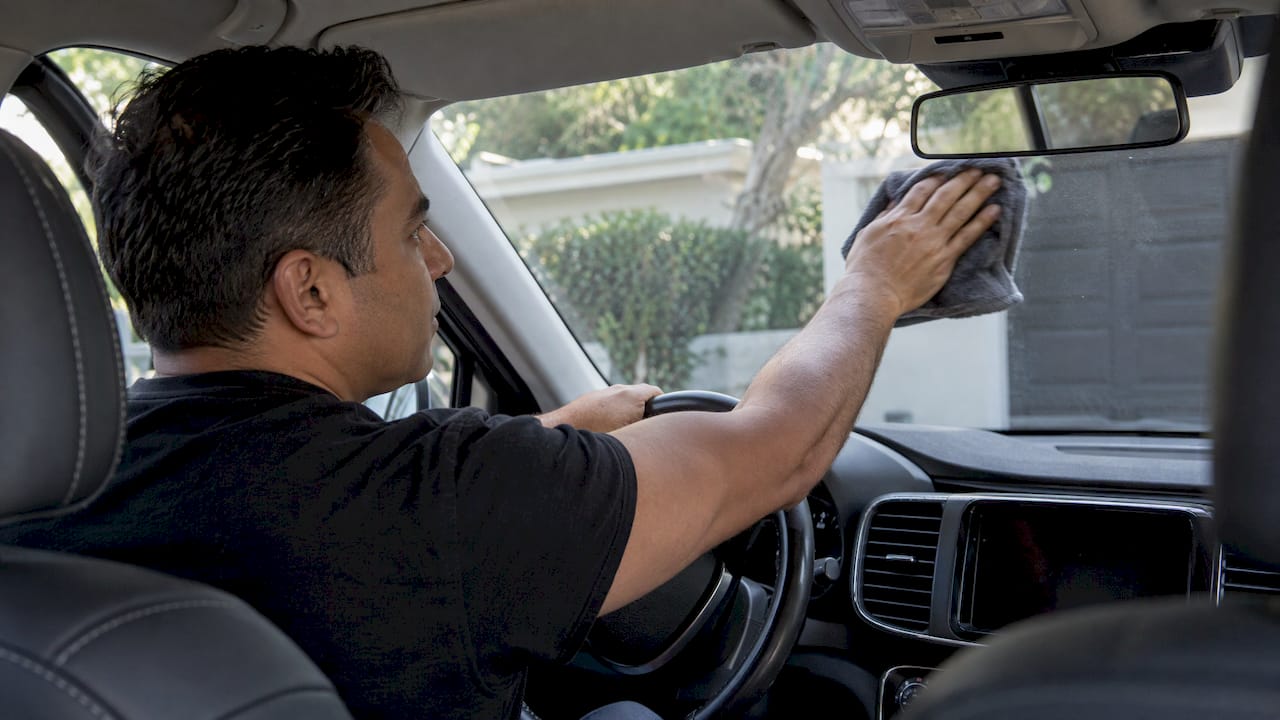
A thin film of off-gassed chemicals can settle on glass and dashboard plastics and release odor again. ScienceInsights suggests wiping these surfaces with a damp microfiber cloth and a mild, unscented cleaner. Skip heavily perfumed sprays: they stack a second smell on top of the first. Be gentle around the edges of the new glass and do not scrub the molding or any tape the installer left in place.
5. Deal with fabric and lingering odor last
If the smell has soaked into upholstery or the headliner, wait until the glass is fully cured, then work through the cabin. This guide to interior odor removal steps walks through the options for cabin odors in general.
Avoid fogging or ozone treatments in the first couple of days, and avoid pressure washing or an automatic car wash until your installer says the adhesive is ready. Our guide to wash time after windshield replacement explains why.
When to call your installer
Call if any of these apply:
- The smell is as strong on day two or three as it was right after the install.
- The odor is accompanied by headaches, nausea or breathing symptoms.
- You hear wind noise, see moisture, or notice a gap or lift at the glass edge along with the smell.
- The smell is a fuel, burning or coolant odor instead of the sweet chemical one.
The 48 hour threshold is a common installer rule of thumb: a smell that persists beyond 48 hours may point to incomplete bonding that needs correction. We treat it the same way. Adhesive that has not cured properly can come from surface contamination, the wrong or expired primer, or too little time, warmth or humidity during the cure, and a quick inspection tells the technician which it is. Surface prep, primer and curing conditions all affect how well a bond forms, which is why professional installs are done in controlled steps.
If the smell comes with a leak, our 6 checks for a windshield leak after replacement show what to look at while protecting your warranty.
When the urethane smell is not urethane
Search results for this topic are full of drivers describing very different smells. If you have not had glass work recently, the adhesive is not your problem. A rough sorting:
| Smell | Common cause | What to do |
|---|---|---|
| Sweet, chemical, after glass work | Urethane and primer curing | Ventilate, wait, call after 48 hours if no improvement |
| Burning rubber or plastic | Debris on the exhaust, electrical issue, slipping belt | Have it checked soon, stop driving if you see smoke |
| Sweet syrup smell with fogging glass | Coolant leak into the heater | Have it inspected promptly |
| Exhaust fumes in the cabin | Exhaust leak or poor sealing | Drive with windows open and get it checked right away |
| Musty or sour | Moisture in carpets or the HVAC system | Find the water source and dry it out |
Exhaust smell in the cabin is a carbon monoxide risk. Do not wait that one out. Open the windows and see a mechanic the same day.
Why mobile installation helps with this
When glass is installed in a bay with a dealer or a shop, you drive away and the car then cures in your garage or office lot. Cure conditions are partly in your hands. A mobile install changes the picture in a useful way: the technician is with you when the work is done, so you can ask about the adhesive, the drive-away time and how to handle the windows, and you can phone the same crew if the smell worries you.
We do all glass work and any required ADAS calibration in-house, on-site and in one visit, so there is no second trip to a dealership. That matters for the smell too: the car is not shuttled between sites in the first hours of the cure. We are available from 5 AM daily, which suits Orange County commuters who want it done before work.
Promo: glass work handled at your driveway or office
If your windshield is cracked, or you are due for a replacement, we come to your home, office or school lot at no charge for the visit, using OEM-quality materials and backed by a lifetime warranty on every install. We bill most insurance carriers directly, and many clients report paying nothing out of pocket.
Start with windshield replacement. If a chip is the only problem, windshield repair is listed at $79–$129. If your car has driver-assistance cameras, ADAS calibration is listed at $250–$700. You can also see how mobile windshield replacement works, from first visit to final checks.
Perspective
We think a good windshield job is one you do not have to think about afterward. That includes the smell.
Urethane odor is a sign the adhesive is working, and the right response is clear air and patience, not a scented spray or a heat gun. We would rather you ask us about it than guess, because the smell, the drive-away time and the cure are all part of one process.
That is why we do the glass and the calibration in one visit, on-site, with OEM-quality materials and a lifetime warranty on every install. Whether you are a parent in a carpool line, a professional with an 8 AM meeting or a classic car owner with a rare piece of glass, the work should end with a car you can trust and a technician you can call.
Auto Glass Kings
FAQ
How long does urethane smell last after a windshield replacement?
It depends on the adhesive, temperature and humidity, so there is no fixed answer. Most drivers notice the odor getting clearly weaker within a day or two and gone within a few days. If it is not improving by about 48 hours, call your installer.
Is it safe to drive with the urethane smell?
Once your technician says the safe drive-away time has passed, driving is fine. Keep fresh-air mode on and a couple of windows partly open. Stop and get fresh air if you feel dizzy, wheezy or short of breath, and see a doctor if symptoms continue.
Can I use an air freshener or odor bomb to cover it?
It is better to let air do the work. Perfumed sprays add a second smell, and fogging products are best avoided in the first days while the adhesive is still curing. Wipe interior glass with a damp cloth and mild unscented cleaner instead.
Does a strong smell mean my windshield was installed badly?
Not necessarily. Fresh adhesive always has an odor. A smell that stays strong beyond 48 hours, or comes with leaks or wind noise, deserves an inspection, since it can point to a bond that did not cure as intended.
Why does my car smell like urethane when I had no glass work?
Then it is probably something else. Check the table above: coolant, burning plastic, exhaust and mold all smell different from adhesive and call for their own checks.
Sources
- Glass Windshield Urethanes, Sika
- Volvo Car U.S. LLC: Statement on Replacement of Windshields
- Safety Data Sheet, 3M Windo-Weld urethane
- FAQ for auto glass replacement, Sika USA
- How to Remove VOCs From a New Car, ScienceInsights
- Interior odor removal service guide
- Windshield repair kit guide, FrenzyCars
- How Long After Windshield Replacement Before Driving?
Recommended
- Windshield Urethane Adhesive: Types, Primer and Cure Times
- 15 Minute Wind Noise Check After Windshield Replacement for Drivers
- How Long Until You Can Drive After Windshield Replacement
🎧 Listen to This Article
Share
Recent Posts
November 22, 2026
Auto Glass Coverage in California: What Your Policy Pays
How California auto insurance covers windshields, side glass and ADAS calibration, what deductibles mean, and what the 2026 glass law changes for you....
November 21, 2026
Bentley Windshield Sensors: What Sits Behind the Glass
Bentley windshield sensors explained: the camera, rain and light sensors behind the glass, what a replacement does to them, and how to get...
November 20, 2026
Urethane Smell in Your Car: What It Is and What to Do
A sweet, chemical smell after a windshield replacement is usually fresh urethane adhesive. Learn what causes it, how to ventilate safely and when...