
Automotive
Zero deductible glass coverage exists, but only three states guarantee it by law: Florida, Kentucky, and South Carolina waive your comprehensive deductible on qualifying windshield or safety glass claims automatically. Everywhere else, including states like Arizona, Connecticut, Massachusetts, Minnesota, and New York that force insurers to offer a full-glass endorsement, you have to elect and often pay for that protection yourself. Even then, “zero deductible” rarely means free. Insurers build the cost into your premium, so you avoid a lump-sum hit at claim time, but you’re still paying for it over the life of your policy.
TL;DR:
- Only Florida, Kentucky, and South Carolina automatically waive comprehensive glass deductibles for qualifying claims, with other states requiring optional endorsements.
- Adding a full-glass endorsement typically costs between $10 and $50 annually, making it more economical than paying high replacement deductibles out of pocket.
- Filing a claim makes sense mainly for full windshield replacements or when damage exceeds your deductible, especially if your insurer covers ADAS recalibration.
- Modern vehicle windshields with ADAS often require in-house calibration, which increases costs and speeds up claim approval when documented properly.
- Most insurance policies cover glass claims without increasing premiums if you have comprehensive coverage or a glass endorsement, but sunroof glass usually remains excluded.
Table of Contents
- Which States Mandate Zero Deductible Glass Coverage?
- How Full Glass Endorsements and Deductible Waivers Actually Work
- When Should You File a Claim vs. Pay Out of Pocket?
- Why ADAS and Luxury Vehicles Cost More to Fix
- How to Check Your Policy and File a Glass Claim
- What Zero Out-of-Pocket Glass Service Looks Like in Practice
- Get Zero Out-of-Pocket Glass Service in Orange County
- Sources
- FAQ
Which States Mandate Zero Deductible Glass Coverage?
Three states take the decision out of your hands entirely. If you carry comprehensive coverage in Florida, Kentucky, or South Carolina, your insurer legally cannot charge you a deductible for a covered windshield or auto glass claim.
- Florida (§627.7288): The mandate specifically targets windshields, so other glass, like side windows or a sunroof, may still carry a standard deductible.
- Kentucky (KRS §304.20-060): Broader statutory language covers motor vehicle glass more generally, not just windshields.
- South Carolina (§38-77-280): Similarly broad, covering safety glass claims under a comprehensive policy.
Outside those three, a second tier of states requires insurers to make zero-deductible coverage available, but not automatic. Arizona, Connecticut, Massachusetts, Minnesota, and New York fall into this “offer at option of insured” category, meaning the carrier has to sell you the full-glass endorsement if you ask, but won’t include it by default.
If you live anywhere else, assume your standard comprehensive deductible applies to glass claims unless you’ve specifically added an endorsement or your insurer chooses to waive it for a repair. That assumption alone saves a lot of confused phone calls after a rock chip turns into a crack.

How Full Glass Endorsements and Deductible Waivers Actually Work
A full-glass endorsement is a separate line item you add to your policy, distinct from your regular comprehensive deductible. It typically overrides that deductible specifically for glass claims, whether that’s a cracked windshield or a shattered side window.
The math tends to favor drivers who add it. A glass endorsement usually runs somewhere between $10 and $50 per year. Compare that to a standard comprehensive deductible, which varies widely depending on your policy.
By the numbers: chip repairs typically run $70 to $150, while full windshield replacements land between $250 and $600 for most vehicles, and can push past $1,000 once ADAS calibration and OEM parts enter the picture.
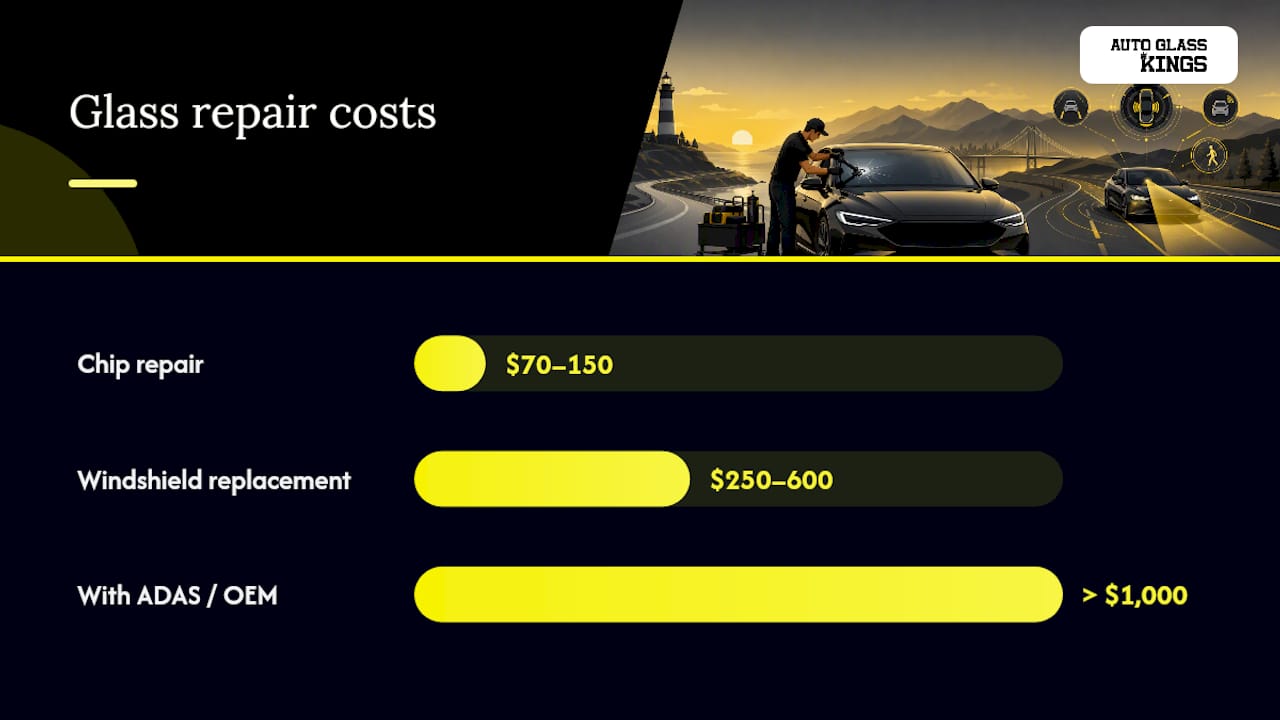
That cost gap explains a pattern many drivers notice but rarely question: insurers waive deductibles for repairs far more often than for replacements. A $0 deductible waiver on a chip repair costs the insurer less than paying out a full replacement claim later, so it’s in their financial interest to get you into a repair chair fast, before that chip spreads.
When Should You File a Claim vs. Pay Out of Pocket?
The decision usually comes down to simple arithmetic, plus a little foresight about your claims history.
- Compare the repair cost to your deductible. If a chip repair costs $100 and your deductible is $500, paying out of pocket is the obvious move. Filing a claim for less than your deductible accomplishes nothing except adding a claim to your record.
- Check if a full replacement is required. If the damage means replacement, and either your state mandates a zero deductible or you’ve got a glass endorsement, filing makes sense. Your out-of-pocket cost drops to zero or close to it.
- Weigh repeat claims against premium risk. One glass claim rarely moves your rates much on its own, but multiple small claims in a short window can flag you as higher risk, especially outside the states with legal deductible protections.
- Ask your agent directly about surcharge policies. Some carriers explicitly exempt glass-only claims from any rate impact; others don’t. That answer changes your calculation entirely.
Pro Tip: Keep a photo of the damage with a timestamp and your receipt if you pay out of pocket. If the crack spreads later and you do end up filing a claim, that documentation heads off any argument about pre-existing damage.
Why ADAS and Luxury Vehicles Cost More to Fix
Modern windshields aren’t just glass anymore. Most vehicles built in the last several years mount forward-facing cameras and sensors directly to the windshield as part of an Advanced Driver Assistance System, and every one of those systems needs recalibration after a replacement.
That recalibration step is where costs and insurer friction both spike.
- OEM-quality glass and OEM-spec camera mounts cost more than aftermarket parts, and mismatched components can throw calibration off entirely.
- Adjusters sometimes push back on ADAS line items without documentation, so shops need to provide pre-scan and post-scan results proving the system was checked and calibrated correctly.
- High-end brands like Tesla and Bentley often require additional labor time and specialized calibration targets, which adds to the bill even when the glass itself is comparable in price to a mainstream vehicle.
Before you approve a repair, ask your shop three things: whether they use OEM-quality parts, whether they perform pre- and post-calibration scans in-house, and whether the work comes with a written warranty. Then confirm with your insurer that ADAS calibration is included in the claim, not billed as a separate, uncovered service. Shops that handle calibration in-house tend to get insurer approval faster, since there’s no back-and-forth with a third-party calibration vendor.
How to Check Your Policy and File a Glass Claim
Your declarations page is the first place to look, and most drivers have never actually opened it. Search for “comprehensive coverage” and then specifically for a line labeled “glass coverage,” “full glass,” or “glass endorsement.” If you don’t see a separate glass line, your standard comprehensive deductible applies to glass claims by default, even if you have comprehensive coverage in the first place.
Before damage happens, call your agent and ask three direct questions: Do I have a glass endorsement, and what does it cost to add one? Does my policy cover ADAS recalibration as part of a windshield claim? Will you bill the repair shop directly, or do I pay and get reimbursed?
Once damage occurs, the filing process follows a predictable sequence, and understanding Arizona car accident claims can help you navigate insurance filings smoothly: Arizona car accident claims.
- Photograph the damage and note when and how it happened.
- Call your insurer or use their app to start a glass claim.
- Confirm you have adjuster authorization before scheduling repair work.
- Choose a shop equipped to handle ADAS calibration if your vehicle has it.
- Confirm direct billing arrangements and get the warranty terms in writing.
Pro Tip: Ask your insurer specifically whether they have a preferred network for glass claims. You’re usually not required to use it, and choosing your own qualified repair shop instead can mean better ADAS handling on newer vehicles.
What Zero Out-of-Pocket Glass Service Looks Like in Practice
Working glass claims every week teaches you where insurers actually push back, and it’s rarely on the glass itself. It’s on documentation. The shop handles direct insurance billing, and when a customer’s comprehensive coverage or glass endorsement applies, that can mean paying nothing at the time of service.
The real leverage comes from doing calibration in-house rather than farming it out. Adjusters approve ADAS claims faster when pre-scan and post-scan results come from the same shop that did the glass work, with OEM-quality parts documented on the invoice. Before any appointment, we tell customers to have their policy number, declarations page, and photos of the damage ready. It cuts the back-and-forth in half and gets the claim authorized the same day in most cases.
— Auto Glass Kings
Get Zero Out-of-Pocket Glass Service in Orange County
If your policy already includes comprehensive coverage or a glass endorsement, the gap between “covered” and “zero out-of-pocket” usually comes down to paperwork, not eligibility. Auto Glass Kings handles that gap directly: mobile windshield repair and replacement, in-house ADAS calibration, OEM-quality parts, and a lifetime warranty on every install, all backed by direct insurance billing so you’re not fronting cash and waiting on reimbursement.
Because calibration happens in-house rather than through a third-party vendor, adjusters get the pre-scan and post-scan documentation they need without extra delays. That’s often the difference between a claim approved in a day and one stuck in review for a week. The shop serves drivers with early-morning mobile appointments, working on various vehicles including daily commuters and high-end brands. If you want to find out exactly what your policy covers before damage turns into a bigger bill, request a free quote and get your windshield repair or replacement scheduled around your day, not the shop’s.
Sources
- Do You Have to Pay a Windshield Replacement Deductible?
- Free Windshield Replacement States | Progressive
- Windshield Insurance Coverage: State-by-State Deductible Guide | Windshield Advisor
- Does car insurance cover windshield replacement? | Glass.net blog
- Zero Deductible Glass States: Coverage Rules and Costs – LegalClarity
FAQ
Do I Need Comprehensive Coverage for Zero Deductible Glass Coverage?
Yes. Zero deductible glass benefits, whether mandated by state law or added through an endorsement, only apply if your policy already includes comprehensive (other-than-collision) coverage.
Is My Windshield Free to Replace in My State?
Only in Florida, Kentucky, and South Carolina does the law require insurers to waive your deductible automatically on covered windshield or glass claims. Everywhere else, you need a glass endorsement or an insurer waiver to get the same result.
Will Filing a Glass Claim Raise My Premium?
A single glass claim, especially a repair, rarely moves your rate on its own, but ask your agent about their specific surcharge policy since practices vary by carrier and state.
Does Zero Deductible Coverage Include My Sunroof?
Usually not. Sunroof and moonroof glass is commonly excluded from state zero-deductible statutes and typically falls under your standard comprehensive deductible instead.
Does Auto Glass Kings Handle Insurance Billing Directly?
Yes. Auto Glass Kings bills many insurance carriers directly and provides the documentation, including ADAS calibration scans, that adjusters need to approve claims quickly.
Recommended
- ADAS Calibration Orange County
- Auto Glass Replacement: A Complete Guide for US Drivers
- Auto glass replacement: 7 common mistakes to avoid
- Auto Glass Replacement in Orange County: Cost, Process, and What to Expect
🎧 Listen to This Article

Share
Recent Posts
October 6, 2026
1–3 Hours Per Door: Run Channel Replacement That Puts Fitment First
DIY run channel replacement with a fitment-first approach. Follow parts, tools, and a 1–3 hours per door procedure, plus when to call a...
October 5, 2026
Expect $305–$3,400: U.S. Tesla Windshield Costs and How to Save
U.S. model-by-model Tesla windshield price ranges ($305–$3,400 observed). Practical steps to cut out-of-pocket costs, mobile ADAS calibration options, and…...
October 4, 2026
Drivers, Follow Your Installer’s Wash Time After Windshield Replacement
Follow your installer’s written safe-wash time. If none, wait 24 hours for a hand wash and 48 to 72 hours before automatic or...