
Automotive
Yes, most auto insurance policies cover windshield and window damage, but only if you carry comprehensive coverage (or collision, when the damage comes from a crash) and pay whatever deductible applies. If another driver caused the damage, their liability coverage may pick up the tab instead. Either way, document the crack or chip with photos before you touch it and file your auto glass insurance claim before scheduling repairs, since most insurers want the claim opened first.
TL;DR:
- Filing a glass claim is worthwhile only if the damage exceeds your deductible or if your insurer waives the deductible with a full-glass endorsement.
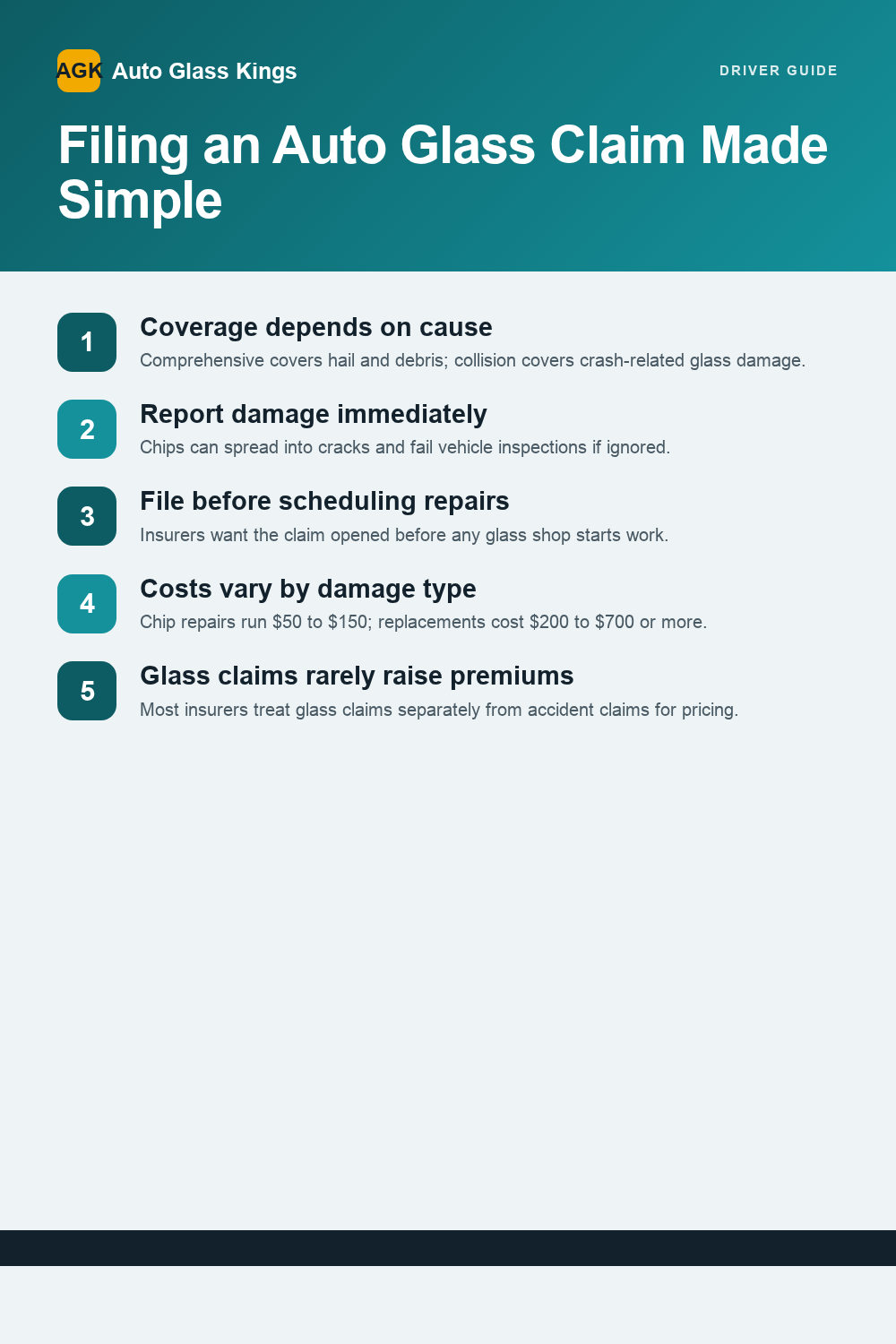
- Comprehensive coverage covers hail, debris, vandalism, and animal strikes, while collision coverage handles crash-related glass damage.
- Reporting damage immediately is crucial to prevent chips from spreading into cracks, which can significantly increase repair costs or cause inspection failures.
- Repair costs are usually between $50 and $150 for chips and $200 to $700 for full windshield replacements, with the latter becoming more expensive if sensors or heating elements are involved.
- Most insurers treat glass claims as separate from accident claims, so filing generally won’t increase your premium, but it depends on your insurer’s specific policies.
Table of Contents
- What Coverage Actually Pays for an Auto Glass Insurance Claim?
- How Fast Should You Report Glass Damage?
- How Do You File a Glass-Only Claim Step by Step?
- What Does a Windshield Repair or Replacement Actually Cost?
- Will Filing a Glass Claim Raise Your Premium?
- Repair or Replace: How Do You Know Which One You Need?
- What Happens After You File the Claim?
- How Does a Mobile Provider Handle the Claims Side of Things?
- A Provider’s View on What Matters Most
- Get Your Windshield Fixed With Zero Guesswork on Billing
- Where to Check Your Own Policy Details
- Sources
- FAQ
What Coverage Actually Pays for an Auto Glass Insurance Claim?
Comprehensive coverage is the workhorse here. It handles glass damage from causes that have nothing to do with a collision: hailstorms, a rock kicked up on the freeway, a shopping cart in a parking lot, vandalism, even a deer strike. Collision coverage takes over when the glass breaks because of an actual accident, like hitting a guardrail or another vehicle.
Some insurers sell an add-on called a full-glass endorsement, which often removes the deductible entirely for glass claims and can extend to windows, mirrors, and lights depending on your state, according to Amica. That’s different from a standard zero-deductible chip repair, which many carriers offer automatically.
A few things worth checking on your policy before you assume anything:
- Comprehensive coverage: hail, debris, rocks, vandalism, animal strikes
- Collision coverage: crash-related glass damage
- Full-glass endorsement: optional add-on, often waives the deductible
- Third-party liability: another driver’s insurer may pay if they’re at fault, and a homeowner’s or renter’s policy can sometimes cover a garage-related break
If you don’t carry comprehensive at all, ValuePenguin notes there’s no glass coverage to fall back on, and you’re paying out of pocket regardless of who caused the damage.
How Fast Should You Report Glass Damage?
Report it right away, ideally before you book any repair. Insurers generally want the claim on file before the glass shop touches the vehicle, and waiting gives that innocent little chip time to turn into a windshield-length crack.
Chips spread from temperature swings, potholes, even slamming a door too hard. What starts as a $60 repair can become a $400 replacement in a matter of weeks. Beyond the cost, many states have windshield-crack rules tied to vehicle inspections, so a damaged windshield that could’ve been a quick repair can turn into a failed inspection.
Before you call your insurer:
- Photograph the damage from several angles, including something for scale
- Note the date, time, and location the damage occurred
- File a police report if the damage came from vandalism or a hit-and-run
Pro Tip: Cover a fresh chip with clear tape to keep dirt and moisture out until you can get it repaired. It won’t stop a crack from spreading, but it buys you a day or two.
How Do You File a Glass-Only Claim Step by Step?
A glass-only claim is usually one of the simpler claims you’ll ever file. Insurers built dedicated workflows for exactly this because it happens so often. Here’s the order that saves you the most back-and-forth:
- Document the damage. Photos, location, and a rough description of how it happened.
- Gather your policy details. Have your policy number, VIN, and any prior glass claims handy.
- Check your declarations page. Confirm you have comprehensive or collision, and note your deductible before you call.
- Start the claim. Most carriers let you file glass-only claims online or through an app; Nationwide and similar insurers route these separately from full accident claims, which usually moves faster.
- Schedule the repair. Decide between a mobile appointment at your home or office versus an in-shop visit, and ask whether your insurer requires a specific partner vendor or lets you pick your own shop.
- Confirm billing. Ask whether the shop bills the insurer directly so you’re only responsible for the deductible, if any.
- Save your claim number and receipt. You’ll want both if anything gets disputed later.
Many carriers, including GEICO, let you track the claim status the same way you’d track a package, which takes some of the guesswork out of the waiting period.
What Does a Windshield Repair or Replacement Actually Cost?
A chip repair typically runs $50 to $150. A standard windshield replacement lands somewhere between $200 and $700, and that number climbs fast for windshields with embedded sensors, rain detectors, or heating elements, which is increasingly common on newer vehicles.
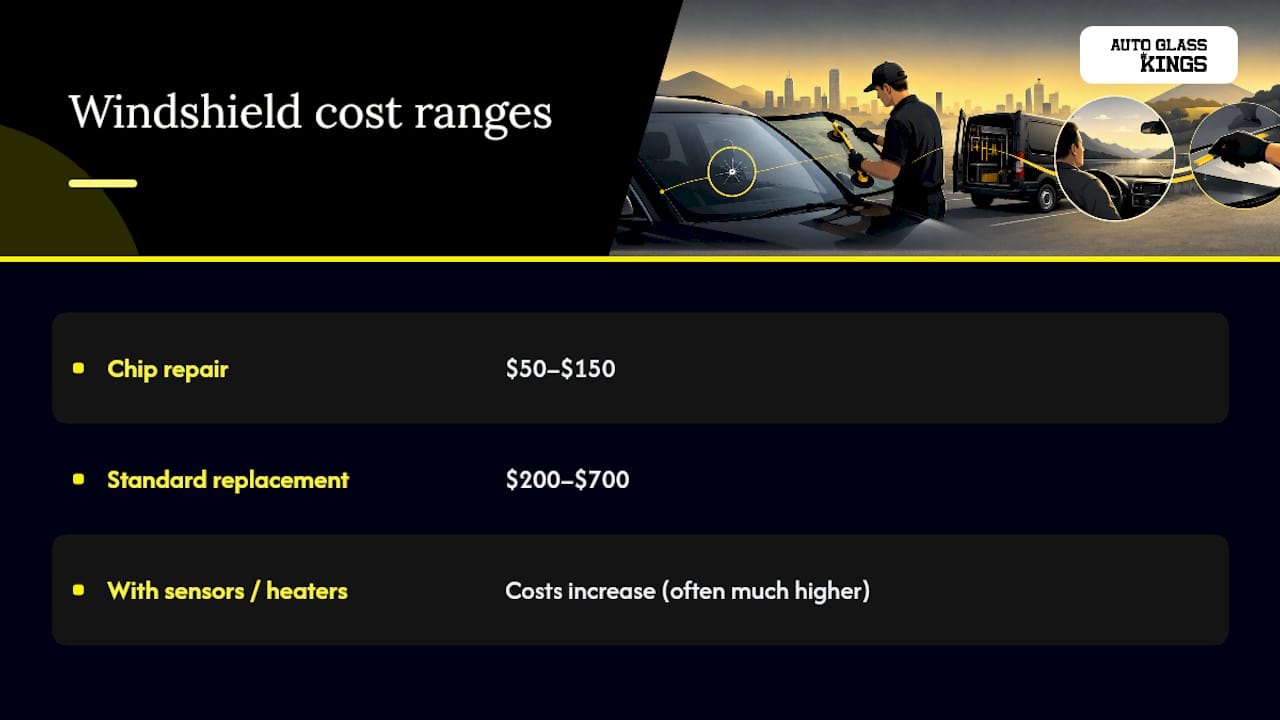
Run the math before deciding whether to file at all. Say your deductible is $500 and a chip repair costs $80. Filing a claim doesn’t help you there, since you’re still paying the full $80 out of pocket and now have a claim on record for a repair insurance wouldn’t even have covered past the deductible. Full replacement at $600 against that same $500 deductible only saves you $100, which some drivers decide isn’t worth the hassle of a claim.
That math changes completely if you carry a full-glass endorsement or your insurer waives the deductible for repairable chips, which Progressive says is common in several states.
A quick way to think about it: if the repair or replacement cost is close to or under your deductible, paying directly is usually simpler and keeps your claims history clean.
Will Filing a Glass Claim Raise Your Premium?
Usually not. Comprehensive claims, glass claims included, are generally treated as separate from at-fault accident claims and tend to have a much smaller effect on your rate, if any. Collision claims or a pattern of frequent claims are far more likely to move your premium.
That said, insurers and states don’t all handle this identically. Some carriers track claim frequency across categories and may flag you after several glass claims in a short window. If you’re on the fence, ask your agent directly whether this specific claim triggers any rate review at your next renewal. That’s a five-minute phone call that beats guessing.
Repair or Replace: How Do You Know Which One You Need?
Size and location decide this more than anything else. A chip or crack smaller than about six inches, sitting away from the windshield’s edge, is usually repairable in under an hour. Anything longer, anything touching the edge, or any damage that compromises the windshield’s structural integrity typically means replacement.
Modern windshields complicate the decision further:
- Chips under roughly six inches, away from edges: repair
- Long cracks, edge damage, or spiderwebbing: replacement
- Windshields with embedded ADAS sensors, cameras, or heating elements: replacement plus recalibration
If your vehicle has forward-collision warning, lane-keep assist, or automatic braking, the camera or sensor package mounted near the windshield almost always needs ADAS recalibration after a replacement. Skipping that step can leave those safety systems misaligned, so confirm your vendor performs calibration and ask whether your insurer covers it as part of the claim.
What Happens After You File the Claim?
Once your auto glass insurance claim is open, most insurers connect you with a network of partner vendors, but you often retain the right to choose your own shop instead, according to Nationwide. Check your policy or ask your agent directly if that’s not clear.
Mobile service tends to move faster than driving to a shop and sitting in a waiting room. A few things to confirm before the technician shows up:
- Ask whether the glass is OEM-quality and whether the work carries a warranty
- Confirm ADAS calibration is included if your vehicle needs it
- Verify the shop bills your insurer directly so you know your exact out-of-pocket cost upfront
Pro Tip: Ask for the warranty terms in writing before the appointment, not after. A common mistake drivers make is assuming a lifetime warranty applies automatically when some shops only cover materials, not labor.
How Does a Mobile Provider Handle the Claims Side of Things?
Auto Glass Kings runs its windshield replacement, repair, and ADAS calibration work on-site, and handles insurance billing directly so many customers report paying nothing out of pocket when a claim covers the job. The company performs calibration in-house rather than sending vehicles to a separate facility, and every install carries a lifetime warranty backed by OEM-quality materials.
Whichever shop you use, ask these questions before booking: What’s the warranty, and does it cover labor as well as parts? Is ADAS calibration included if my vehicle needs it? Who handles the paperwork with my insurer? And what will I actually owe out of pocket?
A Provider’s View on What Matters Most
Visibility and structural integrity aren’t things to gamble on for the sake of convenience. A cracked windshield is a safety issue before it’s a paperwork issue, and the fastest way to keep costs down is repairing damage the moment you notice it, not weeks later. Document everything, and if your vehicle gets a replacement, confirm the calibration was done before you drive off.
— Auto Glass Kings
Get Your Windshield Fixed With Zero Guesswork on Billing
Auto Glass Kings comes to you, wherever your car is parked in Orange County, and handles the insurance paperwork so you’re not stuck on hold with your carrier while a crack spreads across your windshield. Every job includes OEM-quality glass, in-house ADAS recalibration when your vehicle needs it, and a lifetime warranty on the install.
Chip repairs run $79 to $129, and side window replacements start from $189, with direct billing available so many customers pay nothing out of pocket once their claim is approved. For full windshield replacement, you can get a quote and see current availability, including early morning appointments, on the windshield replacement page. If you’re not sure whether your damage needs a repair or a full replacement, request a quote and a technician will walk you through it before anything gets scheduled.
Where to Check Your Own Policy Details
For specifics tied to your own coverage, start with your insurer’s glass claims page, such as Progressive or GEICO, and confirm details against your declarations page or your agent directly.
Sources
- Does Car Insurance Cover Windshield Damage? | Progressive
- Windshield Replacement With Car Insurance: What’s Covered and What’s Not | ValuePenguin
- Does Insurance Cover Windshield Replacement? | Amica Insurance
- Windshield Replacement Insurance Claims – Nationwide
- GEICO Glass & Windshield Insurance Claims
FAQ
Is It Worth Filing an Insurance Claim for Windshield Replacement?
It depends on your deductible versus the repair cost. If replacement runs $600 and your deductible is $500, filing only saves you $100, and some drivers decide that’s not worth a claim on record, while others with a full-glass endorsement pay nothing either way.
What Does a $500 Deductible With Full Glass Mean?
It means your standard comprehensive deductible is $500, but a full-glass endorsement on your policy waives that deductible specifically for glass claims. You’d pay the $500 for other comprehensive damage, but nothing for a covered windshield repair or replacement, as Amica explains.
Does a Glass Claim Make Your Insurance Go Up?
Usually not much, since comprehensive glass claims are typically treated separately from at-fault accident claims. Rules vary by insurer and state, so if you’re worried, ask your agent whether this specific claim affects your renewal rate.
Who Pays When a Rock Hits Your Windshield?
Your own comprehensive coverage pays for this, minus your deductible, since a random rock strike isn’t anyone’s fault to hold liable. If a full-glass endorsement is on your policy, the deductible may be waived entirely for the repair.
Does Auto Glass Kings Handle the Insurance Paperwork for Me?
Yes, Auto Glass Kings bills insurance carriers directly, and many customers report zero out-of-pocket cost once their claim is approved. You can start by requesting a quote through the windshield replacement page, and the team handles the claim details from there.
Recommended
- Windshield Chip Repair Orange County
- Auto Glass Replacement: A Complete Guide for US Drivers
- Auto Glass Replacement in Orange County: Cost, Process, and What to Expect
🎧 Listen to This Article
Share
Recent Posts
October 6, 2026
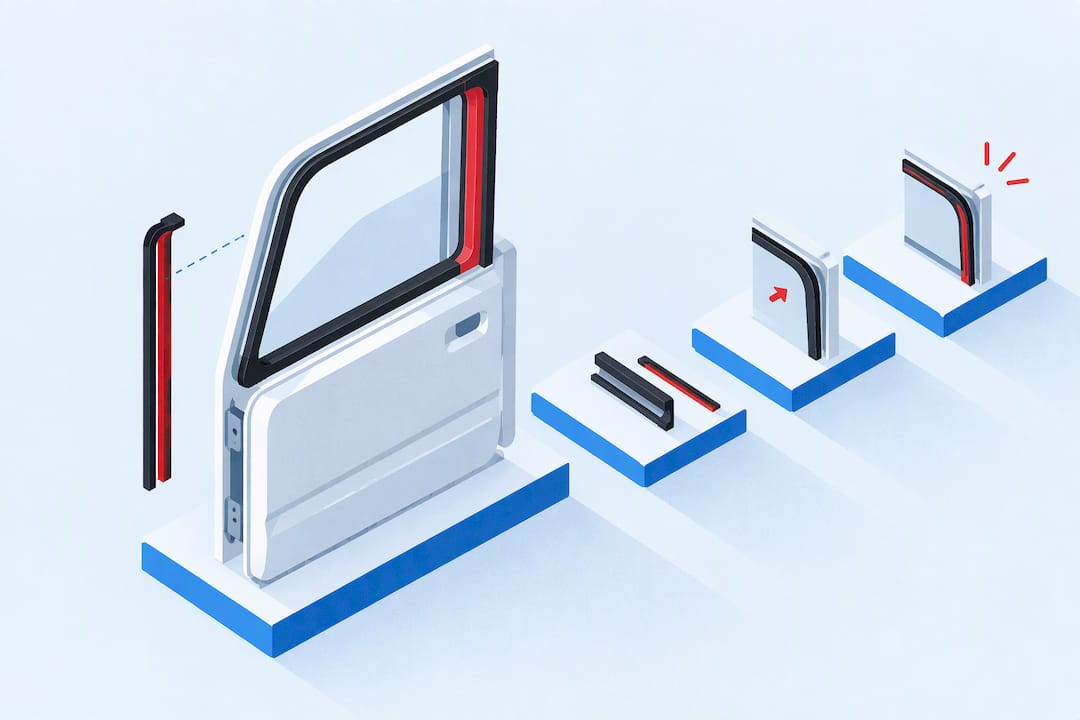
1–3 Hours Per Door: Run Channel Replacement That Puts Fitment First
DIY run channel replacement with a fitment-first approach. Follow parts, tools, and a 1–3 hours per door procedure, plus when to call a...
October 5, 2026
Expect $305–$3,400: U.S. Tesla Windshield Costs and How to Save
U.S. model-by-model Tesla windshield price ranges ($305–$3,400 observed). Practical steps to cut out-of-pocket costs, mobile ADAS calibration options, and…...
October 4, 2026
Drivers, Follow Your Installer’s Wash Time After Windshield Replacement
Follow your installer’s written safe-wash time. If none, wait 24 hours for a hand wash and 48 to 72 hours before automatic or...