
Automotive
OEE stands for original equipment equivalent. It is replacement auto glass made by a company other than your automaker’s glass supplier, built to fit and perform like the glass your car left the factory with. OEM glass, by contrast, is the same part the automaker installed or specified, usually carrying the automaker’s logo. The two can look almost identical, and the markings in the corner of the glass are how you tell them apart.
This guide explains what OEE means, what the stamp in the corner of your windshield actually says (including the DOT number), and how to choose the right glass when your windshield needs to be replaced, especially on a car with driver-assistance cameras.
TL;DR
- OEE means original equipment equivalent: replacement glass made to compatible standards by a third party, usually without the automaker’s logo.
- OEM glass is the original part, typically marked with the automaker’s logo near the corner stamp (the “bug”).
- The DOT number in the stamp identifies the glass manufacturer. It does not tell you whether the glass is OEM or OEE.
- On cars with cameras, rain sensors or a heads-up display, glass choice and calibration go together. Ask for both to be handled in one visit.
- We replace windshields on-site across Orange County and handle ADAS calibration in-house.
Table of Contents
- What OEE glass means
- OEM vs OEE: how they compare
- How to tell if your windshield is OEM
- What the DOT number on a windshield means
- Other markings in the bug
- Why glass choice matters when your car has ADAS
- What to ask before you approve a windshield
- Our perspective
- Prices and what we offer
- Book mobile glass service in Orange County
- FAQ
- Sources
What OEE glass means
The auto glass trade sorts replacement windshields into a few groups. OEM (original equipment manufacturer) glass is made by the supplier the automaker uses, and carries the automaker’s branding. OEE (original equipment equivalent) glass is the term for glass made by another manufacturer to equivalent specifications. You will also hear “aftermarket” used for the same category.
Professional Windshield and glass trade guidance describes OEE as the glass used by most windshield installers. It is made to exacting standards, but it is usually not an exact replica of the OEM windshield. That phrase is worth reading carefully. “Equivalent” describes the target: same fit, same function, same legal safety requirements. It does not promise every small detail matches.
In practice, the differences you might notice are:
- Branding. OEM glass shows the automaker’s logo. OEE shows the glass maker’s own name or logo, or sometimes no logo at all.
- Small design details. Features such as the shape of the sensor mounting area, the tint band, the acoustic layer or the shape of the frit (the black ceramic edge) can vary between suppliers and vehicles.
- Price. OEE is generally the lower-cost option, which is why many insurance policies default to it.
You may also see “OER” or “OEM-quality” in quotes and on invoices. These are not formal grades, so ask what manufacturer made the glass and which markings it carries.
OEM vs OEE: how they compare
| OEM glass | OEE glass | |
|---|---|---|
| Made by | The automaker’s glass supplier | A different glass manufacturer |
| Logo in the corner stamp | Automaker’s logo | Glass maker’s logo, or none |
| Built to | The vehicle’s original specification | Equivalent specification and the same federal safety standard |
| Typical cost | Higher | Lower |
| Best fit | Late-model cars with cameras, HUD, acoustic or heated glass; leased vehicles; classics where originality matters | Older vehicles without advanced features, or when cost is the priority |
The right answer depends on the car. For a ten-year-old commuter with no sensors on the glass, a quality OEE windshield is a sensible choice. For a newer car with a forward camera, a heads-up display or a specific acoustic layer, the closer the glass is to the original, the less there is to go wrong at calibration. Our deeper comparison is in OEM vs OEE glass: what matters for your windshield and in matching glass to your sensors.
How to tell if your windshield is OEM
Look at the corner of the glass, usually the lower driver’s side or passenger side, where a small block of printed or etched marks sits. Trade bodies call it the “bug.” The Oregon Pacific Coast glass association explains that a U.S. bug can include a manufacturer’s logo, a subtype designation, the DOT number, a part number and the date of manufacture.
To check whether yours is OEM:
- Find the bug. Sit outside the car in good light. Wipe the area clean.
- Look for the automaker’s logo. On OEM glass it usually appears near the bug, often below any other vehicle logo. If you see your car brand’s emblem, it is very likely the original or an original-supplier part.
- Read the glass maker’s name. A glass manufacturer’s name with no automaker logo points to OEE.
- Check the other glass. If the side and rear windows carry the same logos as the windshield, the car probably has its original glass or matching replacements.
- Compare with your invoice. Your repair order should name the glass type and manufacturer.
Be aware that markings alone are not a perfect guarantee. The National Windshield Repair Division of the glass trade notes that some products may be used to mislead consumers into believing they are getting an OEM windshield when they are actually aftermarket. The best protection is a shop that writes down exactly what it is installing before the work begins.
What the DOT number on a windshield means
The “DOT” followed by digits in the bug is the question many drivers search for. Here is the short version: it identifies who made the glass, not whether the glass is OEM.
The letters refer to the U.S. Department of Transportation. Federal Motor Vehicle Safety Standard No. 205 sets performance requirements for windshields installed in new vehicles and for new windshields sold as replacement equipment, and it requires the glass to be certified as complying. The DOT mark is part of that certification. The trade association explains that every piece of glass should show a DOT number tied to the specific manufacturer registered with DOT, with examples such as DOT27, DOT39 and DOT617.
So a DOT number tells you:
- The glass maker has a registered code, and the piece is marked as meeting the federal standard.
- Which factory it came from, which helps when tracing a defect or matching a part.
It does not tell you:
- Whether the part was sold through the automaker.
- Whether the glass will suit your car’s camera or heads-up display.
Because an automaker’s supplier and an aftermarket maker can be the very same company, two windshields with the same DOT number can be sold as OEM and OEE respectively. The logo, part number and your paperwork are what separate them.
Other markings in the bug
Beyond the DOT number, you may see several other codes. Knowing them makes it easier to read a quote or confirm a part.
AS1, AS2 and AS3
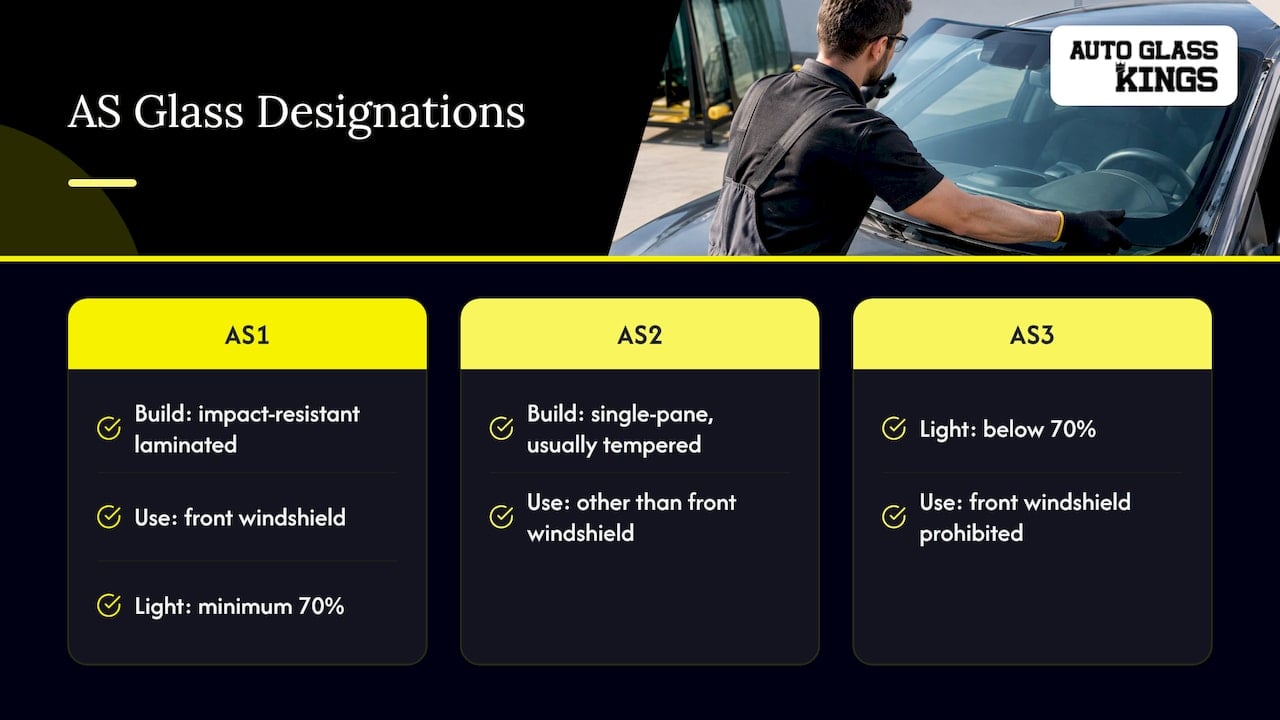
These are safety designations. The Oregon trade association describes AS1 as impact-resistant laminated glass typically used for front windshields, with a minimum light transmission of 70%. AS2 is for locations other than the front windshield and is single-pane, usually tempered. AS3 allows light transmittance below 70% and is not permitted in front windshields. If you want a closer look at how these designations and certification marks are used on replacement glass, this overview of glass safety designations and markings is a good companion.
Part number and date
The manufacturer part number helps a shop order the exact windshield for your trim level. The date code shows when the glass was made, which is useful if you are checking whether a windshield is original to the car.
Why a windshield is different from your side windows
In the United States, automobile glazing is primarily three-ply laminated windshields, with a plastic interlayer such as PVB, and tempered glass for side, rear and roof windows, according to a peer-reviewed review of automotive glass injuries. That structure is why a cracked windshield stays in one piece while a tempered side window crumbles into small pieces. We explain the difference in tempered vs laminated glass, and some newer vehicles use laminated side windows too.
Why glass choice matters when your car has ADAS
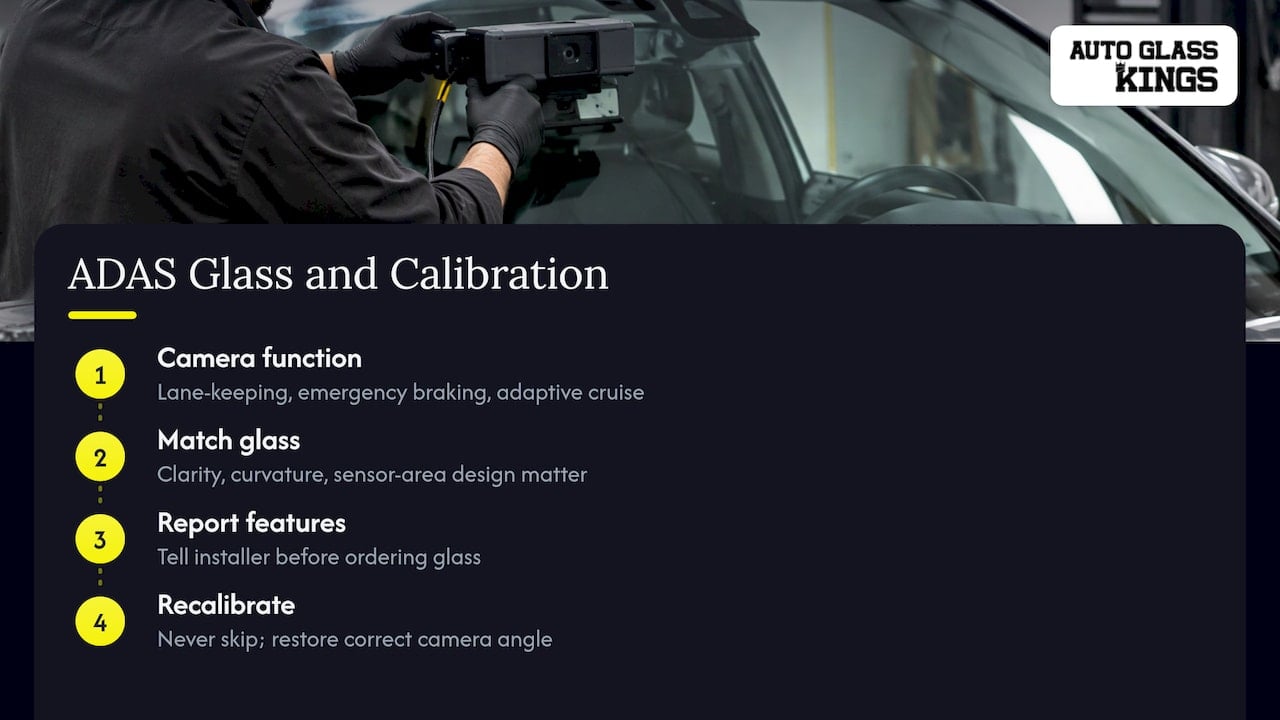
Many modern cars carry a forward-facing camera mounted on the windshield. It feeds lane-keeping, automatic emergency braking and adaptive cruise control. After a windshield replacement, that camera usually needs to be recalibrated so it sees the road at the correct angle.
This is where OEM versus OEE becomes practical rather than theoretical. The camera looks through the glass, so the clarity, curvature and sensor-area design of the windshield all matter. A closely matched part is easier to calibrate. Whichever glass you choose, the calibration step should never be skipped. Our guides on static versus dynamic calibration and what ADAS calibration costs explain what happens next, and owners of certain electric vehicles can read about Tesla camera calibration.
If you have a heads-up display, a rain sensor, a heated wiper park area or an acoustic layer, tell your installer before ordering glass so the part matches those features.
What to ask before you approve a windshield
Whether your insurer offers OEE or you are weighing an upgrade to OEM, these questions keep the job clear:
- Is this glass OEM or OEE, and who manufactured it?
- Does it have the features my car has: HUD area, rain sensor, acoustic layer, heating, camera bracket?
- Will the calibration be done in the same visit, and who does it?
- What does the warranty cover, and for how long?
- How will the claim be billed?
The five answers should come from the shop in writing or on your work order. If you are reviewing how insurance affects the choice, see what you’ll pay for windshield replacement with insurance.
Our perspective
We see the OEM versus OEE question every week, and our view is simple: choose the glass that fits your car and your sensors, then make sure the whole job is finished properly.
That means OEM-quality materials on every install, calibration done by us in-house rather than sending you to another appointment, and a lifetime warranty on the installation. Drivers in Orange County are busy. A windshield is not the thing you want to spend three days managing.
For newer cars, we recommend talking through glass type before the work starts, because the camera, the HUD and the acoustic layer all depend on a close match. For classics and older vehicles, we match the glass to what the car needs, not to a generic catalog.
Our goal is one visit, at your home or workplace, with insurance billed directly so that most customers pay nothing out of pocket.
Auto Glass Kings
Prices and what we offer
If your windshield has a small chip, repair is often possible and costs far less than replacement. Our windshield repair is priced at $79 to $129. If the damage is larger or in the driver’s line of sight, you will need windshield replacement, and we can quote it for your exact vehicle.
Other services you may need alongside it:
- Side window replacement, from $189
- Back window replacement, from $350
- Quarter and vent glass replacement
- ADAS calibration, $250 to $700
Book mobile glass service in Orange County
We come to you, starting as early as 5 AM, so you can get the glass fixed before work or between school runs. Mobile service is free, we use OEM-quality materials, handle direct insurance billing, and perform any required ADAS calibration in the same visit.
Tell us your car’s make, model and year, and whether it has a camera or heads-up display, and we will recommend the right glass. Start on our windshield replacement page or see how OEM verified ADAS calibration works in one visit.
FAQ
What does OEE stand for in auto glass?
OEE stands for original equipment equivalent. It refers to replacement glass made by a manufacturer other than the automaker’s supplier, built to equivalent specifications. It usually has no automaker logo.
Is the DOT number on my windshield the same as an OEM stamp?
No. The DOT number identifies the glass manufacturer and shows the glass is marked as meeting the federal safety standard. OEM status is shown by the automaker’s logo and your paperwork, not by the DOT code alone.
Is OEE glass safe?
Replacement windshields sold in the U.S. must be certified to the federal windshield standard, FMVSS 205, and carry the DOT marking. Safe results also depend on a correct installation with the right adhesive and, if your car has them, properly calibrated driver-assistance cameras.
Do I need ADAS calibration after a windshield replacement?
If your car has a windshield-mounted camera, calibration is normally part of the job, whether the glass is OEM or OEE. Check your owner’s manual or ask your installer. We perform calibration in-house during the same visit.
Will my insurance pay for OEM glass?
Many policies cover replacement with equivalent glass, and some allow OEM for an added cost or with a specific endorsement. Check your policy or call your insurer, and we can help with the claim and bill them directly.
Sources
- PCA Tech Tips: What We Learned To Look For When Getting A Replacement Windshield
- Clearing Of The Bugs: Details Of Automotive Glass (Oregon PCA)
- NWRD Information Center for Consumers
- NHTSA interpretation of FMVSS No. 205
- Laceration and Ejection Dangers of Automotive Glass (PMC)
- Glass safety designations and markings
Recommended
- OEM vs OEE Glass: What Matters for Your Windshield
- Match Glass to Your Sensors: OEM vs Aftermarket for HUD and ADAS
- Tempered vs Laminated Glass: What Your Car Uses and Why
- 3 in and 14 in Repair Rules: Windshield Crack Types & ADAS Notes
🎧 Listen to This Article
Share
Recent Posts
November 22, 2026
Auto Glass Coverage in California: What Your Policy Pays
How California auto insurance covers windshields, side glass and ADAS calibration, what deductibles mean, and what the 2026 glass law changes for you....
November 21, 2026
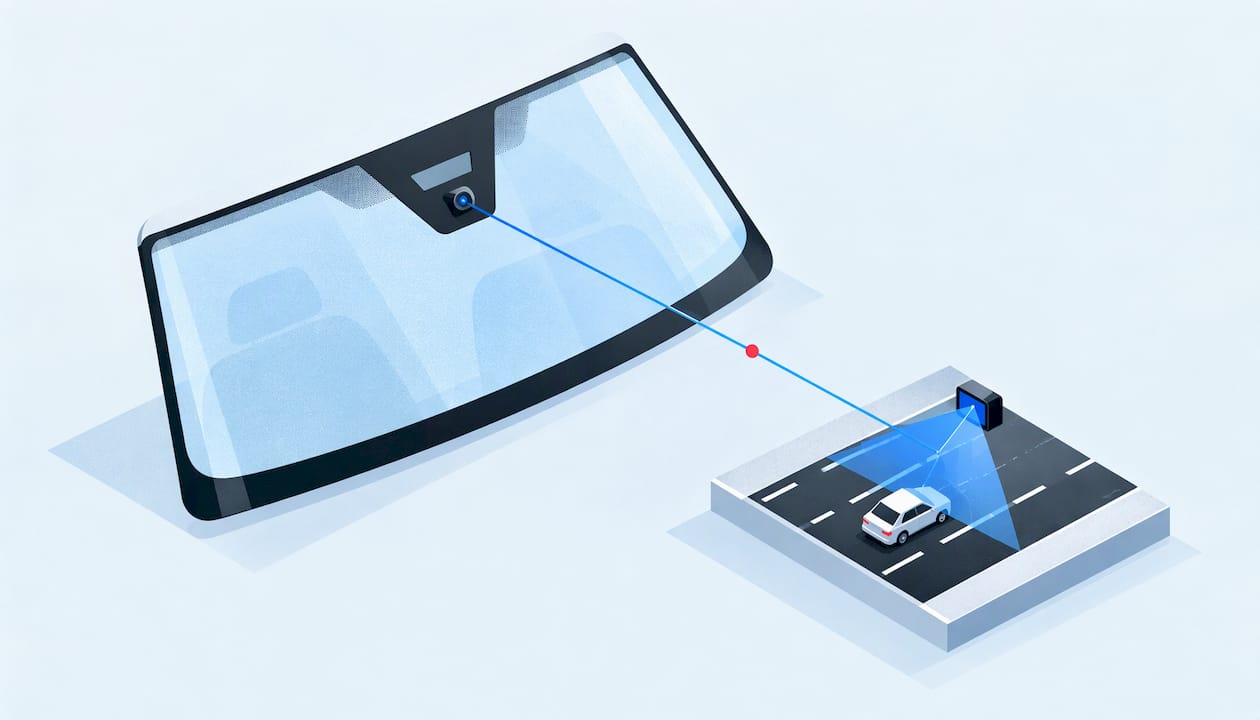
Bentley Windshield Sensors: What Sits Behind the Glass
Bentley windshield sensors explained: the camera, rain and light sensors behind the glass, what a replacement does to them, and how to get...
November 20, 2026
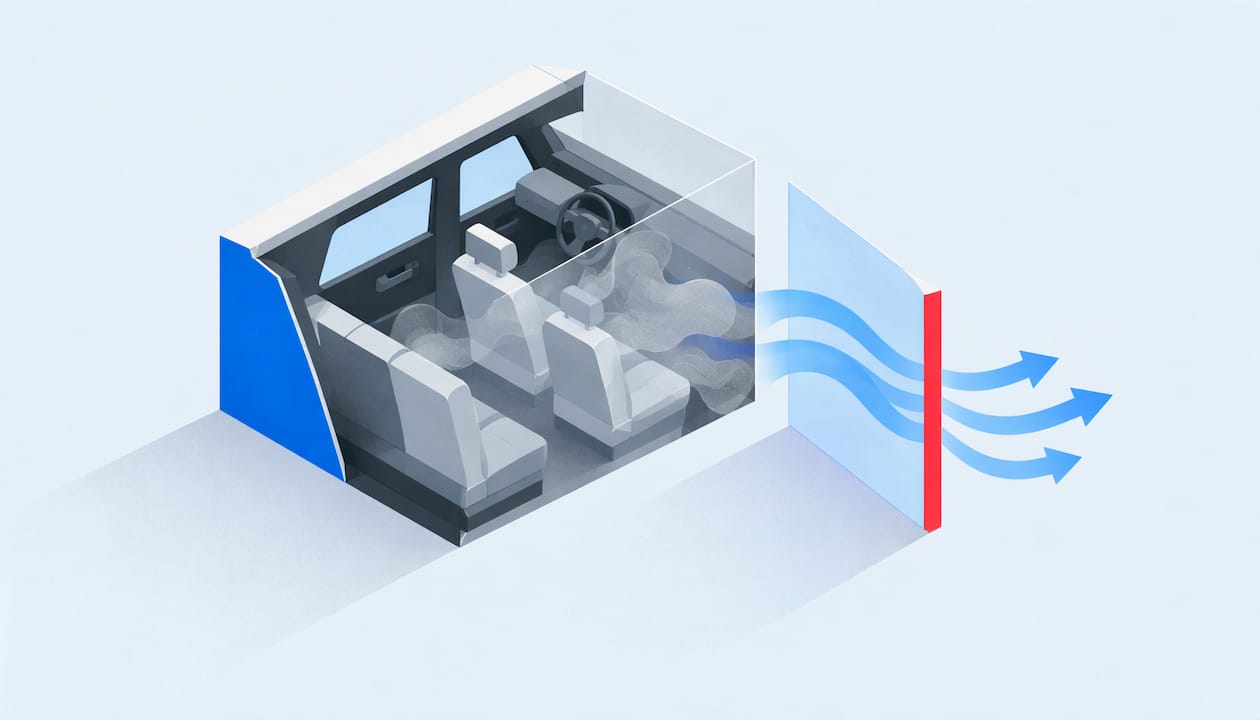
Urethane Smell in Your Car: What It Is and What to Do
A sweet, chemical smell after a windshield replacement is usually fresh urethane adhesive. Learn what causes it, how to ventilate safely and when...