
Automotive
Yes, but only if the glass and the metal frame stay completely dry while the new windshield is bonded in. Adhesive makers say a wet bond area is a problem, so an installer in open, active rain should not do the job. Under a proper shelter, or after the rain passes, the replacement can go ahead. Cold weather is a separate question with its own limits. This guide explains what the rules say, what that means for your car in an Orange County driveway or office lot, and how to plan the visit.
TL;DR
- Rain is a problem because the urethane that holds your windshield must bond to a dry surface. Moisture on the glass or the frame can weaken that bond.
- Installing in open rain is not recommended. A covered work area, or a different day, solves it.
- Cold matters too. Adhesive makers publish temperature limits, and cure time depends on temperature and humidity.
- Your safe drive-away time comes from the adhesive’s datasheet and the conditions where the car will sit, not from a generic rule.
- Tell your installer about the forecast and where the car is parked when you book. That lets them plan around it.
Table of Contents
- Why rain is a problem for a windshield replacement
- What the safety standard requires
- Rain, drizzle, humidity and fog: what actually counts
- Can a windshield be replaced in your driveway?
- Replacing a windshield in cold weather
- How long until you can drive after a rainy-season replacement
- What if rain starts during or after the install?
- Our perspective
- How to plan a windshield replacement around the weather
- Book a mobile windshield replacement that fits your weather
- FAQ
- Sources
Why rain is a problem for a windshield replacement
A modern windshield is not just a pane held in a rubber gasket. It is bonded to the body with urethane adhesive, and that bond is part of the car’s safety system. It keeps the glass in place in a crash and helps the passenger-side airbag deploy against the glass as designed.
That bond only works if the adhesive grips clean, dry surfaces. The installer first applies primer to the glass and to the bare edge of the body opening, called the pinchweld, then lays a bead of urethane. Water at any of those steps interferes.
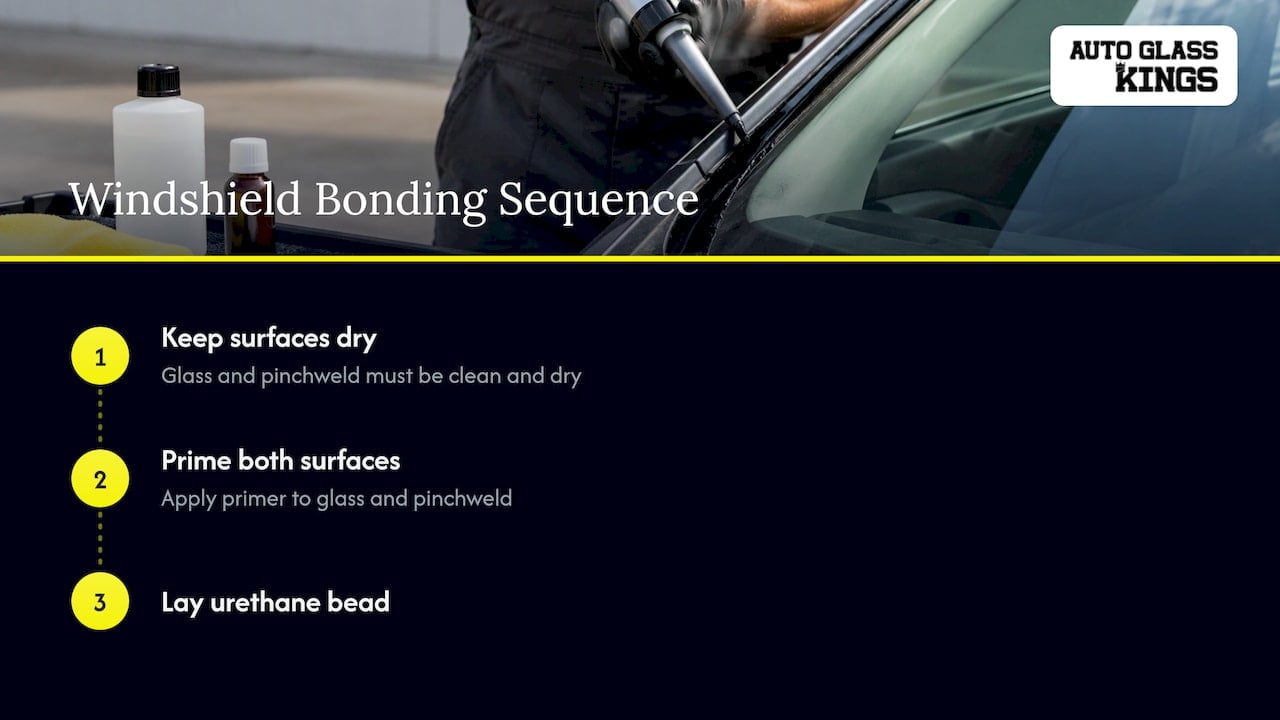
One major adhesive maker’s installation manual says the glass and pinchweld must be perfectly dry before any primers or adhesives go on. It also says the adhesive should never be applied to a wet surface. The same manual warns that rain, snow and fog moisture can be detrimental to the bond to the glass or the pinchweld.
Another manufacturer’s training material is just as direct. It says all bonding areas must be dry, and that installations in the rain are not recommended unless the work is properly enclosed under a sheltered area or shop.
The key phrase there is “unless properly enclosed.” The rule is about moisture reaching the bond, not about the sky itself.
What the safety standard requires
The auto glass industry’s U.S. safety standard does not ban rain by name. It points to the adhesive maker’s instructions instead. The ANSI/AGSC/AGRSS 005-2022 standard requires that in-shop and mobile windshield installations be done under environmental conditions compatible with the adhesive manufacturer’s application instructions.
In practice that means the adhesive’s instructions are the rulebook. If they say “dry surfaces only,” a wet install breaks the standard. An installer who tells you the job can’t be done in a downpour is following the instructions, not looking for an excuse.
The industry is also candid about how hard this is. Aftermarket installers, unlike carmakers working in controlled factories, face conditions that range from 20°F at 40% relative humidity to 100°F at 90% humidity on mobile jobs. That is why choosing the right urethane and keeping the bond area dry are treated as critical. If you want the full background on adhesive types and primers, see our guide to windshield urethane adhesive, primers and cure times.
Rain, drizzle, humidity and fog: what actually counts
Not every wet day is the same. Here is how the main situations play out.
| Condition | What it means for the bond | Typical approach |
|---|---|---|
| Active rain, open air | Water can reach the glass, pinchweld and primer | Move under cover or reschedule |
| Light drizzle with cover overhead | Surfaces can be kept dry | Work can proceed if the bond area stays dry |
| Morning dew or fog | Moisture can settle on surfaces | Wipe and dry the surfaces before priming |
| Cold glass moved into warm air | Condensation can form | Clean and dry before starting |
| Dry day, high humidity | Surfaces stay dry, but cure time is affected | Installer checks the adhesive’s cure data |
Condensation deserves its own note. One adhesive maker’s guidance says that when cold materials are moved into a warm environment, condensation can occur. If an installer faces condensation, damp or wet conditions, they should clean and dry any materials or surfaces before starting work. The SRP manual likewise tells technicians to remove any condensation that appears, and never to apply its adhesives to a wet surface.
So the question is never just “Is it raining?” It is “Can every bonding surface be kept clean and dry from primer to finished bead?”
Can a windshield be replaced in your driveway?
Yes, mobile windshield replacement is done in driveways, office parking lots and garages every day. The work area still has to meet the same requirement: dry bonding surfaces, and conditions that suit the adhesive’s instructions. The standard cited above applies to mobile installs as well as shop installs.
That gives you a practical checklist for your own spot:
- Cover helps. A garage, carport or covered parking space keeps rain off the car. If your driveway is open, say so when you book.
- Space around the car. The technician needs room to open doors, lay out tools and move the old glass out and the new glass in.
- A level, clean area. Debris and dust near the opening are not what you want around fresh primer.
- Access to the car for the cure period. The car will need to sit for a period afterward, ideally somewhere you can leave it.
Here is a detail many drivers miss. The SRP manual requires technicians to determine the temperature and relative humidity of the place where the vehicle will sit and cure, not just where the replacement is performed, when working out minimum drive-away times. If you plan to have the work done at home and then drive to work, the place the car waits is part of the calculation.
Mobile service means the glass shop comes to you. It does not mean the weather stops mattering. A good mobile installer plans around it.
Replacing a windshield in cold weather
Southern California rarely gets truly freezing weather, but cold mornings and damp coastal air are common, and many readers ask about cold. Two limits are worth knowing.
- One adhesive maker states that bonding cannot take place in air temperatures below -10 °C (14°F). The vehicle has to be stored somewhere warmer, or the job postponed.
- A 3M technical data sheet for an auto glass urethane notes that bonding is not recommended below 40°F, and that cure time depends on temperature and relative humidity.
Cold affects more than whether the adhesive bonds. As temperatures drop, the thickness of direct glazing adhesives increases, and cold installations may need extra pressure to seat and position the windshield. The same guideline says cold-applied adhesives can be warmed up to a maximum of 35 °C (95 °F), and not for more than 8 hours in total.
Primer timing shifts as well. The SRP manual notes that in cold applications additional time may be needed for primer to dry fully before adhesive goes on. A cold, damp morning combines two issues: slower drying and possible condensation. That is exactly when an experienced technician slows down and checks surfaces, which is part of why the job is better done by a trained installer than rushed.
How long until you can drive after a rainy-season replacement
The number you hear, often one hour, is a general figure. The real answer depends on the adhesive and the conditions.
The long-standing industry standard, ANSI/AGRSS 002-2002, requires installers to obtain and follow the manufacturer’s written instructions, which must include minimum drive-away time charts with temperature and humidity variables. It also says no replacement should use a bonding system that would not reach minimum drive-away strength by the time the vehicle is likely to be driven.
The spread between products is real. One DuPont fast-cure urethane lists a 30-minute minimum drive-away time for that product. Meanwhile, a 3M one-component urethane’s data sheet lists full cure through at 24 hours at 50% relative humidity and 75°F. Minimum drive-away time and full cure are different things, and damp or cool air can stretch both.
The practical rule: ask your installer for the exact drive-away time for the adhesive they used, in the conditions where your car is parked. Then follow it. Our aftercare guide for the first 48 to 72 hours covers what to avoid in the days that follow, and our note on wash timing after replacement covers rain and car washes alike.
What if rain starts during or after the install?
Rain starts before the new glass is set. The job should pause. Surfaces that were primed and then got wet cannot just be glued over. The installer needs to cover the car, dry and re-prep the surfaces, or reschedule.
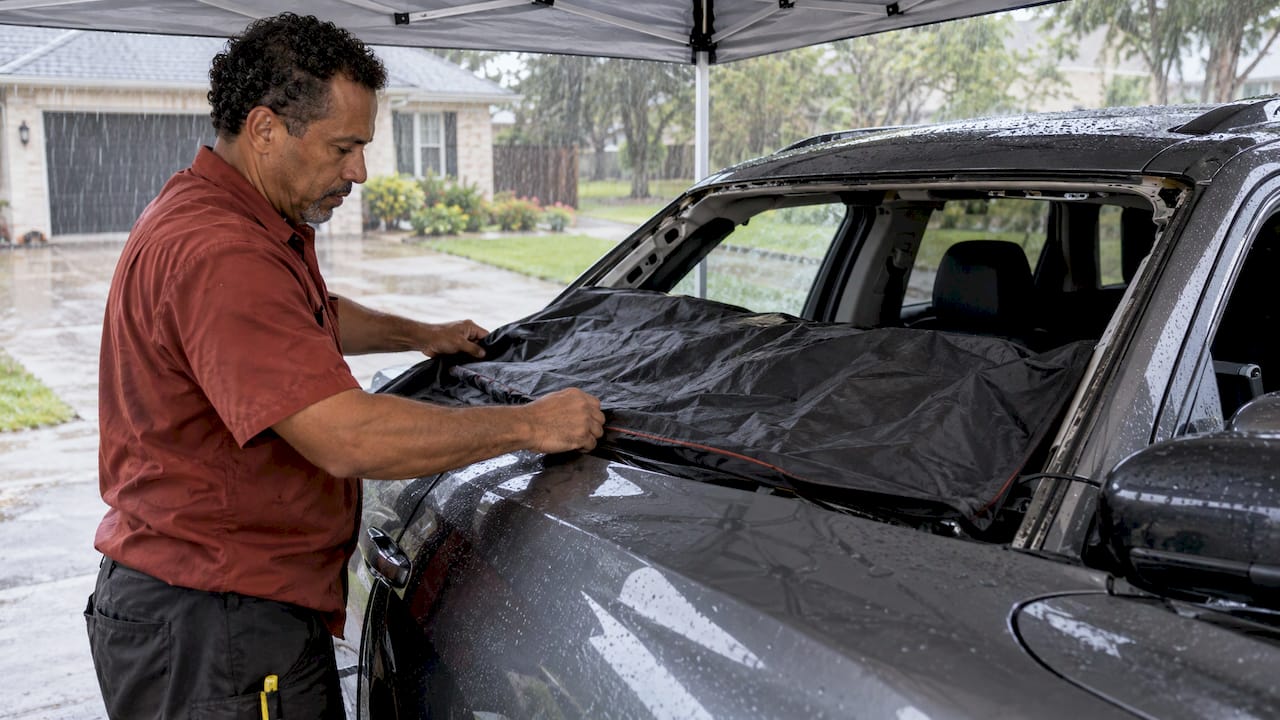
Rain starts after the glass is set and the car is under cover. If the bond is complete and the work area stayed dry, a normal shower afterward is not the issue the installation rules address. Follow the drive-away time and the aftercare instructions you were given.
Rain starts after you drive away. Once you are past the minimum drive-away time, ordinary rain is fine. Before that point, stay put or stay off the road, as instructed.
Two habits help in any weather:
- Do not slam doors for the first day or so. Pressure spikes inside the cabin can stress a fresh bond. Our installer’s guidance is to leave a window cracked slightly if you can.
- Leave the retention tape on until you are told it can come off.
After the job, watch for signs something isn’t right: water at the edge of the glass, wind noise, or a damp carpet. A fresh install should not leak. If you see water inside the car after a rainy day, call the installer straight away so they can inspect it.
Our perspective
We get this question a lot, usually from someone looking at a forecast and a cracked windshield at the same time. Our answer is simple: the weather should shape the plan, not delay your repair for weeks.
A windshield replacement is a bonding job, and bonding needs dry, clean surfaces. That is how the adhesive makers write their instructions, and it is how we think about every visit. We come to you, so we plan around your parking spot, the forecast and the cure conditions where your car will sit.
The other half of the story is ADAS. If your car has a forward camera behind the glass, a new windshield usually calls for recalibration. We do that in-house and on-site, in a single visit, so you do not need a second appointment or a trip to a dealership. A repair that has to be repeated because of weather or a missed calibration costs you more time than a well-planned first visit.
We start as early as 5 AM daily, which helps when you want the glass done before work, before school drop-off, or before the afternoon clouds roll in. Every install carries our lifetime warranty, and we use OEM-quality materials.
Auto Glass Kings
How to plan a windshield replacement around the weather
- Check the forecast when you book, not the morning of. Share it with your installer. Early morning slots can help on days when afternoon rain is expected.
- Say where the car will be. Garage, carport, office lot or open driveway. It changes the plan.
- Choose a spot you can leave the car afterward. That is where the adhesive cures, and that is where drive-away time is calculated.
- Mention your car’s features. Rain sensors, heated glass, a heads-up display or a forward camera all affect the glass ordered. Our guide to OEM versus aftermarket glass for HUD and ADAS explains how to match glass to your sensors.
- Ask for the drive-away time. Get the number for the adhesive used, and follow it.
- Plan for calibration. If your car needs it, book it with the glass. See our page on OEM-verified windshield ADAS calibration.
- Ask about insurance. Many policies cover glass, and we bill insurers directly. Our breakdown of what you’ll pay with insurance explains how coverage and calibration costs usually work.
If the crack is small, a repair may beat a replacement and can be quicker. Windshield repair at Auto Glass Kings runs $79 to $129, and our guide to the cost difference between repair and replacement helps you decide. Wet weather matters for repair too, since resin needs a dry chip, so do not let a chip sit through the rainy season. Water and dirt in a chip make it harder to repair cleanly, and a chip can spread from temperature swings.
Book a mobile windshield replacement that fits your weather
Auto Glass Kings is a mobile auto glass service in Orange County. We replace windshields, side windows, back windows and quarter and vent glass at your home, office or wherever the car is parked, with no charge for the mobile visit. We can also calibrate your ADAS in-house in the same visit, with calibration priced from $250 to $700 depending on the vehicle. Our work carries a lifetime warranty, and we bill insurance directly.

Ready to schedule? Start with our windshield replacement page, tell us where your car is parked and what the forecast looks like, and we will plan the visit around it. If you only need to confirm calibration details, see our ADAS calibration service.
FAQ
Can a windshield be replaced in the rain?
Only if the bonding surfaces stay completely dry. Adhesive makers say rain moisture can harm the bond, and some say installs in rain are not recommended unless the work is enclosed under a shelter. If your car is in the open, expect the installer to cover it or move the appointment.
Is it okay if it rains right after my windshield is replaced?
After the glass is set and the work area stayed dry, the main concern becomes the drive-away time and the aftercare steps. Follow the adhesive’s drive-away time for your conditions. Do not wash the car or use high-pressure water until your installer says it is fine.
Can you replace a windshield in cold weather?
Often yes, within limits. One adhesive maker says bonding cannot take place below -10 °C (14°F), and a 3M data sheet does not recommend bonding below 40°F for its urethane. Cold also slows primer drying and cure, so installers adjust their process and drive-away time.
Can a windshield be replaced in a driveway?
Yes. Mobile installers work in driveways and parking lots regularly. The work area must keep the bond surfaces dry and meet the adhesive’s instructions, so a covered spot or a dry day is ideal. Tell your installer about your space when you book.
How long should I wait before driving after a replacement?
It depends on the adhesive and the temperature and humidity where the car sits. Some fast-cure products list a 30-minute minimum, while full cure can take about a day. Ask your installer for the exact figure for your job.
Sources
- ANSI/AGSC/AGRSS 005-2022 standard
- DINITROL training manual, Selection of Glass and Retention Systems
- SRP Velocity installation manual, AGSC requirements matrix
- SRP installation manual
- Sika, Special Weather Conditions
- Sika, General Guideline for Vehicle Glass Replacement
- 3M Auto Glass Windshield Urethane technical data sheet
- DuPont BETASEAL NOVA datasheet
- ANSI/AGRSS 002-2002 standard
Recommended
- The Cost Difference Between Windshield Repair and Replacement
- How Long Until You Can Drive After Windshield Replacement
- Windshield Replacement Aftercare: 48–72 Hour Steps for US Drivers
- Windshield Leak After Replacement? 6 Checks to Protect Your Warranty
🎧 Listen to This Article
Share
Recent Posts
November 22, 2026
Auto Glass Coverage in California: What Your Policy Pays
How California auto insurance covers windshields, side glass and ADAS calibration, what deductibles mean, and what the 2026 glass law changes for you....
November 21, 2026
Bentley Windshield Sensors: What Sits Behind the Glass
Bentley windshield sensors explained: the camera, rain and light sensors behind the glass, what a replacement does to them, and how to get...
November 20, 2026
Urethane Smell in Your Car: What It Is and What to Do
A sweet, chemical smell after a windshield replacement is usually fresh urethane adhesive. Learn what causes it, how to ventilate safely and when...