
Automotive
Most of the time, comprehensive coverage pays for broken auto glass. A rock, hail, vandalism or a falling branch is a non-collision loss, so it goes under comprehensive. Collision coverage only comes into play when the glass breaks in a crash with another vehicle or an object. Either way, you usually pay your deductible first, unless your policy has a glass endorsement or your state waives it.
The details decide what you pay. Below: which coverage applies to which kind of damage, how the deductible changes the math, what full-glass coverage adds, and how to decide whether to file a claim at all.
TL;DR
- Glass damage with no crash (road debris, hail, vandalism, falling objects, animals) is generally a comprehensive claim.
- Glass broken in a collision with a car, curb, guardrail or other object falls under collision, or under the at-fault driver’s liability coverage if they caused the crash.
- Your deductible is normally the most you pay for a covered glass claim. An optional full-glass endorsement can reduce or remove it.
- Check your declarations page before you have a loss. Changing coverage after the damage is too late for that claim.
- If the claim would barely exceed your deductible, paying for a small repair yourself may be the smarter move.
Table of Contents
- The short answer: comprehensive covers most glass claims
- Comprehensive vs. collision for glass, side by side
- Which coverage applies to your situation
- What you actually pay: the deductible
- Full-glass coverage: when paying extra makes sense
- California drivers: what to check on your policy
- Should you file a claim for a cracked windshield?
- Our perspective: the coverage question is really a scheduling question
- Let us handle the glass and the paperwork
- FAQ
- Sources
The short answer: comprehensive covers most glass claims
Insurers sort physical-damage claims by cause, not by which part of the car broke. The California Department of Insurance’s auto guide ties collision to physical contact and comprehensive to other causes such as fire, theft, vandalism, windstorm, flood or falling objects. Windshields, side windows and back glass are all part of the car, so they follow the same rule.
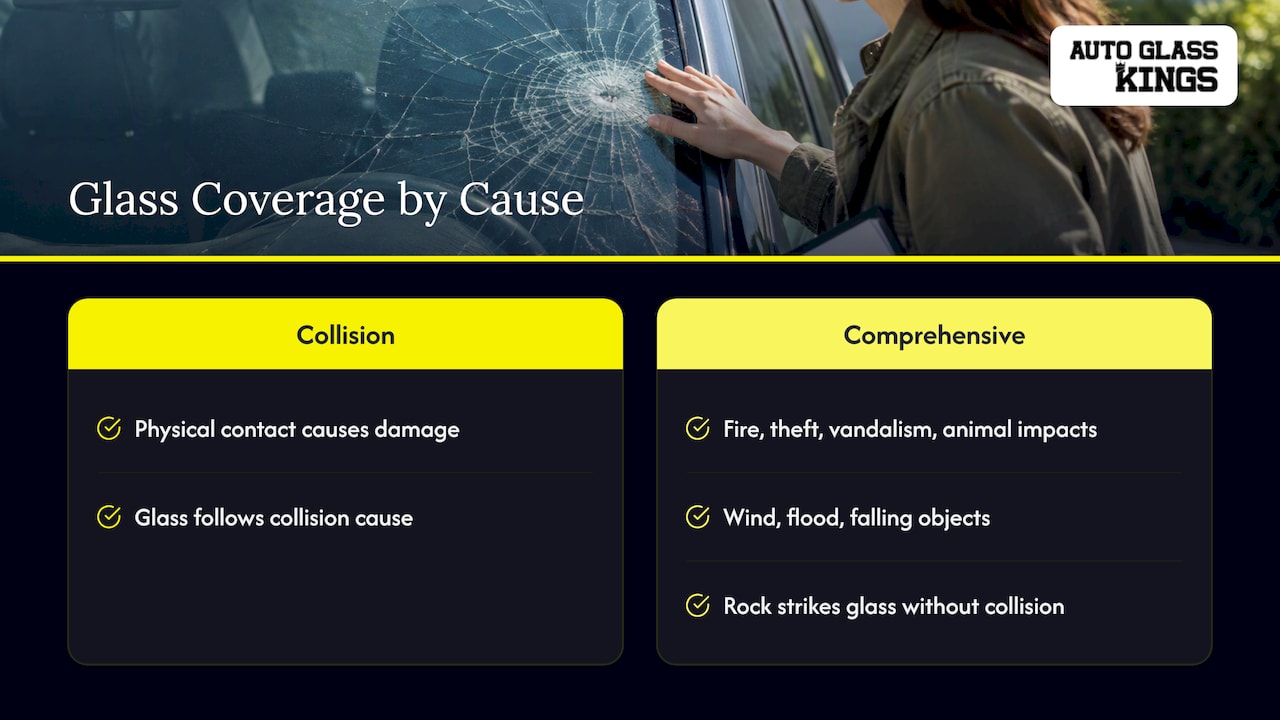
That is why the same cracked windshield can land in different coverages. Amica’s glass guidance says a rock that strikes the windshield while you drive, without a collision, is generally handled under comprehensive, which some insurers label “other than collision.” State Farm likewise describes comprehensive as covering glass claims for losses not caused by a collision, including weather, falling objects, theft, vandalism and animal impacts.
Two conditions apply everywhere. You must have bought comprehensive before the damage happened, and the terms (deductible, glass-specific rules, endorsements) vary by state and policy.
Comprehensive vs. collision for glass, side by side
| Comprehensive | Collision | |
|---|---|---|
| Triggered by | Non-collision events: debris, hail, vandalism, theft, falling objects, animals | Impact with another vehicle or object, such as a curb or guardrail |
| Typical glass example | A pebble kicked up on the 405 cracks the windshield | A fender-bender shatters the side window |
| Deductible | Your comprehensive deductible, unless waived or reduced | Your collision deductible |
| Fault matters? | No | No, though the at-fault driver’s insurer may pay instead |
| Optional? | Yes, usually required by a lender if you finance or lease | Yes, usually required by a lender if you finance or lease |
Both are optional physical-damage coverages that protect your own vehicle regardless of fault. Virginia’s State Corporation Commission makes the point in its consumer guide: unlike liability coverage, which pays for damage you cause to others, these two protect the car you own.
Which coverage applies to your situation
Road debris, hail and falling objects
This is the classic comprehensive claim. Massachusetts, which publishes unusually clear guidance, says comprehensive can cover glass repair or replacement for non-collision damage such as vandalism, fire, theft, falling objects or contact with a bird or animal. The same state tells drivers that when an unidentified object damages a windshield, comprehensive applies if the vehicle carries it, subject to any glass deductible you selected.
You do not need to prove which pebble did it. A chip that grew into a crack after a cold morning is still, in practice, a debris claim.
A crash with another car or object
When the glass breaks because the car hit something, collision coverage typically applies. Progressive’s guidance says collision generally covers windshield damage in a crash involving another vehicle or a stationary object.
If the other driver caused the crash, you may also be able to claim against their liability insurance for the windshield. That route can keep your own deductible out of it, but it can be slower, because you wait on another insurer’s investigation.
In a crash, the glass is usually the smallest line on the estimate. A single collision claim covers the whole repair, windshield included, and you pay one collision deductible, not two.
Break-ins, theft and vandalism
A smashed side window from a break-in is comprehensive. So is a keyed or bashed back window. These are the claims where drivers are often surprised to learn that the glass is covered while the stolen items inside are not. Belongings generally fall under renters or homeowners coverage, not your auto policy.
Cracks from nothing in particular
Stress cracks that start at the edge, heat-related cracks and chips that spread overnight do not have a collision cause. If your policy has comprehensive, they are filed there. Insurers may ask questions about when and where you first noticed the damage, so note the date and location.
What you actually pay: the deductible
Coverage names decide which deductible you face. The deductible decides how much. The California guide states that physical-damage coverage pays the cost of repair or replacement minus the applicable deductible. Progressive adds that, depending on state and policy, your maximum out of pocket for a qualifying glass claim is generally the deductible, with the insurer paying the rest.
A worked example, using round numbers for illustration only:
- Comprehensive deductible: $500. Replacement invoice: $900. You pay $500, the insurer pays $400.
- Comprehensive deductible: $1,000. Same invoice. The claim pays nothing, because the bill is below the deductible.
- Comprehensive deductible: $250. Repair of a small chip: $100. You pay the $100 yourself, and filing makes no sense.
The pattern: the higher your deductible, the less your insurance does for glass. A $1,000 deductible lowers your premium, but it means nearly every windshield job comes out of your pocket.
Repair vs. replacement can change the deductible
Many insurers treat the two differently. Amica notes that comprehensive waives the deductible for repairs, but a deductible may apply to replacement. Progressive says repairable cracks under 6 inches can often be fixed without a deductible. Policies differ, so ask your insurer before booking.
That makes speed worth money. A chip repaired the week it happens often costs you nothing out of pocket under such terms, and it keeps a small problem from becoming a full replacement. Our windshield repair service is priced at $79 to $129. For the longer comparison, see the cost difference between repair and replacement.
Full-glass coverage: when paying extra makes sense
A full-glass endorsement is an optional add-on. Amica describes it as paying for auto-glass repair or replacement without a deductible. Farmers explains that it can cover windshield and other window damage with no deductible or a lower one than comprehensive, although it costs extra.
The tradeoff is simple: a small added premium against a possible deductible later. It tends to pay off when:
- Your comprehensive deductible is high ($500 or more).
- You drive a lot of freeway miles, where debris strikes are common.
- Your car has a camera-equipped windshield, so replacement also needs ADAS recalibration and costs more.
- You would rather have predictable costs than a lower premium.
It matters less if you carry a low deductible, or if your state already waives the comprehensive deductible for glass. South Carolina’s Department of Insurance states that state law waives the comprehensive deductible for covered glass damage, and Progressive says a few other states, including Florida under the conditions it lists, do something similar. Those are state rules, not national ones.
If you are choosing glass for a newer or higher-end vehicle, the type of replacement glass can affect both fit and sensor behavior. A guide on OEM versus aftermarket windshields walks through that decision. Ask your insurer which glass it will authorize before you schedule.
California drivers: what to check on your policy
California’s framework is the cause-based one described above: collision for physical contact, comprehensive for the other listed perils, each paying repair or replacement minus the deductible. What the state guide does not do is promise a particular glass deductible on your policy. That is set by your insurer’s terms and the declarations page.
Before you need it, open your declarations page and confirm four things:
- Whether you carry comprehensive at all.
- Your comprehensive deductible amount.
- Whether there is a separate glass deductible or a full-glass endorsement.
- Whether repairs and replacements are treated differently.
Massachusetts’s Division of Insurance gives advice that applies anywhere: read the policy and declarations page, because insurers can quote different glass-deductible structures, and changing a deductible after a loss is too late for that claim. If you want to remove a glass deductible, ask your agent now, not in the parking lot.
Should you file a claim for a cracked windshield?
Run a quick test:
- Is the damage repairable? Farmers says small chips or short cracks may be repairable, especially outside the driver’s line of sight, while large or spreading damage or impaired visibility may call for replacement.
- Is the cost above your deductible? If the quote is lower than the deductible, the claim pays nothing.
- Is repair deductible-free on your policy? If so, file or ask first. You have nothing to lose.
- Is your car equipped with driver-assistance cameras? Replacement may add recalibration, which raises the bill and makes a claim more attractive.
If you are replacing, our guide to what you pay for windshield replacement with insurance and the walkthrough on filing an auto glass claim explain the process step by step. Our page on zero-deductible glass coverage goes deeper on the endorsement.
A final point on safety: do not wait on a crack in the driver’s view because the claim is not filed. Cracks spread, and a compromised windshield can weaken the structure that supports the airbags and roof. Get the quote first, decide on the claim second.
Our perspective: the coverage question is really a scheduling question
We see the same pattern every week in Orange County. A driver finds a chip, assumes insurance will not cover it or will cost too much, and waits. Three weeks later the chip is a crack across the glass, the repair is now a replacement, and a vehicle with a forward camera needs recalibration on top of it.
Our advice, from doing this work every day:
- Ask your insurer about repair terms first. Repairs are often the cheapest, and sometimes free, claim you will ever make.
- Do not let a deductible talk you out of getting an estimate. An estimate costs nothing, and it tells you whether a claim is worth filing.
- If the car has driver-assistance features, treat calibration as part of the glass job, not an optional extra. Replacing the windshield without it can leave lane-keeping and braking systems working from the wrong reference point.
- Choose a shop that can bill your insurer directly and finish the calibration in the same visit. That is how we work: all glass and required ADAS calibration in-house, on-site, in one appointment, with a lifetime warranty on every install.
Many customers pay nothing out of pocket because the claim covers the work. We cannot promise that for your policy, which is why we check your coverage before we start.
— Auto Glass Kings
Let us handle the glass and the paperwork
When your glass is cracked, we come to your home or office in Orange County, with service starting at 5 AM daily. We replace the glass, calibrate ADAS on-site when your vehicle needs it, and bill your insurance directly. Mobile service is free. Start with windshield replacement, or see ADAS calibration, priced from $250 to $700 depending on the vehicle. Side window damage? Side window replacement starts at $189. Rear glass starts at $350 for back window replacement.
FAQ
Does comprehensive cover a windshield?
Yes, in most cases. Comprehensive generally pays for glass damage caused by something other than a collision, such as road debris, hail, vandalism or falling objects, minus your deductible. You must have the coverage before the damage happens, and terms vary by state and policy.
Is a windshield covered under collision or comprehensive?
It depends on how the damage happened. A rock or debris strike is typically comprehensive. If the glass broke in a crash with another vehicle or an object, collision typically applies, or the at-fault driver’s liability insurance may pay if they caused it.
What does a $1,000 deductible with full glass mean?
That usually describes a policy with a $1,000 deductible for most claims plus a full-glass endorsement that lowers or removes the deductible for glass. Exact terms differ by insurer, so check your declarations page for the glass deductible amount.
Is it better to have collision or comprehensive?
They cover different events, so they are not interchangeable. For glass, comprehensive matters more, because most glass damage comes from debris and other non-crash causes. Lenders typically require both on financed or leased cars.
Will a glass claim be cheaper if I repair instead of replace?
Often. Some insurers waive the deductible for repairs but not for replacement, and repairable chips cost far less to fix. Ask your insurer for its repair terms, and get the chip looked at quickly before it spreads.
Sources
- California Department of Insurance: Automobile Insurance guide
- Massachusetts: Understanding whether auto coverage pays for windshield damage
- Massachusetts: Auto insurance claims FAQ
- Virginia State Corporation Commission: Auto Insurance Consumer Guide
- South Carolina Department of Insurance: Auto insurance FAQs
- Amica: Auto insurance glass coverage
- State Farm: Comprehensive coverage
- Progressive: Does car insurance cover windshield damage?
- Farmers: Does car insurance cover my windshield?
- OEM versus aftermarket windshields
Recommended
- Drivers: File an Auto Glass Claim, Chip $50–$150, Mobile Billing
- Only 3 US States Require It: Zero Deductible Glass Coverage, ADAS Tips
- What You’ll Pay: Windshield Replacement With Insurance, ADAS $150–$400
- Auto Glass Replacement: A Complete Guide for US Drivers
🎧 Listen to This Article
Share
Recent Posts
November 22, 2026
Auto Glass Coverage in California: What Your Policy Pays
How California auto insurance covers windshields, side glass and ADAS calibration, what deductibles mean, and what the 2026 glass law changes for you....
November 21, 2026
Bentley Windshield Sensors: What Sits Behind the Glass
Bentley windshield sensors explained: the camera, rain and light sensors behind the glass, what a replacement does to them, and how to get...
November 20, 2026
Urethane Smell in Your Car: What It Is and What to Do
A sweet, chemical smell after a windshield replacement is usually fresh urethane adhesive. Learn what causes it, how to ventilate safely and when...