
Automotive
Yes, you can be cited in California for driving with a cracked windshield, but only when the damage is bad enough to impair your vision. California Vehicle Code section 26710 prohibits driving with a windshield or rear window in a defective condition that impairs the driver’s vision. The statute sets no inch measurement for private cars, so the officer’s judgment about your view decides the stop. Here is how the rule works, what happens if you are cited, and how to get the glass fixed before it becomes a problem.
TL;DR
- California’s rule (CVC 26710) is about impaired vision, not a fixed crack size. A crack across your line of sight is the riskiest kind.
- If an officer finds a non-compliant windshield, the officer must direct you to correct it within 48 hours and may require proof of the repair in court.
- Federal inch-based limits (49 CFR 393.60) apply to covered commercial vehicles, not as a measuring stick for your family car.
- A crack is also a safety issue: it can affect airbag performance, rollover roof strength and, on newer cars, ADAS cameras.
- Replacement on most modern cars means ADAS recalibration. We do both on-site in Orange County.
Table of Contents
- What California law says about a cracked windshield
- Is it illegal to drive with a crack in your windshield?
- What about the federal inch rules you keep seeing?
- Where the crack sits matters more than how long it is
- Can police pull you over for a cracked windshield?
- What happens if you get a cracked windshield ticket
- The safety case is stronger than the legal one
- Repair or replace: a quick decision guide
- Perspective: why we tell drivers not to wait
- Fix it before the 48 hours run out
- FAQ
- Sources
What California law says about a cracked windshield
Two statutes do most of the work.
CVC 26710 is the cracked-windshield law. It makes it unlawful to drive with a windshield or rear window in a defective condition that impairs your vision. Notice what it leaves out: there is no “three-inch crack” or “six-inch chip” rule for passenger vehicles. A short crack low on the passenger side may never draw attention. A shorter crack that runs right through the area you look through to drive can.
CVC 26701 requires safety glazing material on motor vehicles (other than motorcycles) manufactured after January 1, 1936, and requires it to be maintained in safe, non-defective condition, as the California Highway Patrol’s policy manual summarizes. The same CHP chapter, citing 13 CCR 1287, says glazing must be free of cracks, breaks or defects that could endanger the driver, passengers or others. In other words, the legal test looks at safety, not only at a ruler.
Obstruction rules are a separate law
People often mix up damage and obstruction. CVC 26708 deals with objects and materials placed on the windshield, side or rear windows, or in the vehicle, that obstruct or reduce your clear view. It carries exceptions, including mirrors, sunvisors and certain devices. A phone mount in the wrong spot or a stack of stickers is an obstruction issue. A star-shaped impact or a long crack is a defect issue under 26710. Officers can cite either, and a cracked windshield with a dash-mounted device in the same sight line makes your case worse.
CVC 26708 was amended effective January 1, 2026, to allow vehicle safety technology devices on specified commercial vehicles when their mounting complies with federal requirements. If you are curious how equipment rules shape vehicle tech more broadly, this overview of U.S. matrix headlight rules shows how a federal standard can differ from what drivers assume.
Is it illegal to drive with a crack in your windshield?
It depends on the crack and on your state. In California, the answer is “yes, if it impairs your vision.” A small chip outside your main field of view is generally not what the statute targets, but it is still a risk, because chips grow. Our guide to how windshield cracks spread explains why a chip that is legal today can be a citation tomorrow.
Search results for this topic are full of other states’ numbers, and they do not carry over:
- Georgia sets a size threshold in its own law.
- Minnesota and Missouri frame theirs around obstructed view.
- Texas and Arizona pages quote their own state rules.
If you live in Orange County, the California statute is the one that governs you on the 5, the 405 or the 55.
What about the federal inch rules you keep seeing?
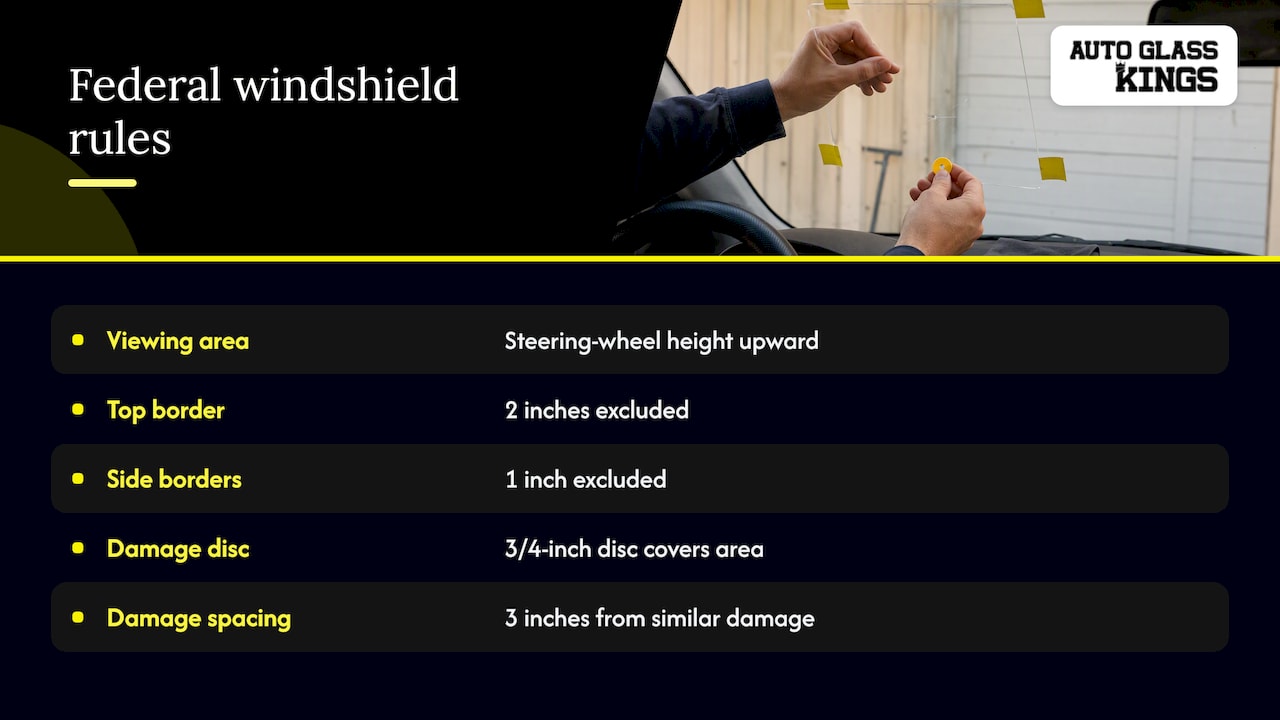
The measurements you see online usually trace back to federal motor carrier regulation. 49 CFR 393.60 sets windshield condition requirements for covered commercial vehicles. Under it, the driver’s primary viewing area, measured from the height of the steering wheel upward and excluding a 2-inch top border and 1-inch side borders, must be free of damage. There are narrow exceptions: an isolated crack may qualify, and a damaged area may qualify if a 3/4-inch disc can cover it and it sits at least 3 inches from another similarly damaged area.
Those are standards for trucks and buses. California-regulated commercial vehicles must also comply with Title 49 CFR Part 393, and the CHP equipment requirements chapter says objects must not obstruct or reduce the driver’s view through the windshield or side windows. For commercial fleets mounting safety technology, a CHP information bulletin says it may only go in locations compliant with 393.60 that do not obstruct sight lines.
If you drive a private car, those numbers are a useful rule of thumb for how seriously to take damage in front of you, but they are not the statute your officer would cite.
Where the crack sits matters more than how long it is
In practice, we see drivers get into trouble based on three factors:
- Location. Damage in the driver’s side sweep of the wipers, or at eye level, is the hardest to defend. Damage at the very bottom corner of the passenger side is the easiest.
- Type. Long cracks, spiderwebs and stress cracks reduce clarity and tend to spread. Our page on windshield crack types walks through the common patterns and which can be repaired.
- Light. Cracks scatter headlights and low sun. A crack you do not notice at noon can be blinding at sunset on PCH.
Edge cracks deserve a special mention. They start near the frame, spread faster, and compromise the bond. See edge cracks near the frame for why those usually mean replacement. Stress cracks, which appear without an impact, are covered in our stress crack guide.
Can police pull you over for a cracked windshield?
Yes. If the officer believes your windshield is defective enough to impair vision, that is a violation of 26710 and a lawful basis for a stop. The practical risk is rarely a stop for the windshield alone. More often, a crack gets noticed during a stop for something else, and it becomes an added line on the citation.
The DMV also cares. The California Driver’s Handbook notes that a windshield crack may postpone a behind-the-wheel license test if the windshield does not allow a full, clear, unblocked view. If you are about to test a teenager, fix the glass first.
What happens if you get a cracked windshield ticket
The statute’s remedy is built around fixing the problem. Under CVC 26710, when a windshield or rear window fails to comply, the inspecting officer directs you to make it conform within 48 hours. The officer may also require you to produce satisfactory evidence of the repair in court. The statute also lets the officer arrest the driver or give a notice to appear.
So if you are cited:
- Read the citation. Note the section number and any instruction about correction.
- Get the glass fixed quickly. The 48-hour window is the clock the statute gives you. Book a repair or replacement the same day.
- Keep proof. Ask for an itemized invoice showing the date, your vehicle and the work performed. Photos of the new glass help.
- Follow the court or notice instructions. The citation tells you how to submit proof. Check the court’s current procedure and fee information on your citation or the court’s website, because they change.
If the stop turned into something more complicated, such as an arrest or other violations, talk to a licensed California traffic attorney. We fix glass; we do not give legal advice.
Our separate guide, stop or drive: the 24 to 48 hour window, covers what to do between the moment you spot the damage and the repair.
The safety case is stronger than the legal one
Even if you never see a patrol car, a cracked windshield is a structural part with a job to do. The federal glazing standard, 49 CFR 571.205, is intended to reduce injuries from impacts to glazing, maintain the transparency needed for driver visibility, and minimize the chance of occupants being thrown through the glass.
Damage can undermine those goals. According to one insurance-industry guide, a damaged windshield can weaken structural integrity, affect airbag deployment and leave the roof less supported in a rollover, and poor visibility in bad weather or low light raises accident risk. A farm bureau insurer adds that damage can interfere with windshield-mounted driver assistance systems and warns that even a 1-millimeter sensor shift can affect how they operate.
That last point is why ADAS matters for this topic. Lane-keeping and emergency braking cameras look through the glass. A crack in their field of view can degrade performance, and a replacement windshield changes the camera’s position slightly, so the system needs to be recalibrated afterward. Properly trained technicians must do that work.
Repair or replace: a quick decision guide
| Situation | Usual path |
|---|---|
| Small chip or short crack outside the driver’s view | Repair, ideally right away |
| Chip in the driver’s line of sight | Often repairable, but a blemish can remain; have a technician judge it |
| Long crack, or crack reaching the edge | Replace |
| Multiple cracks or spiderweb damage | Replace |
| Stress crack with no impact | Replace, since it tends to keep spreading |
| Damage near an ADAS camera mount | Replace and recalibrate |
Repair is faster and cheaper when it is an option. Our windshield repair service is published at $79 to $129. For a full comparison of costs, see repair versus replacement. If you are on the fence, a repair that stops a chip from spreading is the cheapest way to avoid both the replacement bill and the ticket.
Perspective: why we tell drivers not to wait
Most drivers we meet are not trying to break the law. They are trying to get to work, drop off the kids, and deal with the glass later. The trouble is that “later” is when a chip becomes a crack, usually during a hot afternoon or a cold morning with the defroster on. (If that sounds familiar, our piece on defroster-related cracking explains the heat-ramping habit that helps.)

We also think the “how long is too long” question misses the point. California’s law asks whether you can see, and the CHP’s own policy language is about keeping glazing free of defects that endanger people. A crack is a reason to schedule the fix this week, whatever a ruler says.
The second thing we want drivers to know is that replacement on a newer car is two jobs: the glass and the calibration. Sending a car to one shop for glass and another for the camera means two appointments and a gap where the car is on the road uncalibrated. We do the glass, the required ADAS calibration and the insurance billing in one visit, at your home or office, starting at 5 AM, so the fix does not cost you a work morning.
— Auto Glass Kings
Fix it before the 48 hours run out
If you have a crack, a ticket, or just a nagging chip, we come to you anywhere in Orange County. Mobile service is free, every install carries a lifetime warranty, and we use OEM-quality materials. We bill insurance directly, and many customers pay nothing out of pocket.
For a cracked windshield that needs to come out, start with windshield replacement. If your car has a forward camera, we perform ADAS calibration ourselves, in-house, in the same visit; our published range is $250 to $700 depending on the vehicle. Want to know what insurance typically covers first? Read what you’ll pay with insurance. Afterward, our aftercare steps cover the first 48 to 72 hours.
A crack in a side, rear or quarter window is a different job but the same promise: see side window replacement, back window replacement or quarter and vent glass. Back glass is covered by 26710 too, since the statute names the rear window.
FAQ
Is it illegal to drive with a cracked windshield in California?
It is illegal when the windshield is in a defective condition that impairs your vision, under CVC 26710. California does not set a specific crack length for passenger cars in that statute. A crack in your line of sight is the one most likely to draw a citation.
Can I get a ticket for a cracked windshield in California?
Yes. An officer who finds a non-compliant windshield must direct you to correct it within 48 hours and can require proof of the repair in court. Get it repaired or replaced quickly and keep the invoice.
Does the same law apply to the rear window?
Yes. CVC 26710 covers both the windshield and the rear window. A shattered or heavily cracked back glass that impairs your view is treated the same way, and it also leaves you exposed to weather and theft.
Do I need ADAS recalibration after replacing a cracked windshield?
If your car has a windshield-mounted camera for features like lane-keeping or automatic braking, yes, recalibration is part of a proper replacement. A shift of even a millimeter can affect how these systems work, according to the insurer source cited above. We handle it on-site in the same visit.
Will my insurance pay for it?
Often, depending on your policy and deductible. We bill insurance directly and many customers report no out-of-pocket cost, but your coverage determines the outcome, so check your policy or ask us when you book.
Sources
- California Vehicle Code 26710
- California Vehicle Code 26708
- California Highway Patrol Highway Patrol Manual 82.7, chapter 5
- California Highway Patrol Highway Patrol Manual 82.6, chapter 6
- California Highway Patrol information bulletin on windshield-mounted commercial vehicle safety technology
- California Driver’s Handbook, DMV
- 49 CFR 393.60, eCFR
- 49 CFR 571.205, eCFR
- When to Repair or Replace Your Windshield, Baldwin
- What to Do When Your Windshield is Damaged, South Carolina Farm Bureau Insurance
Recommended
- Stop or Drive? 24–48 Hours to Fix a Cracked Windshield in the US, ADAS
- 3 in and 14 in Repair Rules: Windshield Crack Types & ADAS Notes
- Stop Windshield Cracks: NHTSA Backed Steps, Repair Rules for Drivers
- Car Owners: Windshield Stress Crack? Replace If Over 6 Inches, 4 Rules
🎧 Listen to This Article
Share
Recent Posts
November 22, 2026
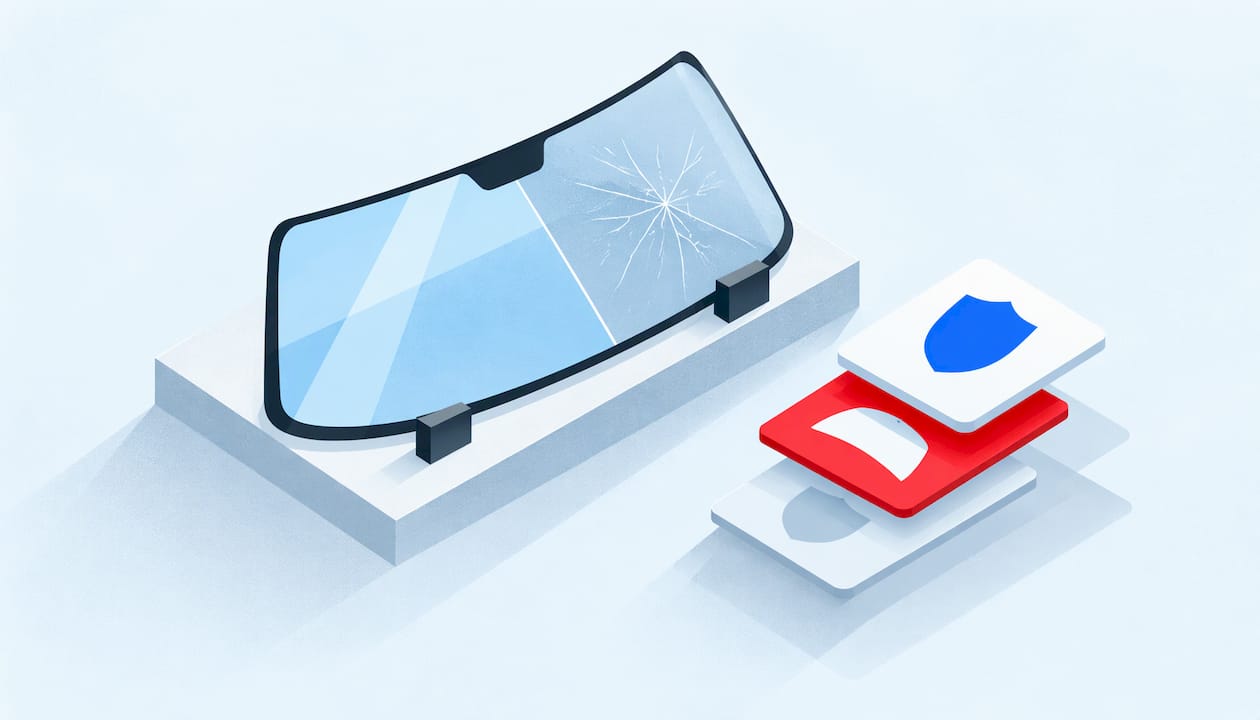
Auto Glass Coverage in California: What Your Policy Pays
How California auto insurance covers windshields, side glass and ADAS calibration, what deductibles mean, and what the 2026 glass law changes for you....
November 21, 2026
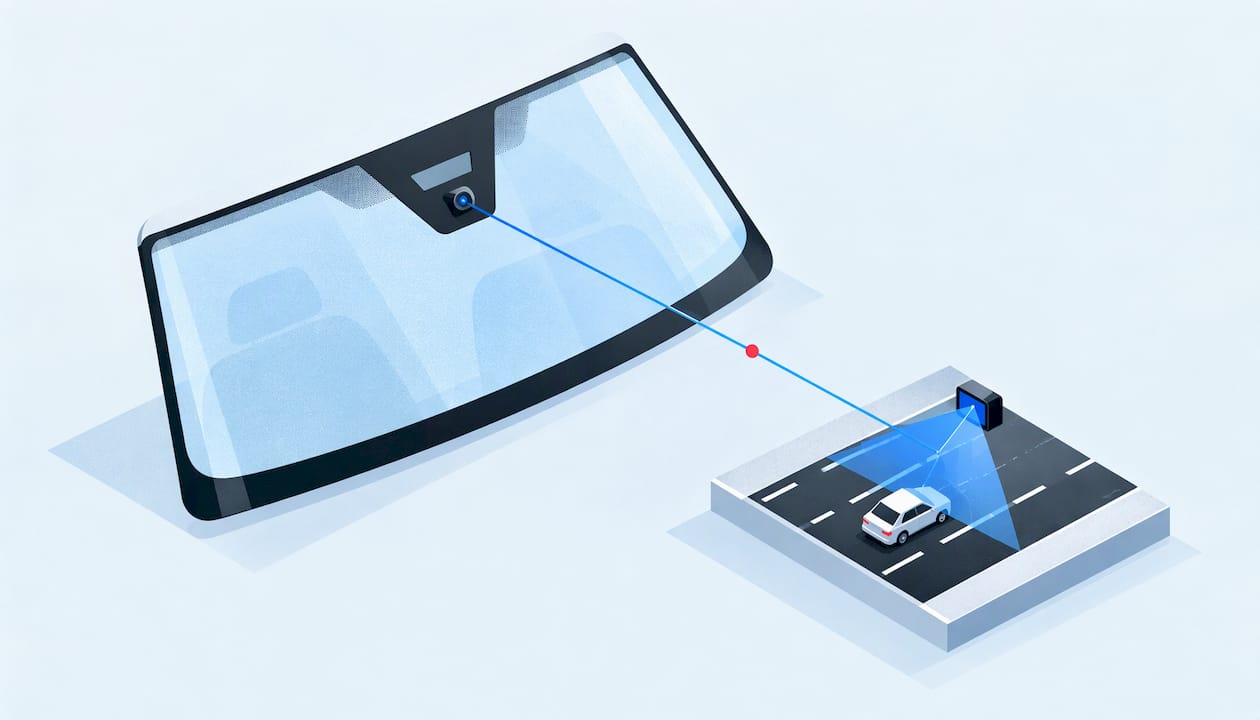
Bentley Windshield Sensors: What Sits Behind the Glass
Bentley windshield sensors explained: the camera, rain and light sensors behind the glass, what a replacement does to them, and how to get...
November 20, 2026
Urethane Smell in Your Car: What It Is and What to Do
A sweet, chemical smell after a windshield replacement is usually fresh urethane adhesive. Learn what causes it, how to ventilate safely and when...