
Automotive
If your rearview mirror fell off the windshield, you can often fix it in under an hour with the right two-part adhesive kit, as long as the metal mounting button and the glass are both intact. If a chip of glass came off with the button, or your car has driver-assistance cameras behind the mirror, skip the glue and have a glass technician look at it. Here is how to tell which case you have, how to do the simple repair properly, and what to expect from a pro.
TL;DR
- A clean break at the old glue, with no glass damage, is a realistic DIY job using a structural mirror adhesive kit, a fresh razor blade and about 15 minutes of cure time.
- Household super glue, epoxy and hardware-store glass glue are the usual reasons a mirror falls again a day or two later.
- If the button pulled a chip out of the glass, or the windshield has a crack near the mount, the windshield itself is the problem and gluing will not hold.
- Many modern cars have a camera or sensor module at the mirror mount, so a loose mirror there can be tied to ADAS. California now requires shops to tell you about this before work starts.
- We come to you across Orange County, from 5 AM daily, and can handle the mirror, the glass and any calibration in one visit.
Table of Contents
- First, work out what actually failed
- What to do right after it falls
- DIY rearview mirror reattachment, step by step
- When gluing is the wrong answer
- The ADAS angle most guides skip
- Is a DIY mirror repair legal and safe?
- DIY versus a mobile technician
- Our perspective: the mirror is usually a symptom
- What a mobile visit looks like in Orange County
- Aftercare when the glass is bonded
- Windshield warranties and the mirror
- Avoid these mistakes
- Need the mirror and glass handled today?
- FAQ
- Sources
First, work out what actually failed
Before you buy anything, look at the windshield where the mirror was. Three situations account for almost every case.
1. The glue let go, and the glass is clean. You will see a small metal button (it looks like a flat disc or a wedge-shaped foot) either stuck on the glass or sitting in your hand, with dried adhesive on one side. The glass is smooth with a faint square or round ghost of old glue. This is the DIY-friendly case.
2. The button took glass with it. You will see a rough, shell-shaped divot or a flake of glass stuck to the button. The windshield is now structurally damaged at the exact spot that needs to hold weight. Gluing a button onto a chipped surface is a coin flip at best, and a community thread of drivers who tried it twice with glass glue reports the mirror dropping again within a day or two. Treat this as a glass repair question, not an adhesive question.
3. The mirror is a housing for sensors. If there is a plastic cover, a camera lens, a rain sensor gel pad or a lane-keeping module around the mount, the mirror bracket is part of a larger system. The mirror may have come off because the windshield was replaced earlier with the wrong glass or a poor bond.
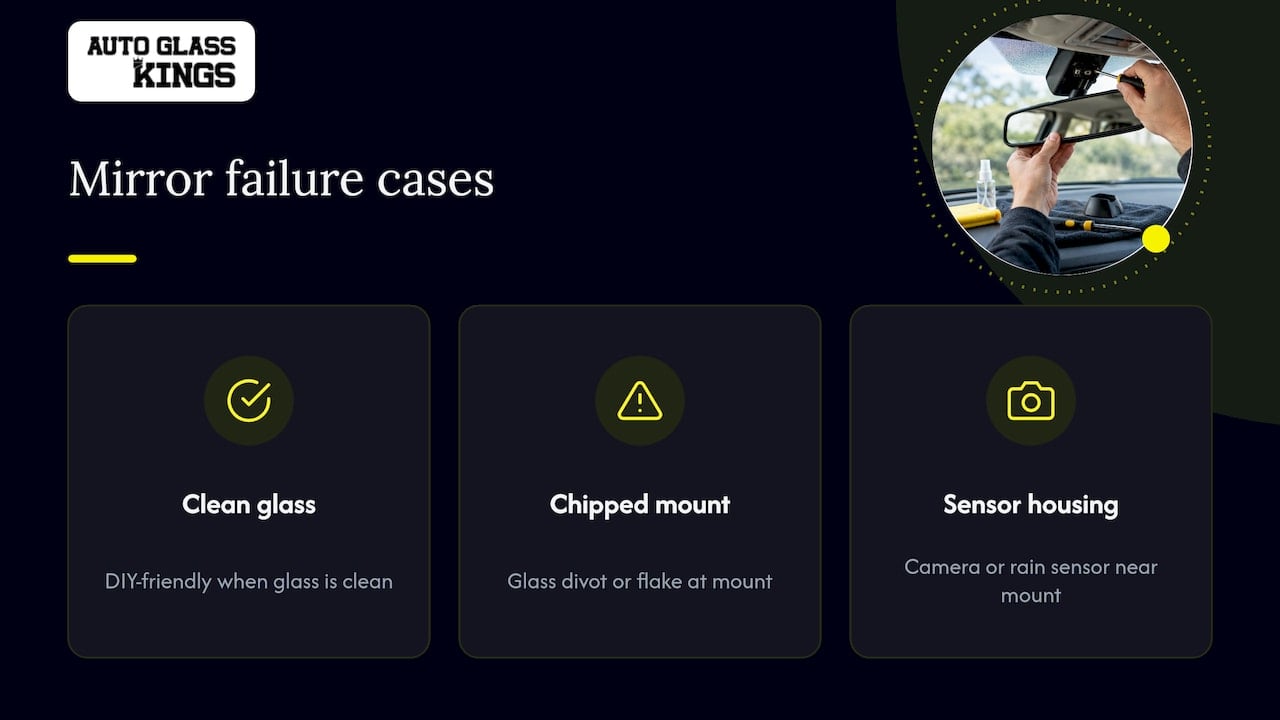
Not sure which one you have? Take a photo of the glass with your phone flashlight held at an angle. Damage that is invisible head-on shows up clearly in raking light.
What to do right after it falls
Pick up the mirror and the button, and keep every piece. If the mirror came off while you were driving, the CarParts.com guide advises staying off busy roads, since without a mirror you cannot see what is behind you. In practice that means relying on your side mirrors, checking over your shoulder and keeping lane changes to a minimum until it is fixed.
Do not tape the mirror to the glass or hang it by a cord. A mirror that drops into your lap on the freeway is a real distraction, and a taped one blocks your view.
DIY rearview mirror reattachment, step by step
This works for the clean-break case only. Plan on 30 to 60 minutes, mostly waiting.
What you need
- A two-part structural adhesive kit made for mirror buttons, such as the 3M rearview mirror adhesive, which is a two-part structural acrylic system designed to mount rearview mirrors. Loctite also makes a single-component rearview mirror bonder, an anaerobic structural adhesive for bonding metals to glass. Check that the kit says it is for mirror mounts and includes the activator.
- A new single-edge razor blade
- Isopropyl alcohol and lint-free towels
- Masking tape to mark the position
- A shaded spot and a mild day
The steps
- Mark the position. Before you touch anything, put a strip of masking tape on the outside of the windshield aligned with the edge of the old glue footprint. Many installers mark the spot this way so the mirror ends up centered and level. If the old button is still stuck to the glass, mark around it.
- Remove old glue from the glass. Use a fresh razor blade held at a shallow angle and scrape until the glass is bare. Technicians point to poor surface preparation as the most common reason these repairs fail, because leftover adhesive stops the new bond from forming.
- Clean the metal button the same way. Scrape or sand the old adhesive off the flat face of the button until you see bare metal, then wipe it with alcohol.
- Degrease both surfaces. Wipe the glass and the button with isopropyl alcohol and let it evaporate fully. Do not touch the bonding surfaces afterward. Skin oil is enough to weaken the bond.
- Apply the activator. Follow your kit’s instructions exactly, including the drying time. Rushing this step is a classic mistake.
- Apply a small amount of adhesive to the button. Less is more. Excess squeezes out and can smear onto the glass where it shows.
- Press and hold. Set the button on the marked spot and apply firm, steady pressure for about 60 seconds. This is the figure most kits recommend, but your kit’s instructions rule.
- Let it cure. Most kits call for at least 15 minutes before you hang the mirror on the button. Longer is better. Keep the car parked and do not slam the doors during this time.
- Reattach the mirror. On most vehicles the mirror arm slides down or twists onto the button. Tighten any set screw gently.
Temperature matters more than people think
Adhesive kits are designed for a working range. Technical data for mirror adhesives typically assumes roughly 65 to 85°F, and applying them on a scorching dashboard or in a cold garage is a common cause of premature failure. In Orange County that mostly means one thing: do not do this at 2 PM in August with the car in direct sun. Park in shade or a garage, and let the glass cool to the touch first. Heat is also a likely reason the first bond failed, since a closed car can get far hotter than the air outside.
Why the hardware-store shortcut fails
Super glue is brittle, and regular two-part epoxy is slow to set and hard to hold in place against a vertical sloping pane. A mechanic in a Stack Exchange discussion makes this point about epoxy for a damaged mount, and it applies here. The adhesive has to bond metal to glass and survive vibration and heat swings, which is why purpose-made kits exist.
When gluing is the wrong answer
Call a professional instead of buying a kit if any of these apply:
- Glass came off with the button. The surface is compromised. Depending on the size and location, a technician may be able to place the button a short distance away from the damage or may recommend replacing the windshield. Our guide to how repair rules differ by crack type explains how size and position decide that call.
- There is a crack running toward the mount. The mirror’s weight and road vibration can make a small crack grow. See the cost difference between windshield repair and replacement before you decide.
- The mount holds a camera or sensor. Moving or reseating anything in this zone can affect how the system sees the road.
- The mirror has auto-dimming, a compass, a microphone or a wired connector. These are costly to damage during a rushed DIY job.
- The mirror fell right after a recent windshield replacement. That points to a bonding or workmanship problem, and the installer’s warranty may apply (more below).
The ADAS angle most guides skip
Most top search results treat a fallen mirror as a pure gluing problem. On many newer vehicles it is not. The area behind the mirror often houses the forward camera used for lane-keeping, automatic emergency braking and similar features. Those cameras are aimed relative to the windshield and the mount, and when glass work happens in that area, the manufacturer may call for recalibration.
California has moved to make this visible to consumers. Under SB 988, the California Motor Vehicle Glass Act, a motor vehicle glass repair shop must tell you before service whether your vehicle has an advanced driver assistance system, and the law also addresses whether recalibration is recommended. Autobody News reported in July 2026 that the bill’s requirements stayed largely unchanged as it narrowed in scope while moving through the Legislature. Because the law has a defined scope of which shops it covers, read the current text rather than assuming every business is bound the same way.
What this means for you as a driver: ask any shop that touches the glass or mirror mount whether your car has ADAS, whether the manufacturer recommends calibration afterward, and get the answer in writing on an itemized invoice.
If the glass behind the mirror is being replaced, the type of glass matters for camera accuracy too. This breakdown of OEM versus aftermarket windshield glass for ADAS cars covers the questions worth asking before you agree to a part.
Is a DIY mirror repair legal and safe?
Federal rules cover how mirrors perform on new vehicles. NHTSA’s interpretation letter explains that FMVSS No. 111 sets performance and location requirements for rearview mirrors in each new motor vehicle. That standard governs manufacturers, so it does not stop you from reattaching your own mirror. The practical risk is simpler: a mirror that is not bonded properly can fall while you drive, which blocks your view and pulls your eyes off the road. If you do the job yourself, do it carefully and check the bond before driving. Pull firmly on the mirror, then tug it side to side. If anything moves, the repair is not done.
DIY versus a mobile technician
| DIY kit | Mobile glass technician | |
|---|---|---|
| Best for | Clean break, intact glass, no sensors | Damaged glass, sensors, newer cars, anyone short on time |
| Time | 30 to 60 minutes, mostly cure time | One visit, at your home or workplace |
| Biggest risk | Poor prep or wrong temperature, so the mirror drops again | Choosing a shop that cannot handle calibration |
| Glass damage found? | You may not recognize it | Inspected on the spot |
| Camera or ADAS check | Not possible at home | Calibration can follow in the same visit |
| Warranty | Only the adhesive’s own guarantee | Workmanship warranty from the installer |
A kit is a fair choice when the break is clean. A pro is the better choice when anything about the glass or the electronics is unclear, because the cost of guessing wrong is a second repair plus a possible windshield.
Our perspective: the mirror is usually a symptom
We see mirror calls from two kinds of drivers. Some have a clean glue failure that heat finally caused, and the fix is quick. Others have a mirror that fell because something else was already wrong: a chipped mount area, a bond from an earlier replacement that never fully cured, or glass that was never prepared correctly.
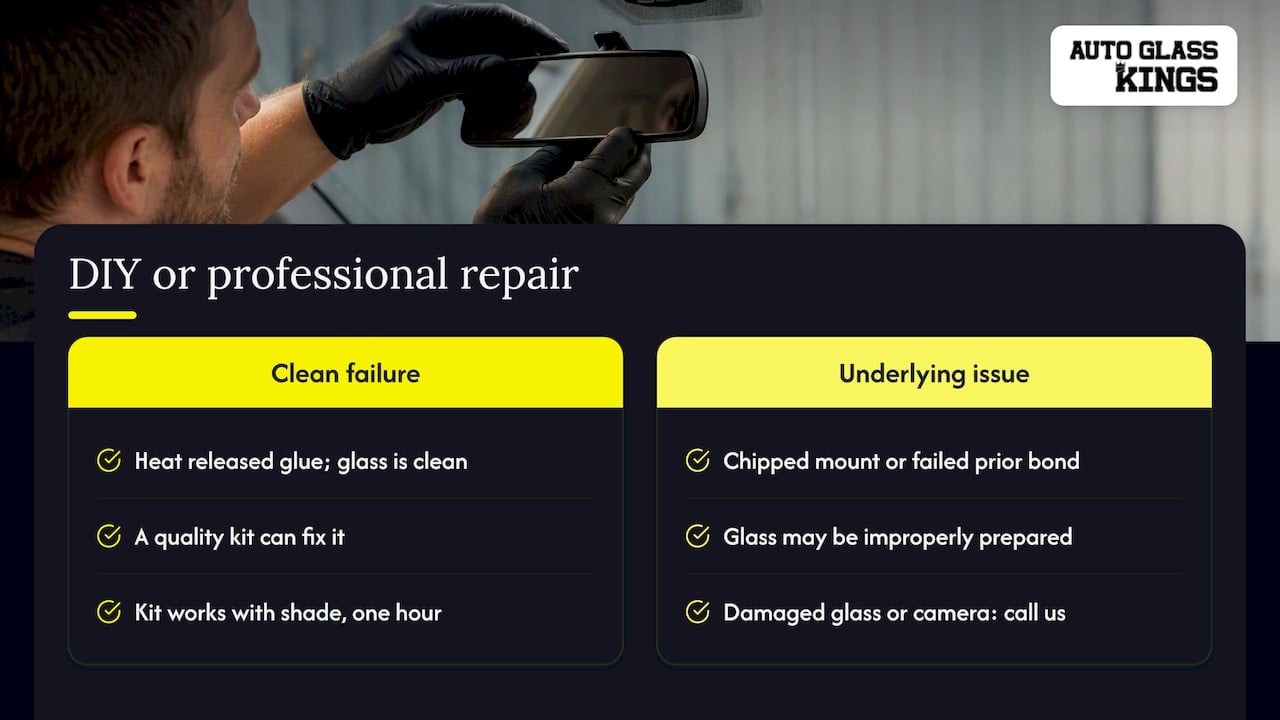
The second group is why we do not treat reattachment as a throwaway job. Before anything gets glued, we look at the glass around the mount, and if the car has ADAS, we think about the camera as well. Our approach is built on doing all necessary glass work and calibration in-house and on-site in a single visit, so you are not sent to a dealership for the second half of the job.
Our advice if you are on the fence: if the break is clean and you have a shady spot and an hour, a quality kit can do the job. If the glass is damaged, or you see a camera housing, call us. We would rather tell you honestly that a kit will do than have you glue a mirror to a damaged windshield for the third time.
— Auto Glass Kings
What a mobile visit looks like in Orange County
The appeal of mobile service is practical. A technician comes to your driveway, office lot or the school pickup line, so you do not lose half a day. We are available from 5 AM daily, which suits anyone who needs the car fixed before work.
What we typically look at on a mirror-related call:
- The mount area for chips, cracks or stress marks.
- Whether the vehicle has a camera or sensor at the mirror.
- Whether the fix is a re-bond or a glass repair or replacement.
- Whether calibration is needed afterward, and whether insurance can cover it.
If the glass needs work, the right page depends on the damage. Small chips and cracks that can be saved are covered under windshield repair, which is listed at $79 to $129. If the windshield has to come out, see windshield replacement and our replacement time breakdown. If your car has driver-assistance features, our ADAS calibration service is listed at $250 to $700, depending on the vehicle. Many customers pay nothing out of pocket because we bill insurance directly, and you can read how that works in what you will pay with insurance.
Aftercare when the glass is bonded
Whether you used a kit or had a pro do it, give the adhesive time. For a windshield replacement the rules are more involved than for a mirror button, and the same principles apply: avoid slamming doors, avoid pressure on the glass and follow the installer’s timing. Our pages on when you can drive after windshield replacement, car wash timing and the 48 to 72 hour aftercare steps cover this in detail.
For a DIY mirror button, a good habit is to leave the car alone for several hours, ideally overnight, before testing the bond with a firm pull. The 15-minute cure on the package gets you to the point of hanging the mirror, but a longer rest costs nothing.
Windshield warranties and the mirror
If the mirror came loose after a recent replacement, check your paperwork first. Installer warranties typically cover defects in materials and workmanship, but terms differ from shop to shop: how long you must report a defect, whether an inspection is required, and whether the coverage passes to a new owner. Some national warranties are explicitly non-transferable, so never assume a warranty follows the car to a buyer.
We provide a lifetime warranty on every install. If you are asking whether coverage carries over when a car is sold, ask us about our written terms for your specific job rather than relying on a general rule. Keep your invoice either way, since it is the record of what was installed and when.
Avoid these mistakes
- Skipping the scrape. Old glue left on the glass or the button is the leading cause of repeat failures.
- Using the wrong adhesive. Mirror-specific structural adhesive only.
- Working in the heat. Shade, mild temperatures and a cool windshield.
- Hanging the mirror too early. Respect the cure time.
- Ignoring damaged glass. A new button on a damaged surface will not hold.
- Forgetting the camera. If your car has ADAS, ask about calibration before anything is reinstalled.
For a wider look at things that go wrong with glass work, our list of common auto glass replacement mistakes is worth a read, and the complete guide to auto glass replacement covers the process end to end.
Need the mirror and glass handled today?
If your mirror is off and you would rather not gamble on a kit, we can come to you anywhere in Orange County, inspect the mount area and handle any glass work or calibration in a single visit. Start at Auto Glass Kings or go straight to windshield replacement if the glass is damaged.
FAQ
Can a rearview mirror be glued back on?
Yes, if the metal button and the glass are undamaged. Use a two-part structural adhesive made for mirror mounts, scrape both surfaces to bare, clean material, hold the button for about 60 seconds and let it cure at least 15 minutes. General-purpose glues usually fail within days.
Why did my rearview mirror fall off the windshield?
The usual cause is the old adhesive weakening after years of heat cycling and vibration, which is why failures cluster in hot weather. Other causes are a poor bond from an earlier replacement or damage to the glass at the mount. If a chip of glass came off with the button, the windshield needs a professional look.
Can I reattach the mirror myself if my car has lane-keeping or emergency braking?
You can only do it safely if the mount is a plain button with no camera or sensor module around it. If a camera sits behind the mirror, have a technician check it, since glass work in that area can call for recalibration. In California, a covered shop must tell you whether your car has ADAS before it starts.
Will my windshield warranty cover a mirror that fell off?
It may, if the mirror fell after a recent replacement and the cause is workmanship. Warranties differ on reporting deadlines, inspections and whether they transfer to a new owner, so read your paperwork. For our own installs, ask us about the written terms for your job.
Is it safe to drive without the mirror?
It is better to fix it first. If you must drive, use your side mirrors, check over your shoulder, avoid busy roads and keep lane changes to a minimum until it is repaired. Never tape or hang the mirror in place.
Sources
- Loctite Product 319 Rear View Mirror Bonder technical data sheet
- NHTSA interpretation 22282, FMVSS No. 111
- California SB 988, Motor Vehicle Glass Act
- Autobody News: California glass bill narrows scope
- Car Talk Community: mirror ripped chunk out of windshield
- Mechanics Stack Exchange: mirror fell off and took the glass
Recommended
- Quarter Glass Replacement
- When to DIY Windshield Molding Replacement
- Fix an Off Track Car Window in an Afternoon, Safety Steps First
- Star Break Repair
🎧 Listen to This Article
Share
Recent Posts

October 26, 2026
Heads-Up Display Windshield: What Changes When You Replace It
A HUD windshield is built differently from standard glass. See how it works, what to check before replacement, and why calibration matters in...
October 25, 2026
Lifetime Windshield Warranty: What It Covers and What It Doesn’t
A lifetime windshield warranty rarely covers everything. Learn what it should include, what it excludes, and how ADAS calibration and insurance fit in....
October 24, 2026
Rearview Mirror Reattachment: DIY Steps and When to Call a Pro
Rearview mirror fell off the windshield? Learn when a DIY glue kit works, when the glass is damaged, and how a mobile pro...