
Automotive
You should not need to polish a brand-new windshield, and in most cases you should not try. New glass comes out of the box without pits, haze or wiper tracks. If something looks wrong right after the install, the cause is almost always residue, a trapped film, or the glass itself, and the fix is a cleaning, an inspection or a re-do by the installer, not an abrasive compound. This guide explains what you are seeing, what is safe to do and when to call the shop.
TL;DR
- New glass is not meant to be polished. Haze, smears and streaks on a fresh install are usually adhesive, primer, sealant or cleaner residue that the installer can remove safely.
- Polishing compounds can reduce light wiper marks and mineral deposits on old glass, but they are the wrong tool for deep scratches, chips and anything in the driver’s direct view.
- Wavy or warped views are a glass-quality or fit question. Report them quickly, because the installer can inspect and, if needed, replace the glass.
- Keep polishes and cleaners away from camera and sensor areas. Modern windshields often carry ADAS cameras that need to stay clean and correctly calibrated.
- Follow the installer’s drive-away time and aftercare instructions before you do anything cosmetic.
Table of Contents
- Why a new windshield shouldn’t need polishing
- Is the windshield safe to touch yet?
- Distortion after replacement: normal or a problem?
- When polishing makes sense, and when it doesn’t
- Cameras, sensors and polish don’t mix
- Our perspective
- When to call the installer
- Book a replacement that comes out clear
- FAQ
- Sources
Why a new windshield shouldn’t need polishing
Polishing exists to remove a thin layer of surface damage: wiper arcs, light scratches, mineral spots, years of weathering. A windshield installed this week has none of that. So when drivers ask about polishing right after a replacement, they are usually reacting to one of four things:
- A film or haze on the glass. Often residue from cleaners, primer or handling.
- Smudges near the edges or the black ceramic band. Typically adhesive or sealant that was wiped but not fully cleaned.
- Wavy or “funhouse” views. Optical distortion, which polishing cannot fix.
- Marks that were already on the old glass and are now visible on the new one, such as wiper chatter on a worn blade.
Each has a different answer, and none of them starts with a power buffer.
Residue is the most common culprit
Installation involves urethane adhesive, primers, cleaners and sometimes tape. Technicians are supposed to follow the adhesive maker’s written instructions, and those instructions tell them to handle the product in specific ways. If a haze shows up after the job, ask the installer to clean it. Don’t scrub cured urethane yourself: it is bonded to the vehicle and the glass, and aggressive scraping near the edge can disturb the bond or the molding.
If you did not get a clean result, tell the shop the same day. A good installer wants to see it, not have you work on it.
Is the windshield safe to touch yet?
Before you wipe, clean or polish anything, remember that the new windshield is a structural part of the car. It supports the passenger-side airbag’s deployment and the roof in a rollover. The adhesive needs time to cure, and that time is not the same on every job.
Sika’s 2026 installation guideline says cure time depends on the adhesive product, temperature and humidity, and that some advanced adhesives reach a safe drive-away time in as little as 30 minutes. The 2022 AGRSS standard goes further: installers must obtain current application instructions that include minimum drive-away time charts, and must tell the vehicle owner the drive-away time before and after installation.
An older, slower product behaves very differently. 3M’s data sheet for one fast urethane says that at 70°F and 50% relative humidity it takes approximately 3 hours to reach 50 psi overlap-shear strength. Cold, damp mornings in the hills can stretch that out.
The practical rule: do not leave the shop until you have been told your drive-away time in plain words, and do not treat that time as the end of your aftercare. Our guides on how long until you can drive after windshield replacement and the first 48 to 72 hours of aftercare go through the steps.
What not to do in the first days
These are the habits that cause most callbacks:
- Don’t slam the doors. With windows closed, a hard slam builds pressure that can push on fresh adhesive. Crack a window slightly for the first day or as your installer advises.
- Don’t pick at or pull tape and moldings. Retention tape, if used, comes off when the installer says so.
- Don’t scrub, buff or use glass polish. This is the answer to the question in this article’s title: wait, and ask first.
- Don’t run an automatic wash with brushes or high-pressure jets until your installer clears it. See what to expect with a car wash after windshield replacement.
- Don’t drive away early to beat traffic. The SRP installation manual reminds technicians that lawsuits have found installers liable even when the owner was warned and signed a release, and says that when in doubt the vehicle should not go back into service. A good shop will hold you to the time for your own safety.
Distortion after replacement: normal or a problem?
People searching for polishing after a replacement often really mean they see something odd through the new glass. Here is how to sort what you see.
Normal: slight bending at the edges
Windshields are curved. Curved glass bends light a little, especially near the edges and corners, and the black band and dotted “frit” area can look slightly different from the center. If the center of your view is clear and the edges only shimmer when you look hard, that is usually not a defect.
Not normal: distortion in your direct line of sight
Take it seriously if you see any of these when looking straight ahead, in daylight, from the driver’s seat:
- Straight lines (a power pole, a lane marker, the horizon) that wave or bend as you move your head
- A magnifying or “lens” effect in one patch
- Eye strain, headaches or fatigue that you did not have with the old glass
- Double images of headlights at night
An industry education piece from an ADAS equipment maker says glass distortion can contribute to driver fatigue, eye strain and headaches. That matches what drivers report to us.
A simple check: park facing a building with straight vertical edges or a tiled wall, sit in the driver’s seat, and move your head slowly left and right. Then do the same through the side window or, if you can, compare with another car. If the lines in the windshield bend noticeably in the driver’s zone, take photos or a short video and contact the installer.
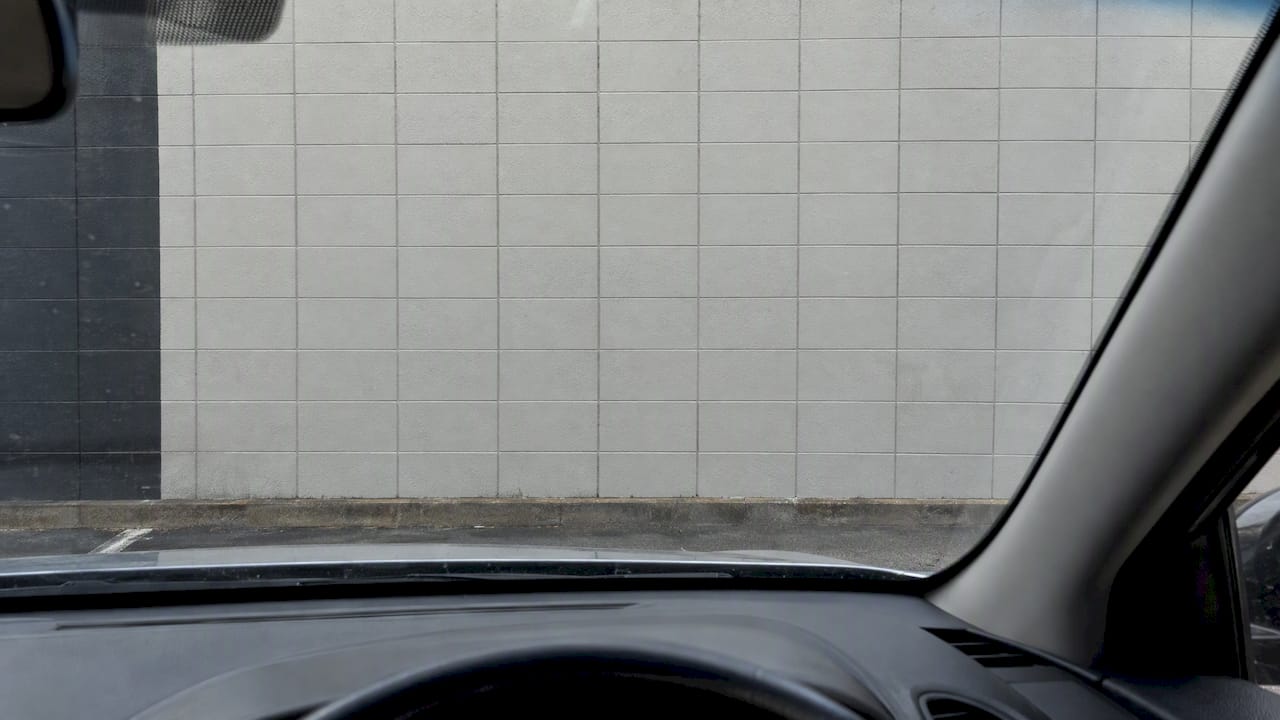
Why it happens and who fixes it
Distortion can come from the glass itself, from the wrong part for your trim, or from how it was seated. None of these can be polished away. Polishing removes material from the surface; it doesn’t change how the glass was formed. In fact, trying to polish out a lens effect can leave you with a new, worse one.
If the glass is at fault, the answer is replacement. That means removal of the old urethane and a fresh install, and the 2022 AGRSS standards require technicians to fully remove faulty materials that compromise the retention system to restore the vehicle to a safe condition. Don’t accept a patch.
When polishing makes sense, and when it doesn’t
Polishing is a legitimate tool on glass that has been in service. It has limits, though.
| Problem | Polishing helps? | What to do instead or additionally |
|---|---|---|
| Hard-water or mineral spots | Often | Gentle cleaning first, then polish if needed |
| Light wiper haze | Sometimes | Replace worn wiper blades after |
| Fine surface marks | Sometimes | Have a glass specialist judge it |
| Deep scratches you can feel with a fingernail | No | Specialist assessment, possibly replacement |
| Stone chips and cracks | No | Repair or replace |
| Pitting across the driver’s view | Rarely worth it | Replacement, see our pitting guide |
| Wavy view from new glass | No | Inspection and re-install |
One glass-care supplier notes that polishing can reduce limescale, stubborn deposits, light weathering and fine wiper marks, while deep scratches, stone chips, cracks and damage in the driver’s direct field of view should go to a specialist. We agree with that line. Heat from a buffer can also build up fast on glass, which is one reason we do not recommend DIY polishing on a windshield you rely on to see through. If you are weighing scratch work, our piece on windshield scratch repair by professional technicians covers what is realistic.
Wiper marks on a new windshield
If you see arcs on the new glass within weeks, the problem is usually the old wiper blade, not the glass. Grit trapped in worn rubber scratches as it sweeps. A fresh set takes minutes, and a mobile mechanic can swap them with wiper blade replacement done at your location. Do it at the same time as your windshield, not after the damage starts.
Protecting new glass from pitting
California freeway driving sandblasts a windshield slowly. If you want to keep new glass clear for longer, a clear film applied to the exterior is an option some drivers choose, for example windshield protection film that takes the pitting instead of the glass. Ask your installer to wait until the adhesive is fully cured before anyone applies anything to the glass.
Cameras, sensors and polish don’t mix
Most late-model windshields carry a forward camera behind the glass, often near the mirror. Some have a rain sensor, a heated wiper park area or a heads-up-display zone. Polish and glass cleaner on those areas are a real risk.
A Subaru EyeSight service bulletin hosted by NHTSA says glass cleaners or polishes must be kept away from the stereo-camera openings, residue that reaches the lenses can damage them, and owners should not clean the lenses themselves. It also says damage in the EyeSight prohibited areas may interfere with the stereo camera, and no repairs may be made in those areas. Even a manufacturer’s own service process for cleaning exterior residue is specific: Audi’s 2023 technical bulletin names a particular polishing compound and a clean, dry microfiber cloth for the job. That is a technician’s procedure for a defined problem, not a license to polish at home.
If your car has driver-assistance features, the replacement also usually calls for calibration. Without it, lane-keeping and automatic braking may not see the road where they think they do. Read about OEM-verified windshield ADAS calibration, and if you drive a Subaru, EyeSight calibration to OEM target tolerances. A distorted windshield can also affect camera performance, which is one more reason to report a bad view quickly.
Our perspective
We install glass every day across Orange County, and the polishing question usually arrives two ways: a driver with an old, pitted windshield asking if it can be saved, and a driver with a new windshield asking why it looks off.
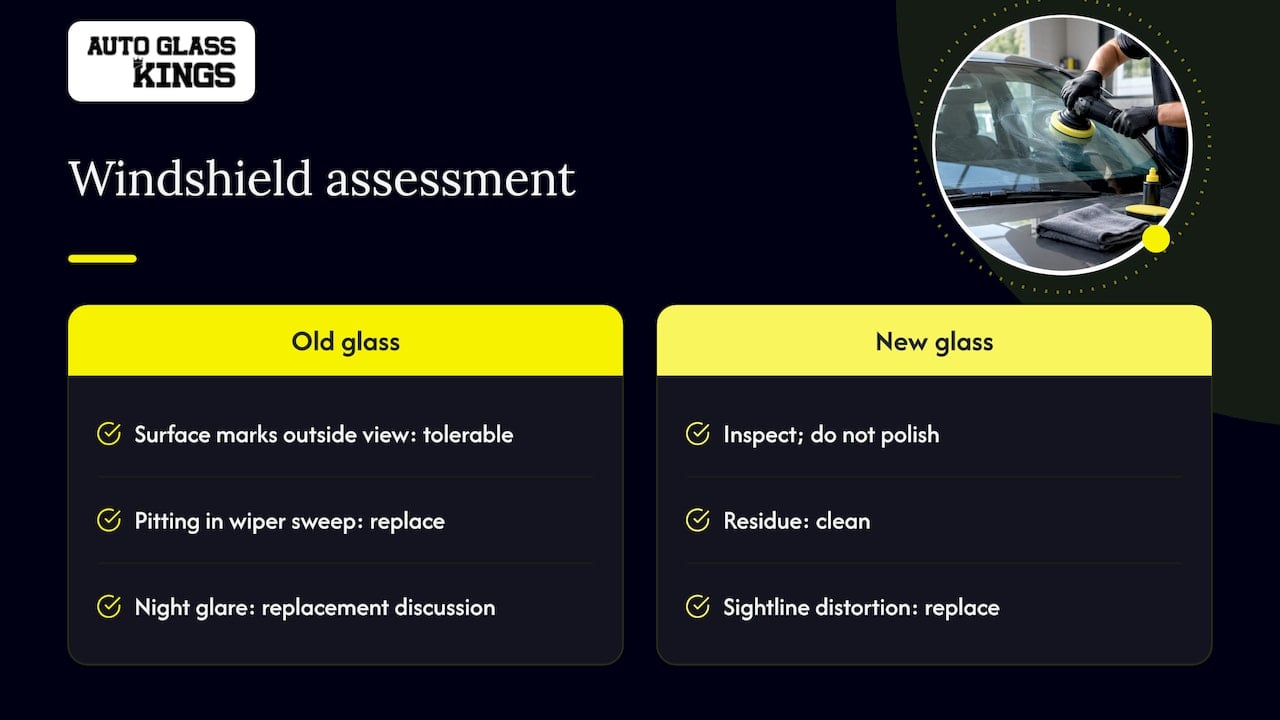
For the first, we look at where the damage sits. Light surface marks outside the driver’s view may be tolerable; pitting and scratches across the sweep of the wipers, especially with glare at night, are a replacement conversation. For the second, we do not polish new glass. We inspect it. If there is residue, we clean it. If there is distortion in the line of sight, we replace the glass, and our lifetime warranty on every install means that is our problem, not yours.
We do everything in one visit: the glass, the calibration and the cleanup, at your home or office, starting from 5 AM. If your car needs a calibration, it happens on-site, so you are not sent to a dealership for a second appointment. Most of our insured customers pay nothing out of pocket because we bill the insurer directly.
— Auto Glass Kings
When to call the installer
Contact the shop that did the work if:
- You see a haze, film or smears that do not wipe off with a clean microfiber cloth and plain glass cleaner after the drive-away time has passed
- Lines wave or bend in the driver’s direct view
- You notice wind noise, water leaks or a whistle at highway speed
- A driver-assist warning light stays on after the job
- Moldings are loose or the glass looks misaligned
Give them photos, the date of the install and what you see. If the issue is residue, expect a quick cleanup. If it is the glass, expect an inspection and, where warranted, a re-do.
Book a replacement that comes out clear
If your current windshield is pitted, hazy or just not clear enough to drive comfortably at night, replacement is cleaner than another round of polishing. We come to your driveway or workplace, install the glass, calibrate ADAS in the same visit, and stand behind it with a lifetime warranty. Start with windshield replacement. If a small chip is all you have, windshield repair is listed at $79 to $129, and ADAS calibration runs $250 to $700 depending on the vehicle. See how replacement costs work with insurance before you call.

FAQ
Can you polish a windshield after it’s been replaced?
Technically glass can be polished, but a new windshield has nothing to polish out. Haze or streaks right after an install are usually residue, which the installer can clean safely. Hold off on any compound until the adhesive has cured and your installer has approved it.
How long does a windshield take to cure after replacement?
It depends on the adhesive, temperature and humidity. Some modern urethanes reach a safe drive-away time in about 30 minutes, while other products take hours. Your installer should tell you the minimum drive-away time for your specific job, and the 2022 AGRSS standard expects them to do so.
What should I avoid after a windshield replacement?
Avoid slamming doors, pulling at tape or moldings, brush or high-pressure car washes, and scrubbing or polishing the glass until your installer says it is fine. Also follow the stated drive-away time exactly. Our aftercare guide lists the full first 48 to 72 hours.
Why does my new windshield look distorted?
A slight bend near the edges is normal on curved glass. Waviness or a magnifying effect in your direct view is not, and polishing will not fix it. Take photos, check it against a straight-edged background and contact the installer, since the glass may need replacing.
Can a pitted windshield be polished?
Light pitting sometimes looks better after professional polishing, but heavy pitting across the wiper sweep usually returns as glare at night, and aggressive polishing can distort the view. If the pits are in your line of sight, replacement is the safer choice.
Sources
- Sika, General Guideline for Vehicle Glass Replacement (2026)
- AGSC, AGRSS standard (2022)
- SRP Installation Manual (2025)
- 3M Super Fast Urethane data sheet
- Subaru EyeSight service bulletin (NHTSA)
- Audi technical service bulletin (NHTSA, 2023)
- Opti-Aim, ADAS Education Series: glass quality
- Safe Shield, windscreen polishing limits
Recommended
- Windshield Replacement Aftercare: 48–72 Hour Steps for US Drivers
- How Long Until You Can Drive After Windshield Replacement
- Auto glass replacement: 7 common mistakes to avoid
- Windshield Leak After Replacement? 6 Checks to Protect Your Warranty
🎧 Listen to This Article
Share
Recent Posts
November 18, 2026
Sticker Transfer on a Windshield: What Moves, What Doesn’t
Moving a windshield sticker to a new windshield or another car: which stickers can be reused, how to peel and reapply them, and...
November 17, 2026
Optical Distortion in a Windshield: What’s Normal, What Isn’t
Wavy or warped view through your windshield? Learn what optical distortion is, what causes it, what’s normal on new glass, and how to...
November 16, 2026
Calibration After Chip Repair: When You Need It
Does a windshield chip repair mean ADAS calibration? Learn when a chip near the camera calls for replacement, what that triggers, and how...