
Automotive
A windshield claim is one of the fastest an insurer handles: approval can come the same day you file, and the glass can go in within a day or two. The slow parts are rarely the insurer. They are an incomplete claim, a shop that cannot come to you, and ADAS camera calibration that has to happen somewhere else. In Orange County, we remove the last two delays: we come to your driveway or office, install the glass, do the calibration in-house in the same visit, and bill your insurer directly.
TL;DR
- Glass claims are typically approved quickly, often the day you file, and one major insurer says repairs may typically be completed within 48 hours of filing.
- Once a claim is approved, payment is typically issued within 5 to 10 business days, but if the shop bills your insurer directly, you never wait on that step.
- Complete information at the first call is the best way to avoid delays: policy number, VIN, date and cause of damage, and where the car is.
- If your car has driver-assistance cameras, calibration after the glass goes in is part of the job. Doing it in the same visit keeps a 1-day job from becoming a week.
- Report damage fast. A small crack can grow, and a replacement costs far more than a repair.
Table of Contents
- The realistic timeline, step by step
- Stage 1: Filing the claim
- Stage 2: Approval, coverage and your deductible
- Stage 3: Scheduling and getting the right glass
- Stage 4: Replacement day
- Stage 5: ADAS calibration, the step that stretches timelines
- Stage 6: Billing and payment
- What slows a claim down
- California specifics for Orange County drivers
- How urgent is a cracked windshield?
- Book the whole job in one visit
- Our perspective
- FAQ
- Sources
The realistic timeline, step by step
Here is how a typical windshield claim runs when nothing goes wrong. Times are ranges, because each insurer and each vehicle differs.
| Stage | What happens | Typical time |
|---|---|---|
| 1. Report the damage | You or your shop opens the claim with your insurer’s glass line or app | 5 to 15 minutes |
| 2. Coverage check and approval | Insurer confirms glass coverage and deductible | Minutes to 1 day for most glass claims |
| 3. Scheduling | Shop books the install and orders the right glass for your VIN | Same day to 2 days |
| 4. Replacement | Old glass out, frame prepped, new glass bonded | Roughly 1 to 2 hours of work, plus adhesive cure time |
| 5. ADAS calibration | Camera and sensors re-aimed to factory spec, if your car has them | Often done in the same visit when the shop calibrates on-site |
| 6. Billing and payment | Shop bills the insurer; you pay any deductible | Handled between shop and insurer |
Two independent professional sources describe glass claims as among the quickest. Insure.com reports that windshield or glass claims are often the fastest to resolve, sometimes the same day you file. Compare that with the general figure for all auto claims: Insurance.com reports that claims are usually settled in about 30 days, and that many states require a claim to be accepted or denied within five to 15 days, with settlement following within 30 to 45 days. Glass is the exception because there is usually no injury, no fault dispute and no total-loss question to resolve.
Stage 1: Filing the claim
The clock starts when you report the damage, so do not sit on it. Nationwide advises reporting glass damage as soon as possible because even a small crack can grow over time. GEICO tells policyholders the same and lets you report the claim online and schedule an appointment for the repair or replacement.
Have these ready before you call, and you can usually finish in one conversation:
- Policy number. It is on your insurance card or in your insurer’s app.
- VIN. The 17-character number visible at the base of the windshield on the driver’s side, or on the door-jamb sticker. It tells the glass supplier which exact windshield your car takes: rain sensor, heated wiper area, camera bracket and so on.
- Date and cause of damage. One line is enough, for example a rock kicked up on the 405.
- Where the car is. A home or office address if you want mobile service.
- Whether the car has driver-assistance features. Lane-keeping, adaptive cruise or automatic emergency braking all mean a forward camera that needs calibration after the glass is replaced.
Insure.com’s Zack Sigel says that submitting documentation completely the first time is the single best way to avoid delays, and that staying in contact with your insurer keeps a claim moving. For glass, that means the five items above. Missing the VIN or guessing at features is how an order for the wrong windshield gets placed, which adds days.
If you would rather not make the call, we can start it with you. Our step-by-step guide to filing a windshield insurance claim walks through the same process, and our Orange County insurance claim page explains how we handle the paperwork.
Stage 2: Approval, coverage and your deductible
Approval for a straightforward glass claim often takes minutes. AutoInsurance.com notes that simple glass claims often need no inspection, and many insurers approve them automatically.
What takes thought is the deductible, not the timeline. Two points matter:
- You choose the shop. Travelers states that you can select the shop of your choice for glass repair or replacement. When the shop bills the insurer directly, you pay only the applicable deductible.
- Repair and replacement are treated differently by many policies. Whether your deductible applies depends on your policy, and some policies include optional full glass coverage that reduces or removes it. Check your declarations page, or ask the person who opens the claim.
For a chip, repair is faster and cheaper than replacement. Our windshield repair runs $79 to $129, and repair is often the better first move if the damage is caught early. Once a crack runs across your line of sight or reaches the edge of the glass, replacement is the answer.
If your policy’s deductible is higher than the cost of a repair, you may not need a claim at all for a small chip. That is a decision between you and your policy. If you are unsure, tell us what you see and we will tell you whether it is a repair or a replacement and what your insurer is likely to be billed.
Stage 3: Scheduling and getting the right glass
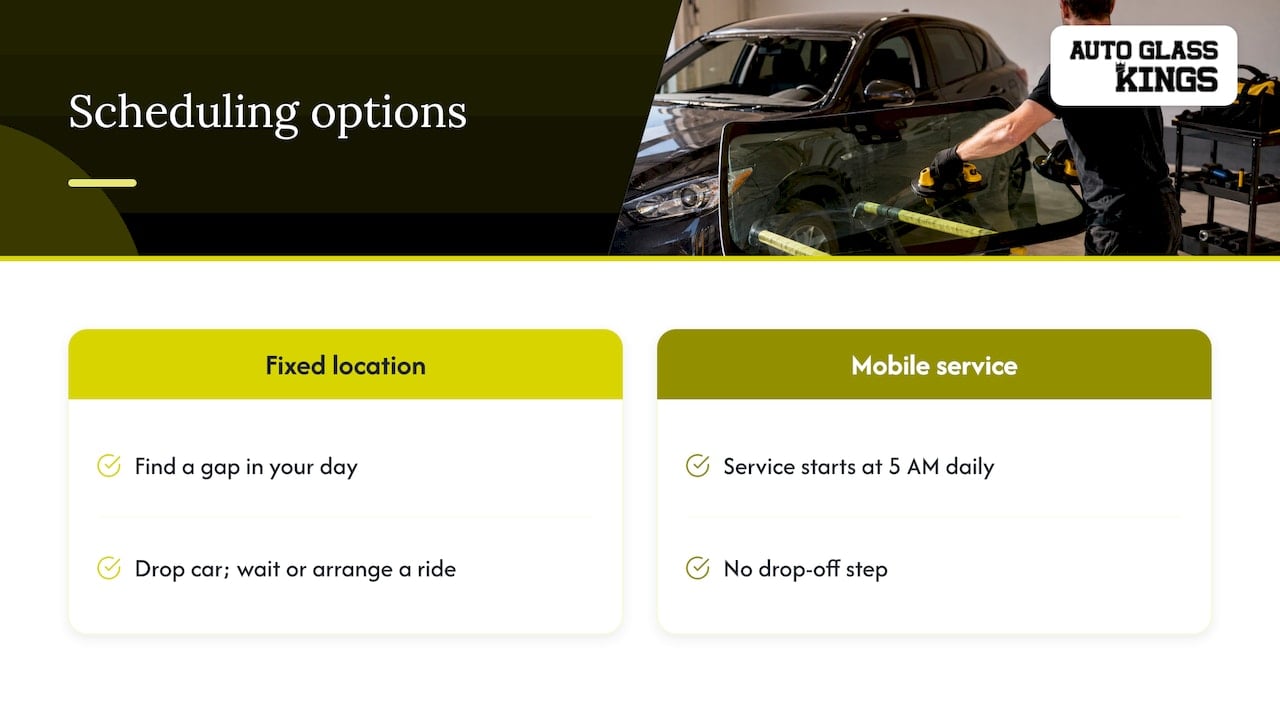
The biggest variable in the whole timeline is scheduling. A shop that works only from a fixed location needs you to find a gap in your day, drop the car, and either wait or arrange a ride. A mobile service removes that step. We start at 5 AM daily, which suits a commuter who wants the glass done before work, and a parent who needs the car back for the school run.
The other variable is glass availability. Windshields for common models are usually easy to source. Windshields for classics, imports and high-end vehicles can take longer. We service everything from classics to Tesla and Bentley, and for those vehicles we confirm the part right after the claim is approved, so you know the install date before you take time off.
Stage 4: Replacement day
The physical swap is short. The technician removes the old glass, cleans and preps the frame, sets the new windshield with adhesive, and checks the fit. Adhesive needs time to cure before the car is safe to drive hard, and the safe drive-away time depends on the adhesive and weather. Our aftercare guide covers the first 48 to 72 hours: leaving the retention tape on, keeping windows slightly open, and avoiding car washes.
We use OEM-quality materials and back every install with a lifetime warranty.
Stage 5: ADAS calibration, the step that stretches timelines
This is where claim timelines go wrong for newer cars. Many vehicles have a forward camera mounted on the windshield that feeds lane-keeping, emergency braking and adaptive cruise. When the glass changes, the camera’s view changes, and the system has to be recalibrated to the manufacturer’s specification.
Calibration is also becoming a notification requirement in California. The text of SB 988, the California Motor Vehicle Glass Act, requires a covered glass shop to tell you before service whether your vehicle has ADAS and whether calibration is needed after replacement, as the vehicle manufacturer recommends. It also calls for estimates, calibration-status notices, an itemized invoice and a receipt. In practice, you should hear about calibration before the work starts, not discover it afterward.
Where you get calibration done changes your timeline more than anything else:
- Shop calibrates on-site in the same visit: one appointment, one day.
- Shop sends you to another location for calibration: a second appointment, a second drive, and the wait that comes with someone else’s schedule.
We do the glass and the calibration ourselves, in the same visit, so there is no second booking. Our ADAS calibration is priced at $250 to $700 depending on the vehicle, and the ADAS calibration page explains what it involves. If you want to know how long it takes after the glass is in, see ADAS calibration time, and for the method differences, static vs dynamic calibration.
Do not skip calibration to save a day. An uncalibrated camera can place lane lines or obstacles in the wrong spot, and the safety features you rely on may not work the way they should.
Stage 6: Billing and payment
This is the stage that stalls reimbursement-style claims. If you pay the shop yourself and submit the receipt, you wait on the insurer. Insure.com reports that once a claim is approved, payment typically goes out within 5 to 10 business days. When the shop bills your insurer directly, that wait is between the shop and the insurer, not you.
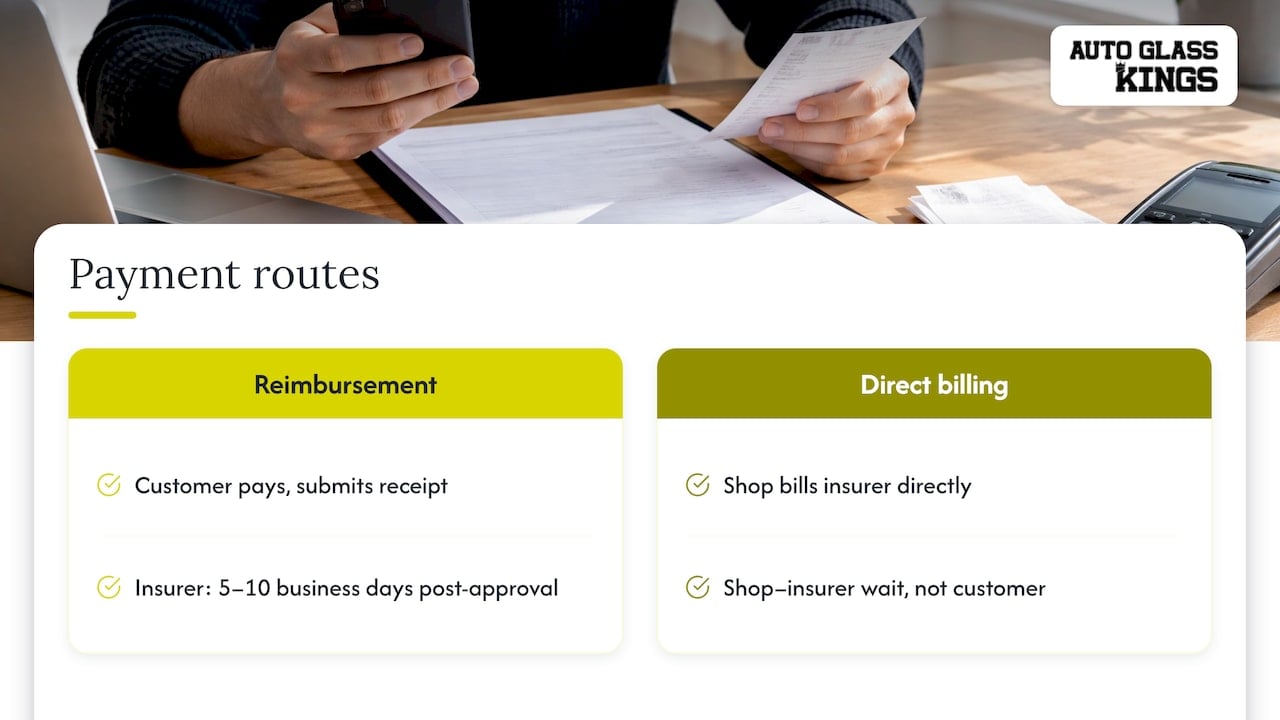
We bill insurance directly, and most of our customers pay nothing out of pocket. Your own cost depends on your policy and any deductible, which we confirm up front. For a fuller look at costs, see what you’ll pay for a windshield replacement with insurance.
What slows a claim down
Most delays trace back to a short list of causes:
- Incomplete information at filing. No VIN, no address, or a vague description sends the claim back for follow-up.
- Waiting to report. A chip that spreads into a crack turns a quick repair into a replacement, and a replacement into a calibration job.
- Wrong glass ordered. Rain sensors, acoustic layers and camera brackets differ by trim. The VIN settles it.
- Calibration booked separately. The most common reason a one-day job becomes a week.
- Unreturned calls. Insurers and shops cannot proceed while waiting on you.
- A second glass claim soon after the first. Your insurer’s rules and your policy govern this, so read your policy or ask the person who opens the claim.
California specifics for Orange County drivers
California has formal claim-handling standards for insurers, and most glass claims finish long before any of those deadlines come into play. The general pattern across states, per Insurance.com, is a short window to accept or deny and a longer one to settle. If your insurer is slow or unclear, ask for the claim number and a written status, and if it still stalls, you can contact the California Department of Insurance.
What has actually changed lately is the glass industry itself. The SB 988 bill text sets disclosure and paperwork duties for glass shops, including ADAS notice before work. That works in your favor: you get clearer estimates and an itemized invoice.
How urgent is a cracked windshield?
Urgent enough to schedule within a day or two, and immediately if the damage blocks your view. Nationwide advises that if damage obscures your vision while driving, you should pull to a safe location and turn on your emergency lights. A damaged windshield also contributes to the structural strength of the cabin and the proper deployment of airbags on many vehicles, so do not treat a crack as cosmetic. Our guide on whether to stop or drive with a cracked windshield lays out the decision, and how to stop a crack from spreading helps in the meantime.
Book the whole job in one visit
If you are in Orange County and your windshield is damaged, start with a single call. We come to your home or workplace, confirm your coverage, replace the glass, calibrate the cameras and bill your insurer directly.
See our windshield replacement service to get started, or visit Auto Glass Kings to request an appointment. Side, rear, quarter and vent glass are covered too, so if the damage is not on the windshield, we handle that in the same way.
Our perspective
Drivers tend to ask how long the insurer will take. In our experience of how this job is built, the better question is how many separate visits and handoffs the job needs.
A glass claim that needs one call, one appointment and one visit is a one-day job. A claim that needs a drop-off, a wait, a second appointment for calibration and a reimbursement is a week-long one, even if the insurer approved it in minutes.
That is why we built our service around doing everything in one place: glass, calibration and insurance billing, at your car, starting as early as 5 AM. Our lifetime warranty and OEM-quality materials mean the job is done once.
If you have a cracked windshield, get it reported and booked today. Every week you wait, you risk a bigger repair and a bigger bill.
Auto Glass Kings
FAQ
How long does a windshield replacement claim take?
Many glass claims are approved the same day, and State Farm says repairs may typically be completed within 48 hours of filing. The installation itself takes a few hours. Adding ADAS calibration in a separate appointment is what usually stretches it.
How soon should I file a windshield claim?
As soon as you notice the damage. Nationwide warns that a small crack can grow over time. California Casualty also notes that waiting too long can affect coverage under your policy, so check your policy terms.
Do I choose the glass shop?
Yes. Travelers states that you can select the shop of your choice. Your insurer may suggest one, but you can tell it which provider you prefer, including a mobile service that comes to you.
Will I pay anything out of pocket?
That depends on your policy and deductible. We bill insurers directly, and most of our customers pay nothing out of pocket. Standard comprehensive coverage may apply a deductible to a replacement, while optional full glass coverage can reduce or remove it.
Does my car need ADAS calibration after the windshield is replaced?
If it has a windshield-mounted camera for lane-keeping, emergency braking or adaptive cruise, the manufacturer typically calls for calibration after replacement. We tell you up front whether your car needs it and do it in the same visit.
Sources
- State Farm: Windshield and Glass Claims
- Insure.com: How Long Does an Insurance Claim Take to Process?
- Insurance.com: Car insurance claims, a complete guide
- AutoInsurance.com: How Long Does a Car Insurance Claim Take?
- Nationwide: Windshield Replacement Insurance Claims
- GEICO: Glass Claims Guide
- California Casualty: Claims FAQs
- Travelers: Auto Glass and Windshield Repairs
- California Legislature: SB-988 California Motor Vehicle Glass Act
Recommended
- How to File a Windshield Insurance Claim, Step by Step
- Insurance Denied Your Windshield Replacement? What to Do Next
- Windshield Replacement Aftercare: 48–72 Hour Steps for US Drivers
- Auto Glass Replacement: A Complete Guide for US Drivers
🎧 Listen to This Article
Share
Recent Posts
November 22, 2026
Auto Glass Coverage in California: What Your Policy Pays
How California auto insurance covers windshields, side glass and ADAS calibration, what deductibles mean, and what the 2026 glass law changes for you....
November 21, 2026
Bentley Windshield Sensors: What Sits Behind the Glass
Bentley windshield sensors explained: the camera, rain and light sensors behind the glass, what a replacement does to them, and how to get...
November 20, 2026
Urethane Smell in Your Car: What It Is and What to Do
A sweet, chemical smell after a windshield replacement is usually fresh urethane adhesive. Learn what causes it, how to ventilate safely and when...